
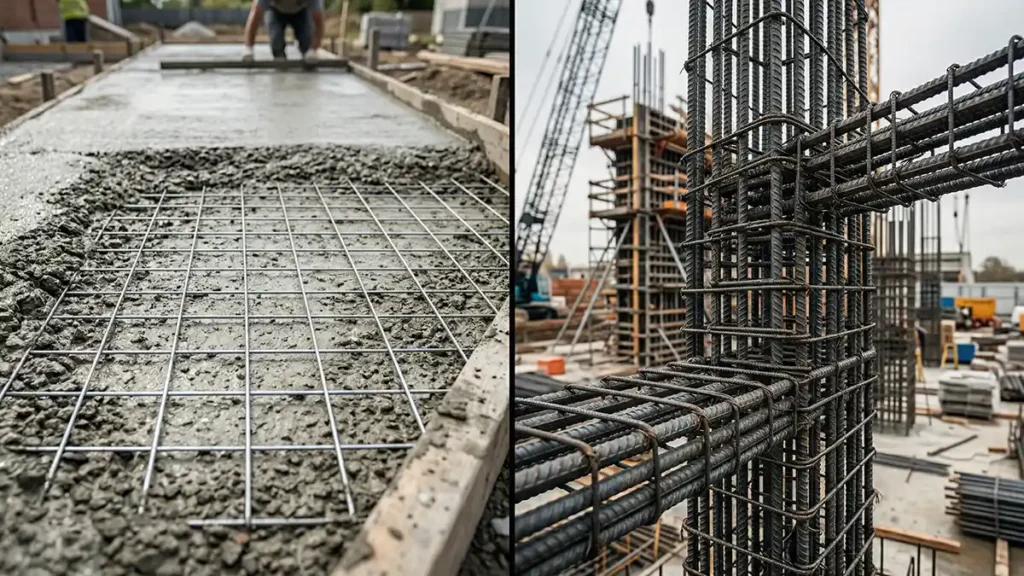
When planning a construction project, choosing the right reinforcement material is crucial to ensure structural integrity and longevity. The two most common reinforcement options are wire mesh and rebar (reinforcing bars). But which one should you choose?
In this blog, we’ll dive into the differences between wire mesh and rebar, explore their uses, and help you make the best decision for your construction needs.
Understanding Wire Mesh and Rebar
Both wire mesh and rebar are used in reinforced concrete structures to add strength and prevent cracking. However, they differ in their structure, application, and performance under various conditions.
What is Wire Mesh?
Wire mesh is made of woven steel wires that are formed into a grid pattern. It is commonly used for smaller concrete applications, such as:
- Flooring
- Slabs
- Driveways
- Sidewalks
It is generally used where flexibility and light reinforcement are needed.
What is Rebar?
Rebar (reinforcing bar), on the other hand, is a steel bar or mesh of steel wires used in reinforced concrete. Rebar has a ridged surface, which allows it to better bond with concrete. It is used in larger, load-bearing structures such as:
- High-rise buildings
- Bridges
- Dams
- Foundations
Wire Mesh vs Rebar: Key Differences
1. Strength and Durability
Rebar:
- Rebar is stronger than wire mesh.
- It offers superior tensile strength and flexibility, making it ideal for heavy-duty applications where high strength is needed to withstand bending and shear forces.
Wire Mesh:
- Wire mesh is suitable for light to medium reinforcement, but it does not have the same strength as rebar.
- It is more commonly used in floor slabs or in pavement work where load-bearing capacity is not as critical.
2. Flexibility and Application
Rebar:
- Rebar can bend and form shapes to accommodate a variety of structural needs.
- It’s used in applications where flexibility and adaptability to complex designs are required, such as columns, beams, and high-rise foundations.
Wire Mesh:
- Wire mesh is rigid and less flexible compared to rebar.
- It’s more appropriate for shallow applications or areas where minimal movement is expected, such as pavement or floor slabs.
3. Ease of Installation
Rebar:
- Rebar requires more time and expertise for installation because it needs to be cut, bent, and tied into the correct configuration.
- However, it provides better overall performance when correctly installed.
Wire Mesh:
- Wire mesh is easier and faster to install. It is often rolled out and laid flat, which saves time on the job site.
- While it’s less labor-intensive, it may not offer the same long-term strength as rebar.
4. Cost
Rebar:
- Generally, rebar is more expensive than wire mesh because of its superior material properties, high strength, and durability.
Wire Mesh:
- Wire mesh tends to be less expensive than rebar. However, this may come at the cost of performance in high-load-bearing situations.
Choosing Between Wire Mesh and Rebar for Your Construction Needs
When to Use Wire Mesh:
- Floor Slabs: In residential or commercial buildings, wire mesh is commonly used in floor slabs for lighter reinforcement.
- Driveways and Sidewalks: For non-load-bearing surfaces, wire mesh provides enough strength without the need for heavier reinforcement.
- Pavement Work: In road construction or pavement projects, wire mesh is typically sufficient to withstand light traffic loads.
When to Use Rebar:
- High-Rise Buildings: For multi-story structures, rebar provides the strength needed to support the weight of the building.
- Bridges and Dams: These structures require high-strength reinforcement to handle massive loads and varying environmental conditions.
- Foundations: Foundation work needs high-strength rebar to prevent cracks and ensure long-term stability under pressure.
TMT Bars for Reinforcement:
For the best strength and flexibility, ET TMT bars (Thermo-Mechanically Treated bars) are recommended for high-strength applications. These bars undergo a special treatment process that ensures:
- Corrosion resistance
- Higher strength
- Better bonding with concrete
This makes ET TMT an ideal choice for heavy construction where durability and safety are paramount.
Wire Mesh vs Rebar: The Final Verdict
Wire Mesh is best suited for light-duty applications, such as floor slabs, sidewalks, and pavement. It is fast and cost-effective but doesn’t offer the high-strength performance needed for more complex structures.
Rebar, especially ET TMT rebars, is the best choice for high-load bearing applications like high-rise buildings, bridges, and foundations. Its superior strength, flexibility, and corrosion resistance make it indispensable for modern construction.
Conclusion: Building for the Future with ET TMT
Choosing the right reinforcement for your construction project is key to ensuring the long-term strength, durability, and safety of your structure. ET TMT bars provide the best of both worlds: superior strength and flexibility, ensuring that your building is not only safe but also resilient for the future.