
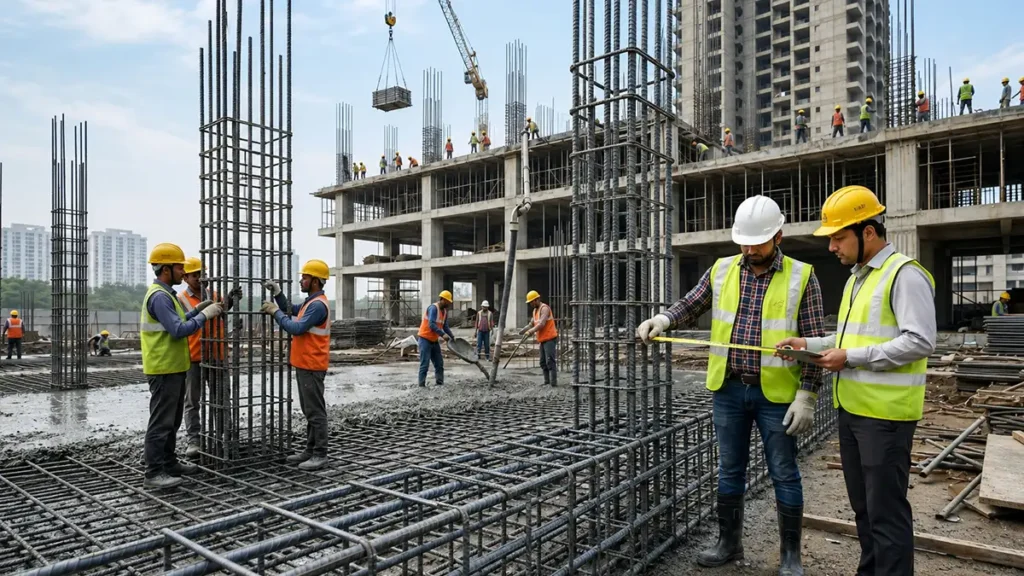
Every strong structure begins with the right material choices. From homes and high-rise buildings to bridges, factories, roads, and public infrastructure, steel plays a major role in modern construction. It gives structures the strength to carry loads, the flexibility to handle movement, and the durability needed for long service life.
In India, steel is especially important in RCC construction, where TMT bars are used inside concrete to create stronger and safer structural members. Concrete handles compression well. Steel reinforcement helps the structure handle tension, bending, shear, and movement. This combination is one of the main reasons steel continues to be trusted in construction projects of all sizes.
1. Steel Gives Structures High Strength
One of the main reasons steel is used in construction is its strength. Buildings and infrastructure carry different types of loads every day. These include the weight of the structure, people, furniture, machines, vehicles, wind pressure, vibrations, and other external forces.
Steel has high tensile strength, which means it can resist pulling forces. This makes it useful in beams, columns, slabs, foundations, bridges, industrial buildings, and other load-bearing structures.
In RCC construction, steel bars help concrete carry forces that plain concrete cannot handle effectively on its own. This is why TMT bars are used inside concrete to create a stronger structural system.
2. Steel Works Well with Concrete
Concrete is widely used in construction because it performs well under compression. The challenge is that concrete is weaker under tension and shear. Steel helps solve this by taking up the tensile stresses inside reinforced concrete.
When steel bars are placed correctly inside concrete, both materials work together. Concrete provides compressive strength and shape. Steel provides tensile strength, ductility, and crack-control support. This is why RCC construction is used in homes, commercial buildings, bridges, flyovers, water tanks, foundations, and other structural applications.
This partnership between concrete and steel is one of the biggest reasons behind the popularity of steel in construction.
3. Steel Adds Ductility to Structures
A good structure should be strong. It should also have the ability to handle movement and stress without sudden failure. This property is called ductility.
Ductile steel can bend, stretch, and absorb stress before breaking. In construction, this matters because structures face changing loads, vibrations, wind effects, and seismic forces. Ductility gives the structure a better ability to respond to stress in a controlled way.
For areas where seismic safety is a concern, the quality and ductility of reinforcement steel become very important. The final performance depends on structural design, steel quality, concrete quality, workmanship, and correct placement of reinforcement.
4. Steel Helps Improve Durability
Durability is a key factor in any construction project. A building is expected to stand strong for decades. Infrastructure projects are expected to perform under heavy use and changing weather conditions.
Good quality construction steel helps improve the long-term performance of RCC structures. TMT bars with controlled chemical composition, proper manufacturing, and tested mechanical properties support strength and durability in load-bearing members.
In areas exposed to moisture, coastal air, chemicals, or aggressive environments, corrosion resistance becomes even more important. That is why choosing the right type of TMT bar matters for long-term structural life.
5. Steel Offers Design Flexibility
Steel is useful because it can be shaped, cut, bent, and placed according to structural design requirements. This makes it suitable for different types of construction projects, from simple residential buildings to complex infrastructure works.
TMT bars are used in various diameters and grades depending on the structural requirement. Engineers select the right steel grade and reinforcement pattern based on load, span, soil condition, exposure condition, and applicable building codes.
This flexibility allows steel to support different construction needs without limiting the design of the structure.
6. Steel Supports Faster and More Efficient Construction
Construction projects need materials that are practical to handle on site. Steel reinforcement can be transported, stored, cut, bent, tied, and placed as per drawings.
Products such as cut and bend TMT bars can help improve site efficiency when used correctly. They reduce manual cutting and bending work at the site and support better accuracy when supplied as per approved bar bending schedules.
For large projects, this can help bring more discipline to reinforcement work and reduce material handling challenges.
7. Steel is Recyclable
Sustainability is becoming an important part of construction decisions. Steel has strong recycling value and can be reused in the material cycle. This makes it relevant for modern construction practices where material efficiency and responsible resource use are becoming more important.
The sustainability of a project depends on many factors, including material sourcing, manufacturing process, design efficiency, construction practice, and end-of-life planning. Steel’s recyclability gives it a clear advantage in this larger conversation.
8. Steel Quality Can Be Tested and Standardised
Construction steel must meet quality requirements. In India, high-strength deformed steel bars and wires for concrete reinforcement are covered under IS 1786:2008. This standard includes requirements related to mechanical properties, chemical composition, and testing.
Tests such as tensile strength, proof stress, elongation, bend test, and re-bend test help confirm whether reinforcement steel meets required performance parameters.
This is why builders, engineers, contractors, and homeowners should look beyond price alone. The quality of steel directly affects the safety, durability, and long-term performance of the structure.
9. Why TMT Bars are Commonly Used in Construction
TMT stands for Thermo-Mechanically Treated bars. These bars are widely used in RCC construction because they are designed to offer strength, ductility, bendability, and better bonding with concrete.
TMT bars are used in:
- Foundations
- Columns
- Beams
- Slabs
- Staircases
- Retaining walls
- Bridges
- Flyovers
- Industrial structures
- Water tanks
- Infrastructure projects
The right TMT bar helps the structure handle load, stress, bending, and movement as per the engineer’s design.
10. ET TMT and Construction-Ready Steel Solutions
ET TMT offers a range of TMT bars for different construction needs, including CRS TMT Bars, Refined Steel TMT Bars, Superior Quality Steel TMT Bars, Epoxy-Coated TMT Bars, and Cut & Bend TMT Bars.
For projects where corrosion resistance is a priority, ET CRS TMT Bars are designed with corrosion-resistant properties. For projects requiring added surface protection, ET Epoxy-Coated TMT Bars use a fusion-bonded epoxy coating that works as a barrier against corrosive elements. ET Superior Quality Steel TMT Bars are positioned for strength, ductility, bendability, corrosion resistance, and RCC construction applications.
The right product should always be selected based on the project type, structural design, environmental exposure, and engineer’s recommendation.
How to Choose Steel for Construction
Before choosing steel for any project, keep these points in mind:
- Check the grade required by the structural engineer
The grade should match the approved structural drawing and project requirement. - Look for standards and test certificates
Steel used in construction should meet applicable quality standards. - Consider the environment
Coastal areas, high-moisture zones, industrial areas, and chemically exposed locations may need better corrosion-resistant options. - Do not choose only by price
Low-quality steel can affect the strength and life of the structure. - Buy from a trusted source
Consistent quality, proper manufacturing, and reliable supply matter in construction.
Final Thoughts
Steel is used in construction because it gives structures strength, durability, ductility, flexibility, and long-term reliability. In RCC construction, steel and concrete work together to create safe and strong structural members.
From a small home to a major infrastructure project, the quality of steel should never be treated as a small decision. The right TMT bars help build a stronger foundation, safer structure, and better long-term performance.
For builders, contractors, engineers, and homeowners looking for reliable TMT bars, ET TMT offers construction-focused steel solutions designed for strength, durability, and demanding project needs.