
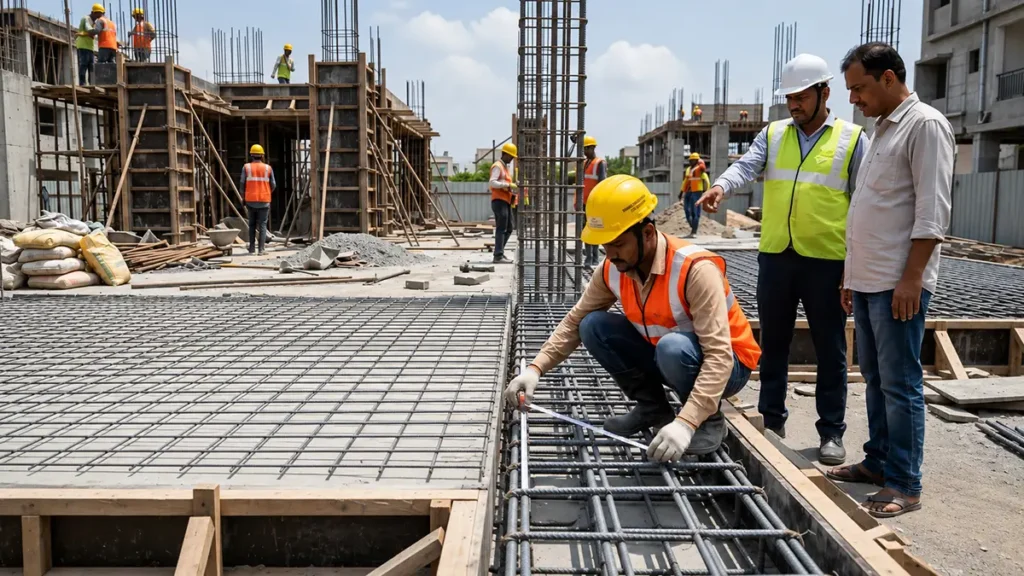
Concrete looks strong from the outside, yet every good structure depends on what goes inside it. Steel reinforcement helps concrete handle tensile stress, control cracks, and perform better under load. Two common reinforcement options are wire mesh and rebar.
Many people compare wire mesh vs rebar while planning slabs, driveways, flooring, footings, or RCC work. The right choice depends on the type of structure, load requirement, design, site conditions, and the structural engineer’s recommendation.
This blog explains the difference in simple terms.
What Is Wire Mesh in Construction?
Wire mesh, also called welded wire reinforcement, is made by arranging steel wires in a square or rectangular grid and welding them at intersections. It is commonly supplied in sheets or rolls.
Wire mesh is mostly used where reinforcement needs to be spread evenly across a surface. It is often seen in slabs, pavements, flooring, precast panels, and similar concrete applications where crack control and distribution of reinforcement are important.
Common Uses of Wire Mesh
Wire mesh is generally used in:
- Slabs-on-grade
- Flooring work
- Pavements and pathways
- Topping slabs
- Precast concrete elements
- Thin concrete sections where uniform reinforcement is needed
Wire mesh helps distribute reinforcement across a wider area. It can make placement faster in suitable slab applications because the grid is already prefabricated.
What Is Rebar?
Rebar, short for reinforcing bar, is a steel bar placed inside concrete to improve its tensile strength and load-bearing performance. In India, TMT bars are widely used as rebar in RCC construction.
Rebar comes in different diameters and grades. The ribbed surface helps the concrete grip the steel, creating a better bond between both materials.
Common Uses of Rebar
Rebar is generally used in:
- Beams
- Columns
- Footings
- Foundations
- Load-bearing slabs
- Retaining walls
- Bridges and infrastructure projects
- RCC residential and commercial structures
For major structural members, rebar is usually the preferred reinforcement because it can be placed, bent, spaced, and detailed as per structural design.
Wire Mesh vs Rebar: Main Difference
Wire mesh and rebar both strengthen concrete, yet they serve different construction needs.
Wire mesh is a prefabricated grid of thinner steel wires. It is useful where reinforcement must be distributed evenly across a slab or surface. Rebar is made of individual steel bars. It is used where the structure needs stronger, design-specific reinforcement.
In simple words, wire mesh is more suitable for crack control and surface-level reinforcement in many slab applications. Rebar is more suitable for structural strength in RCC members such as columns, beams, footings, and load-bearing slabs.
Strength and Load-Bearing Capacity
Rebar is generally used where concrete must handle higher loads. Since bars are available in different diameters and grades, engineers can design the reinforcement as per the exact load requirement.
Wire mesh works well for many slab and flooring applications where uniform reinforcement is required. It may not be suitable as a direct replacement for rebar in beams, columns, heavy foundations, or other critical RCC members unless the structural design clearly specifies it.
For any load-bearing construction, the approved structural drawing should decide the reinforcement type, bar diameter, spacing, grade, and placement.
Crack Control
Wire mesh can help control shrinkage and temperature-related cracking in slabs when placed correctly. Its closely spaced grid spreads reinforcement across the concrete surface.
Rebar also helps control cracks, especially in structural members. The crack-control performance depends on bar spacing, cover, diameter, concrete quality, curing, and site execution.
A common mistake on site is placing wire mesh directly on the ground and trying to pull it up after pouring concrete. This can disturb its position. Wire mesh needs proper supports so it stays at the required level during concreting.
Ease of Installation
Wire mesh can be faster to place in some slab applications because it comes as a ready grid. It reduces the amount of tying work on site.
Rebar takes more detailing, cutting, bending, tying, and spacing. This extra work gives engineers more control over reinforcement placement. That matters in beams, columns, footings, and other structural elements where every bar position has a purpose.
ET TMT also offers cut and bend TMT bar solutions, which can help improve accuracy and efficiency at the construction site when used as per project requirements.
Cost Difference
The cost comparison between wire mesh and rebar depends on the project.
Wire mesh may reduce labour time in certain slab applications. Rebar may require more manual tying and detailing, yet it is essential where the structure needs higher load-bearing strength and engineered reinforcement.
The final cost should consider:
- Steel quantity
- Bar diameter or wire size
- Labour
- Cutting and bending
- Wastage
- Site handling
- Placement accuracy
- Structural requirement
Choosing the cheaper option without checking the structural need can lead to serious quality issues.
Durability and Site Performance
Durability depends on steel quality, concrete grade, cover, exposure condition, curing, workmanship, and corrosion protection.
For RCC work, TMT bars are widely used because they offer strength, ductility, and a strong bond with concrete. In areas where corrosion is a concern, epoxy-coated TMT bars may be considered as per project specifications.
ET TMT offers multiple TMT bar options such as CRS TMT bars, Refined Steel TMT bars, Superior Quality Steel TMT bars, Epoxy-Coated TMT bars, and Cut & Bend TMT bars. The right product should be selected based on the structural design and site requirement.
Wire Mesh vs Rebar: Which One Should You Choose?
Choose wire mesh when the project needs uniform reinforcement across a slab, flooring, pavement, or similar surface application, and the design allows it.
Choose rebar or TMT bars when the project involves load-bearing RCC members such as beams, columns, footings, foundations, and structural slabs.
For home construction, commercial buildings, and infrastructure projects, TMT bars are usually central to the RCC framework. Wire mesh can support specific applications, yet it should never be treated as a universal replacement for rebar.
Common Mistakes to Avoid
1. Using wire mesh as a direct replacement for rebar
Wire mesh and rebar are different reinforcement systems. Replacement should happen only when the structural engineer designs it that way.
2. Ignoring placement height
Reinforcement must stay in the correct position inside concrete. Poor placement reduces performance.
3. Choosing steel only by price
Low-cost reinforcement can become expensive later if it affects strength, durability, or safety.
4. Skipping structural advice
Every project has different loads and exposure conditions. Always follow approved structural drawings.
Why Quality TMT Bars Matter in RCC Construction
The quality of TMT bars directly affects the strength and durability of RCC structures. A good TMT bar should meet the required grade, have consistent quality, bond well with concrete, and support safe construction when used as per design.
ET TMT focuses on TMT bars for residential, commercial, and infrastructure projects. Its product range includes different TMT bar solutions for different construction needs. For structural RCC work, choosing the right TMT bar grade and diameter as per the engineer’s design is one of the most important decisions on site.
Final Thoughts
Wire mesh and rebar are both useful in concrete construction. Their roles are different.
Wire mesh works well for many slab and surface reinforcement applications. Rebar or TMT bars are the stronger choice for structural RCC members that carry load and define the strength of the structure.
For safe construction, never decide reinforcement by guesswork. Follow the structural drawing, use quality steel, maintain correct placement, and choose trusted TMT bars for load-bearing RCC work.