
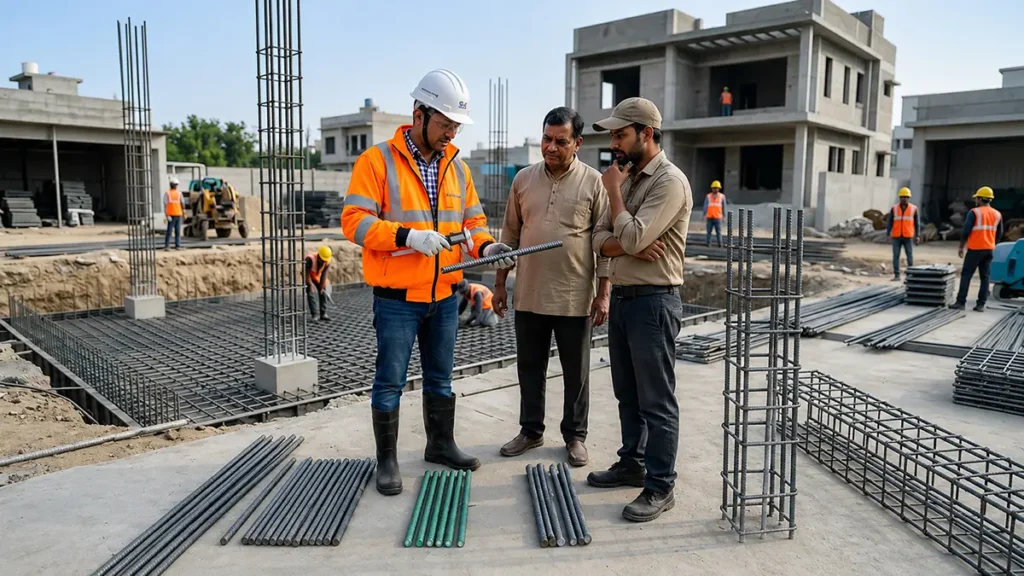
Introduction
Rebar is one of the most important materials in reinforced concrete construction. Concrete handles compression well, while steel reinforcement helps the structure resist tensile and bending forces. This is why the right rebar selection directly affects the strength, durability and service life of a building, bridge, industrial structure or infrastructure project.
In India, TMT bars are widely used for RCC work because they offer strength, ductility and better bonding with concrete. Still, every project does not need the same rebar. A coastal project, a high-rise building, a home foundation and a bridge may have different grade, corrosion resistance and bendability requirements.
This rebar selection guide explains the main types of rebars, their applications and how regional conditions influence the right choice.
What Is Rebar?
Rebar, short for reinforcing bar, is a steel bar used inside concrete to improve structural performance. RCC structures depend on this combination of concrete and steel. The concrete protects the steel and carries compression loads. The steel helps the structure manage tension, bending, shear and movement.
A good rebar should offer:
- Required yield strength
- Adequate ductility
- Strong bond with concrete
- Bendability as per design needs
- Resistance to corrosion based on exposure conditions
- Consistent quality and standard compliance
For Indian construction, buyers and engineers usually refer to grades such as Fe 500, Fe 500D, Fe 550, Fe 550D and Fe 600. The final grade should always follow the structural design and project specification.
Common Types of Rebar Used in Construction
1. TMT Bars
TMT bars, or thermo-mechanically treated bars, are the most common reinforcement choice for modern RCC construction. They are used in homes, apartments, commercial buildings, foundations, slabs, beams, columns, bridges and other load-bearing structures.
TMT bars are preferred because they combine strength with ductility. Ductility matters because steel should be able to elongate before failure. This gives the structure better behaviour under stress, especially in areas where movement, vibration or seismic forces are expected.
Common applications:
- Residential buildings
- Commercial buildings
- RCC foundations
- Columns, beams and slabs
- Roads and infrastructure projects
- Industrial construction
2. CRS TMT Bars
CRS stands for corrosion-resistant steel. CRS TMT bars are designed for environments where moisture, salinity or chemical exposure can increase the risk of corrosion.
In coastal regions, exposed foundations, water-retaining structures and industrial locations, corrosion protection becomes a serious selection factor. Corrosion can weaken steel over time and affect the durability of RCC structures. CRS TMT bars help improve resistance in such demanding conditions.
Common applications:
- Coastal construction
- Marine-side infrastructure
- Bridges and flyovers
- Water treatment plants
- Industrial structures
- Projects exposed to humid or aggressive environments
3. Epoxy-Coated TMT Bars
Epoxy-coated TMT bars have a protective coating over the steel surface. This coating acts as a barrier against corrosive agents such as chloride ions. These bars are usually considered for high-corrosion exposure zones where extra protection is required.
They are relevant for marine infrastructure, bridges, ports, coastal buildings and structures exposed to moisture and salts. The coating quality, handling, storage and bending process must be managed carefully so the protective layer remains effective.
Common applications:
- Marine infrastructure
- Coastal bridges
- Ports and jetties
- Water-facing structures
- High-humidity construction zones
- Infrastructure requiring added corrosion protection
4. Refined Steel TMT Bars
Refined steel TMT bars are manufactured with cleaner steelmaking processes and stricter control over impurities. These are suitable for projects where consistent steel quality, strength and reliability are important.
For large projects, engineers and contractors often look at the steel source, chemical consistency, manufacturing process and testing standards. Refined steel TMT bars can support these quality expectations when selected as per project requirement.
Common applications:
- Premium residential projects
- Commercial towers
- Institutional buildings
- Infrastructure work
- Projects requiring consistent steel quality
5. Cut & Bend TMT Bars
Cut & Bend TMT bars are supplied in ready-to-use shapes as per project drawings. This helps reduce on-site cutting, bending errors, labour dependency and wastage.
Large infrastructure projects, flyovers, bridges, windmills and complex RCC structures often need accurate bar shapes and repeatable bending. Ready-to-use cut and bend bars help improve site efficiency and execution accuracy.
Common applications:
- Bridges
- Flyovers
- Windmills
- Large commercial projects
- Industrial structures
- Projects with complex reinforcement detailing
Understanding Rebar Grades
Rebar grades show the minimum yield strength of the steel. In simple terms, higher grade numbers indicate higher yield strength. The right grade depends on the structural design, load requirement, seismic condition and exposure environment.
Fe 500
Fe 500 is commonly used for general RCC construction. It is suitable for many residential and commercial structures when specified by the structural engineer.
Suitable for:
- Homes
- Low-rise and mid-rise buildings
- General RCC work
- Foundations, slabs, beams and columns
Fe 500D
Fe 500D offers the same minimum yield strength category as Fe 500, with enhanced elongation requirements. The “D” stands for ductility. This makes it a preferred choice where flexibility, seismic performance and bendability are important.
Suitable for:
- Earthquake-prone regions
- Residential and commercial buildings
- RCC members requiring better ductility
- Structures where safety margins are important
Fe 550
Fe 550 offers higher yield strength and is generally selected for structures with higher load demands. It can help in projects where the structural design calls for higher strength steel.
Suitable for:
- High-rise buildings
- Heavy-load structures
- Bridges
- Infrastructure projects
- Industrial structures
Fe 550D
Fe 550D combines higher strength with enhanced ductility. It is useful for demanding structures where both load-bearing capacity and ductility are important.
Suitable for:
- High-rise structures
- Seismic-zone construction
- Bridges and flyovers
- Large infrastructure work
- Heavy-duty RCC design
Fe 600
Fe 600 is a higher-strength grade generally used in specialized construction where the design clearly specifies it. This grade should be used strictly as per structural engineering recommendation.
Suitable for:
- Specialized infrastructure
- Heavy-load structural elements
- Engineer-specified applications
How to Choose the Right Rebar for Your Project
1. Start with the structural design
The structural engineer’s design is the first reference point. The drawing and Bar Bending Schedule should mention the grade, diameter, spacing and shape of the rebar. Site-level grade changes can affect the design behaviour of RCC members.
2. Check the exposure condition
A dry inland site and a coastal site have different durability needs. If the structure is exposed to humidity, saline water, industrial chemicals or aggressive soil, corrosion-resistant options should be considered.
3. Consider seismic performance
In earthquake-prone regions, ductility becomes a key factor. Ductile steel can undergo more elongation before breaking. This supports better energy absorption during seismic movement when combined with proper RCC design and ductile detailing.
4. Match the grade to the application
Higher grade steel is useful where the design demands higher strength. It should never be treated as a direct replacement for a lower grade without engineering approval. Rebar grade selection should match the structural calculation, concrete grade, member design and code requirement.
5. Look at bendability and site execution
For columns, stirrups, hooks, ties and complex reinforcement shapes, bendability matters. Cut & Bend TMT bars can improve execution accuracy for large projects and reduce manual errors on site.
6. Verify quality and standards
Always check the manufacturer, test certificates, grade marking, batch details and applicable standards. Rebar quality should be consistent because reinforcement is hidden inside concrete after casting. Once the concrete is poured, correcting steel-related mistakes becomes difficult and expensive.
Regional Preferences in India
Rebar selection in India changes with climate, seismic risk, soil condition and project type. These are practical selection patterns, while the final decision should come from the structural engineer.
Coastal regions
Coastal belts such as Gujarat, Maharashtra, Goa, Karnataka, Kerala, Odisha, Andhra Pradesh, Tamil Nadu and West Bengal often face humidity, salt-laden air and chloride exposure. For such regions, CRS TMT bars or epoxy-coated TMT bars are commonly considered.
Preferred selection approach:
- CRS TMT bars for improved corrosion resistance
- Epoxy-coated TMT bars for marine and high-chloride exposure
- Correct concrete cover and good concrete quality
- Proper storage to avoid pre-construction rusting
Earthquake-prone regions
North-eastern India, Himalayan regions, Kutch, parts of North India and other seismic zones need careful structural detailing. In these regions, ductility is important because buildings must handle movement and energy during seismic activity.
Preferred selection approach:
- Fe 500D or Fe 550D as per design
- Ductile detailing as per applicable codes
- Proper anchorage, lap length and stirrup spacing
- Engineer-approved reinforcement layout
Urban high-rise and commercial regions
Metro cities and fast-growing urban areas often require high-rise buildings, basements, podiums, commercial towers and mixed-use structures. These projects need consistent steel quality, accurate execution and grade selection based on load requirements.
Preferred selection approach:
- Fe 500D or Fe 550D based on design
- Cut & Bend TMT bars for execution accuracy
- Refined steel TMT bars for quality-led construction
- Detailed material testing and certification checks
Inland residential regions
For many inland residential projects, Fe 500 or Fe 500D TMT bars are commonly specified. The final choice depends on soil condition, building height, seismic zone and engineer’s design.
Preferred selection approach:
- Fe 500 or Fe 500D based on structural design
- Good storage at site
- Correct bar diameter and spacing
- Verified brand and test certificate
Industrial and infrastructure zones
Factories, warehouses, bridges, flyovers, power projects, windmills and public infrastructure demand stronger quality control. These projects may need higher-grade steel, corrosion resistance and ready-to-use reinforcement shapes.
Preferred selection approach:
- Fe 550, Fe 550D or Fe 600 as per design
- CRS or epoxy-coated options in aggressive environments
- Cut & Bend bars for complex reinforcement detailing
- Strict material inspection and QA documentation
ET TMT Rebar Options for Different Needs
ET TMT offers multiple rebar options for different construction requirements:
- ET CRS TMT Bars for corrosion-resistant reinforcement needs
- ET Refined Steel TMT Bars for quality-focused construction
- ET Superior Quality Steel TMT Bars for standard RCC use
- ET Epoxy-Coated TMT Bars for added protection in corrosive conditions
- ET Cut & Bend TMT Bars for ready-to-use reinforcement as per project shapes
This range allows builders, contractors and engineers to select reinforcement based on grade, exposure condition, design requirement and execution needs.
Quick Rebar Selection Checklist
Before finalizing rebar for your project, ask these questions:
- What grade is specified in the structural drawing?
- Is the site coastal, humid or chemically exposed?
- Is the project located in a seismic zone?
- Does the project need higher ductility?
- Does the structure carry heavy loads?
- Are cut and bend bars needed for faster site execution?
- Are test certificates and standard compliance available?
- Is the supplier consistent and reliable?
A small saving on low-quality steel can create a much bigger risk later. Rebar is the backbone of RCC construction, so selection should be guided by safety, durability and engineering accuracy.
Conclusion
The right rebar is not the same for every structure. A residential home, a coastal bridge, a high-rise tower and an industrial foundation can all require different reinforcement choices.
For general RCC construction, Fe 500 and Fe 500D are commonly used. For higher load requirements, Fe 550 and Fe 550D may be specified. For seismic regions, ductility becomes important. For coastal and aggressive environments, CRS or epoxy-coated TMT bars are a smart consideration. For complex projects, cut and bend bars can help improve site efficiency and accuracy.
Choosing the right TMT bar means understanding the structure, the location, the exposure condition and the engineering design. With a wide range of CRS, refined steel, epoxy-coated, superior quality and cut & bend TMT bars, ET TMT supports different reinforcement needs across residential, commercial and infrastructure projects.
Need help selecting the right ET TMT bar for your project? Share your project type, location, grade requirement and structural drawing details with the ET TMT team for the right guidance.