
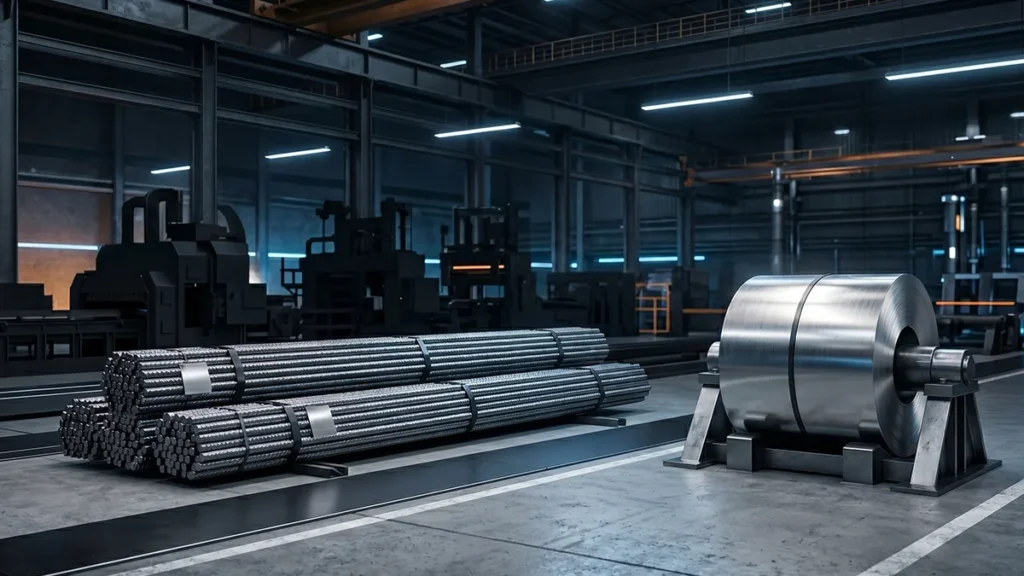
In steel production, TDS usually stands for Total Dissolved Solids. It refers to the total amount of dissolved minerals, salts, metals, and other inorganic substances present in water used across different stages of steel manufacturing.
Steel production depends heavily on water for cooling, cleaning, descaling, boiler operations, and process support. While water may look clean, it can still contain dissolved substances such as calcium, magnesium, sodium, chlorides, sulphates, bicarbonates, and other salts. These dissolved solids affect how water behaves inside equipment and production systems.
That is why TDS plays an important role in steel plants. It does not directly define the strength of steel like carbon content, alloying elements, or rolling process do. Instead, it supports process efficiency, equipment health, surface quality, water reuse, and long-term plant reliability.
What is TDS in Steel Production?
TDS, or Total Dissolved Solids, is a water quality parameter. It measures the concentration of dissolved substances present in water. TDS is usually measured in ppm or mg/L.
In the context of steel manufacturing, TDS is mainly linked to the water used in:
- Cooling systems
- Boiler feed water
- Descaling operations
- Heat treatment processes
- Surface cleaning
- Water recycling systems
- Effluent treatment and reuse
When TDS levels are controlled properly, water performs better in industrial systems. When TDS levels rise beyond suitable operating limits, it can contribute to scaling, corrosion, poor heat transfer, equipment deposits, and higher maintenance needs.
Why is TDS Important in Steel Manufacturing?
Steel manufacturing involves extremely high temperatures, heavy-duty machinery, and continuous water circulation. In such an environment, even small changes in water quality can affect plant performance over time.
TDS becomes important because dissolved solids do not simply disappear during use. In boilers, cooling towers, and recirculating water systems, water may evaporate, but many dissolved solids stay behind. As concentration increases, the water becomes more likely to form deposits or contribute to corrosion.
This is one reason why steel plants monitor TDS as part of their water management and treatment systems.
Role of TDS in Steel Production
1. Helps Maintain Cooling Efficiency
Cooling is one of the most important uses of water in steel production. Water is used to cool equipment, control process temperatures, and support safe operations.
When TDS levels are too high, dissolved minerals can form scale on heat transfer surfaces. Scale acts like an insulating layer. This can reduce cooling efficiency and make equipment work harder than needed.
Controlled TDS levels help cooling systems perform more consistently and support smoother plant operations.
2. Reduces Scale Formation
Scale is a hard deposit that can form when dissolved minerals such as calcium and magnesium become concentrated under heat. In steel plants, scale formation can occur in boilers, cooling systems, pipelines, heat exchangers, and other water-contact surfaces.
Excessive scaling can reduce water flow, affect heat transfer, and increase the need for cleaning or maintenance.
By monitoring and managing TDS, steel plants can reduce the chances of heavy deposits and support longer equipment life.
3. Supports Boiler Water Quality
Boilers are used in many industrial plants, including steel manufacturing units, for steam generation and process support.
In boiler systems, dissolved solids can become concentrated as steam is produced. If TDS rises too much, it can lead to foaming, carryover, deposits, and lower steam quality. This may affect boiler efficiency and reliability.
That is why boiler water treatment often includes TDS monitoring, blowdown control, and proper feed water treatment.
4. Helps Control Corrosion Risk
High TDS water can increase electrical conductivity. Higher conductivity can make water more aggressive toward metal surfaces, especially when chlorides, sulphates, or improper pH levels are also present.
In steel plants, corrosion can affect pipelines, pumps, cooling systems, boiler tubes, storage tanks, and process equipment.
TDS alone does not tell the full corrosion story, but it is an important indicator. It is usually monitored along with pH, hardness, alkalinity, chloride content, dissolved oxygen, and other water quality parameters.
5. Improves Process Reliability
Steel production is a continuous and demanding process. Unplanned downtime can affect production schedules, energy use, maintenance costs, and overall efficiency.
Poor water quality can slowly create operational problems inside equipment. These problems may not appear immediately, but over time they can affect plant reliability.
Managing TDS helps reduce the risk of scaling, clogging, heat transfer loss, corrosion, and water system instability.
6. Supports Better Surface Cleaning and Descaling
Water is used in descaling and cleaning processes to remove surface impurities, mill scale, and other residues during steel production.
If water has very high dissolved solids, it can leave deposits or marks on surfaces after evaporation. In some cases, poor water quality may affect cleaning effectiveness.
Controlled TDS supports cleaner water performance in surface-related operations.
7. Helps in Water Recycling and Sustainability
Modern steel plants focus on water conservation and recycling. Reusing process water can reduce freshwater consumption and improve sustainability.
However, when water is reused again and again, dissolved solids can build up. If this is not managed, the recycled water may become unsuitable for certain applications.
TDS monitoring helps steel plants decide when water needs treatment, dilution, blowdown, filtration, or further purification before reuse.
How High TDS Can Affect Steel Plant Operations
High TDS levels may create several operational challenges in steel production environments. These may include:
- Scale formation in boilers and cooling systems
- Reduced heat transfer efficiency
- Higher corrosion potential
- Deposits inside pipelines and equipment
- Increased maintenance frequency
- Poor boiler steam quality
- Reduced cooling tower performance
- Higher chemical treatment requirements
- Challenges in water reuse and recycling
The impact depends on the actual water chemistry, plant design, temperature, treatment system, and process requirement. TDS is one important parameter, but it is usually evaluated along with other water quality indicators.
Does TDS Affect the Quality of Steel?
TDS does not directly decide the mechanical properties of steel in the way that raw material quality, steel chemistry, refining, rolling, quenching, and tempering do.
For example, the strength, ductility, bendability, corrosion resistance, and consistency of TMT bars depend more directly on steel composition, manufacturing control, refining process, rolling technology, and quality testing.
However, TDS can indirectly support steel production quality by helping maintain stable process conditions. Good water quality can support efficient cooling, cleaner surfaces, reliable equipment, and consistent plant operations.
So, TDS should be understood as a supporting process parameter, not as a direct measure of steel strength.
How is TDS Managed in Steel Plants?
Steel plants may manage TDS through a combination of water treatment and process control methods. These can include:
- Regular water testing
- Conductivity monitoring
- Boiler blowdown control
- Cooling tower bleed-off
- Softening systems
- Reverse osmosis
- Demineralization
- Filtration
- Chemical dosing
- Effluent treatment and water reuse planning
The right method depends on the water source, production process, equipment type, and required water quality.
TDS and the Future of Sustainable Steel Production
Water management is becoming increasingly important in steel manufacturing. As industries focus on sustainability, energy efficiency, and responsible resource use, water quality parameters like TDS are gaining more attention.
Better TDS control can help steel plants reduce water wastage, improve recycling, lower maintenance issues, and support more efficient operations.
For steel producers, this is not just about treating water. It is about creating a more reliable and responsible production ecosystem.
Why Water Quality Matters in Reliable Steel Manufacturing
Reliable steel production depends on many controlled factors, including raw materials, furnace operations, refining, rolling, testing, and process discipline. Water quality is one of the supporting elements that helps these systems function smoothly.
At Electrotherm Steel, the focus remains on producing strong and dependable steel products through controlled manufacturing practices and consistent quality standards. Understanding factors like TDS helps explain the depth of process care involved in modern steel production.
Conclusion
TDS in steel production refers to Total Dissolved Solids in water used across steel manufacturing processes. It is an important water quality parameter that influences cooling efficiency, boiler performance, corrosion control, scaling tendency, equipment reliability, and water reuse.
TDS does not directly define steel strength, but it plays a valuable supporting role in maintaining efficient and stable production conditions. In modern steel manufacturing, controlling TDS is part of a broader approach to quality, reliability, sustainability, and operational excellence.
For anyone trying to understand steel production better, TDS is a useful reminder that strong steel is not only about metal chemistry. It is also about the systems, controls, and process discipline behind every stage of manufacturing.