
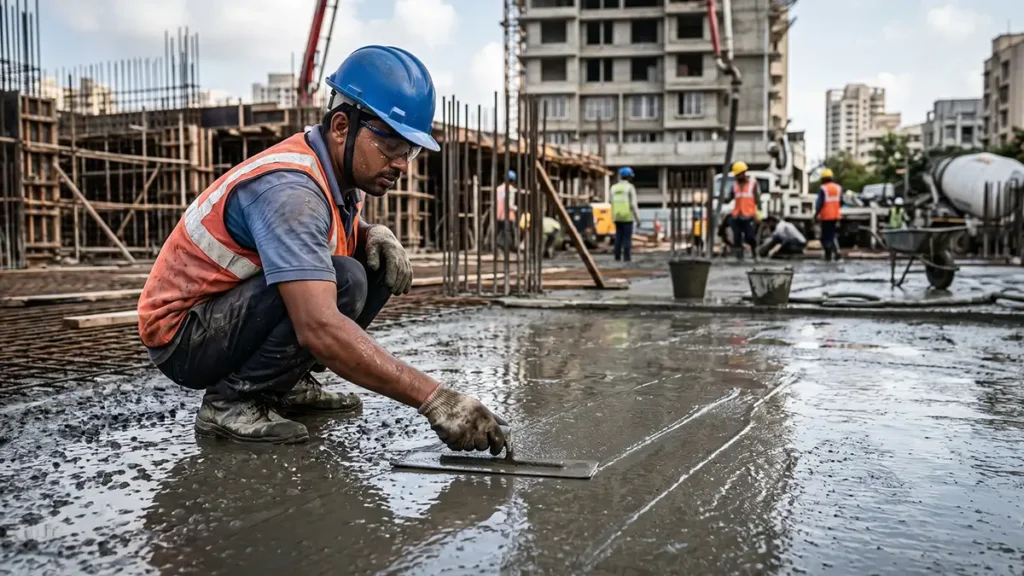
Concrete bleeding is a form of segregation in fresh concrete. As the cement, sand, aggregates, and other solid particles settle, water moves upward because it is the lightest component in the mix. This water collects on the top surface and is commonly called bleed water.
Bleeding usually continues until the cement paste becomes stiff enough to hold the mix together. When bleeding is controlled, it may not cause serious issues. When it is excessive, it can affect the bond, surface finish, and durability of concrete.
Why Does Concrete Bleeding Happen?
1. Excess Water in the Concrete Mix
One of the most common reasons for concrete bleeding is too much water in the mix. When extra water is added to improve workability, the concrete may become easier to place, but the excess water can rise to the surface after placement.
This can leave behind a weaker surface layer and may reduce the quality of the finished concrete.
2. Poorly Graded Aggregates
A well-balanced concrete mix depends on the right proportion of fine and coarse aggregates. If the mix does not have enough fine particles, the concrete may not hold water properly. This can increase bleeding and also make the mix less cohesive.
The presence of adequate fine aggregate can help reduce bleeding by improving the stability of the mix.
3. Over-Vibration During Compaction
Vibration helps remove trapped air and compact concrete. However, excessive vibration can disturb the balance of the mix. It may push heavier particles downward and allow more water to rise upward.
This is why controlled compaction is important. The goal is to remove air pockets without causing segregation or extra bleeding.
4. Improper Finishing Timing
Finishing concrete while bleed water is still present can trap water below the surface or mix it back into the top layer. This can make the surface weak and more prone to dusting, scaling, crazing, delamination, or blisters.
A better approach is to allow the bleed water to disappear before starting major finishing work.
5. Weather and Site Conditions
Hot, dry, and windy conditions can cause surface water to evaporate quickly. This creates another challenge: if evaporation happens faster than bleeding, plastic shrinkage cracks can develop.
So, bleeding is not only about excess water. Site conditions, temperature, wind, humidity, and finishing time all play a role.
How Concrete Bleeding Affects Construction Quality
Concrete bleeding can affect the surface and internal quality of concrete in several ways:
Weak Surface Layer
When bleed water is worked back into the surface during finishing, it can create a weaker top layer. This surface may later show dusting, scaling, or poor wear resistance.
Poor Bond with Reinforcement
Excessive bleeding can create water pockets under aggregates or reinforcement. This may affect the bond between concrete and steel reinforcement in some cases.
Surface Defects
If finishing starts too early, the surface may develop blisters, delamination, or crazing. These issues may not appear immediately but can become visible after the concrete hardens and is exposed to use.
Reduced Durability
Concrete durability depends on good mix design, proper placement, correct finishing, and curing. Bleeding is one factor that can reduce surface quality when not managed correctly.
How to Reduce Concrete Bleeding
1. Control the Water-Cement Ratio
Avoid adding extra water at the site unless it is approved by the mix designer or site engineer. A controlled water-cement ratio helps maintain strength, workability, and durability.
Instead of adding water for workability, suitable admixtures can be considered based on the project requirement and expert guidance.
2. Use a Well-Graded Aggregate Mix
A balanced combination of fine and coarse aggregates helps the concrete mix stay cohesive. Proper grading reduces the chances of water separating from the mix.
3. Avoid Over-Vibration
Concrete needs proper compaction, but excessive vibration can increase segregation and bleeding. Use vibration carefully and only as much as required to remove trapped air and settle the concrete uniformly.
4. Wait Before Final Finishing
After the initial leveling, allow the concrete to stop bleeding before floating, troweling, or other finishing work. NRMCA guidance states that finishing while concrete is still bleeding or while water is present on the surface can result in defects such as dusting, scaling, crazing, delamination, and blisters.
5. Do Not Sprinkle Cement or Water on the Surface
Adding dry cement or water on top of fresh concrete may seem like a quick fix, but it can lead to poor surface quality. It can increase the chances of dusting or scaling after the concrete hardens.
6. Protect Concrete from Harsh Weather
In hot, dry, or windy conditions, protect the concrete surface from rapid moisture loss. Temporary covers, windbreaks, sunshades, or curing compounds may help depending on the site condition and project specification.
7. Start Curing at the Right Time
Curing supports cement hydration and helps concrete gain strength and durability. Once finishing is complete, curing can begin as per the project requirement and site conditions.
How to Fix Concrete Bleeding on Site
The right response depends on whether the concrete is still fresh or already hardened.
If Concrete Is Still Fresh
Allow the bleed water to evaporate naturally before final finishing. Avoid working the bleed water back into the surface. Light leveling can be done early, but major finishing is better after bleeding has stopped and the water sheen has disappeared.
If the Surface Has Already Hardened
If bleeding has already caused dusting, scaling, blisters, or delamination, the repair method depends on the severity of the defect. Minor surface issues may be corrected with suitable surface treatment or resurfacing. Deeper defects or structural concerns need inspection by a qualified professional before repair.
Concrete Bleeding and Reinforced Construction
Concrete quality and steel reinforcement both play important roles in RCC construction. Bleeding is mainly a concrete mix and placement issue, while reinforcement supports tensile strength and load-bearing performance in the structure.
For reinforced concrete work, choosing reliable TMT bars is an important part of building right. ET TMT offers TMT bars for residential, commercial, and infrastructure construction, with product options such as CRS TMT bars, refined steel TMT bars, superior quality steel TMT bars, epoxy-coated TMT bars, and cut & bend TMT bars.
ET Superior Quality Steel TMT Bars are positioned for RCC construction in buildings and other concrete structures, with advantages such as corrosion resistance, ductility, bendability, weldability, and load-bearing capacity listed by the brand.
Conclusion
Concrete bleeding is a common fresh concrete issue, but it can be managed with the right mix design, controlled water content, proper aggregate grading, careful compaction, correct finishing time, and suitable curing.
The key is not to rush the surface finishing process. When bleed water is allowed to disappear before final finishing, the concrete surface gets a better chance to develop strength, durability, and a cleaner finish.
For strong RCC construction, every detail matters – from the quality of concrete placement to the reinforcement used inside the structure. With reliable construction practices and quality TMT bars from ET TMT, builders can work towards safer, stronger, and longer-lasting structures.