
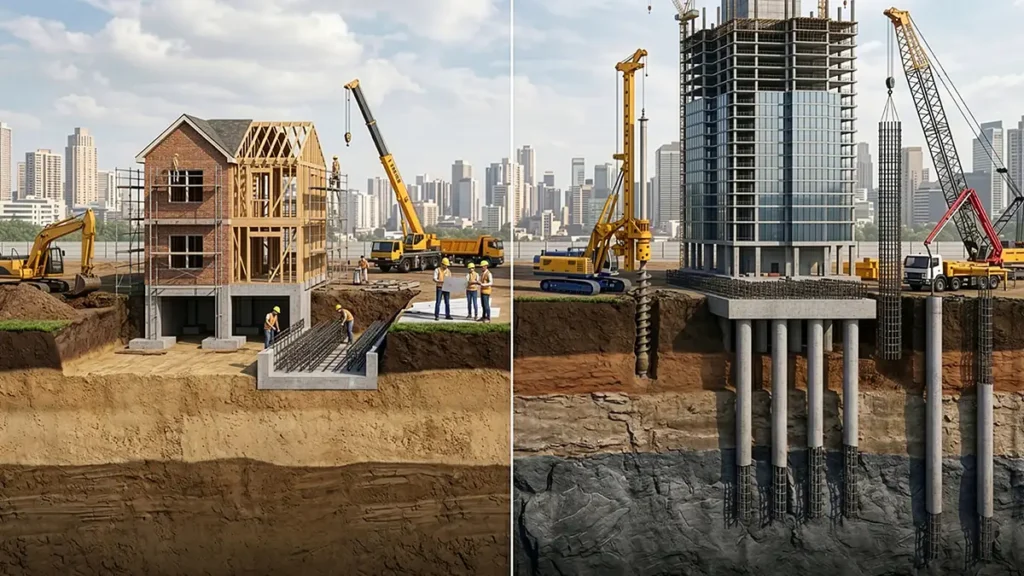
A strong building begins much before the walls, beams, and slabs become visible. It begins with the foundation. The foundation connects the structure to the ground and helps transfer the load of the building safely to the soil or rock below.
In construction, foundations are broadly divided into two main types: shallow foundations and deep foundations. Both serve the same basic purpose, but they work differently, are used in different soil conditions, and are selected based on the type of structure being built.
Understanding the difference between shallow and deep foundations can help homeowners, contractors, builders, and project planners make better construction decisions with the guidance of qualified engineers.
What Is a Foundation in Construction?
A foundation is the lowest part of a structure that supports the building and transfers its load to the ground. It helps keep the structure stable by distributing the weight of walls, columns, beams, slabs, and other building elements.
The type of foundation depends on several factors, including:
Soil strength
Building height and load
Site conditions
Groundwater level
Type of structure
Settlement limits
Local construction requirements
A foundation is not selected only by looking at the size of the building. The soil below the structure plays a major role in deciding whether a shallow or deep foundation is more suitable.
What Is a Shallow Foundation?
A shallow foundation is placed near the ground surface. It transfers the building load to the soil at a relatively shallow depth. This type of foundation is generally used when the upper layer of soil has enough strength to support the structure.
Shallow foundations are common in low-rise residential buildings, small commercial structures, boundary walls, and other projects where the load is moderate and the soil near the surface is stable.
Common Types of Shallow Foundations
1. Isolated Footing
An isolated footing supports a single column. It is one of the most commonly used foundation types for small and medium-sized buildings where the soil has adequate bearing capacity.
2. Strip Footing
A strip footing supports a continuous wall or a line of closely spaced columns. It spreads the load along the length of the wall.
3. Combined Footing
A combined footing supports two or more columns when they are close to each other or when individual footings may overlap.
4. Raft or Mat Foundation
A raft foundation is a large reinforced concrete slab that spreads the load of the entire structure over a wide area. It is often considered when soil has lower bearing capacity or when columns are closely spaced.
What Is a Deep Foundation?
A deep foundation is used when the soil near the surface is not strong enough to support the structure. Instead of relying on the upper soil layer, deep foundations transfer the load to stronger soil or rock layers found at greater depth.
Deep foundations are often used for high-rise buildings, bridges, industrial structures, flyovers, heavy machinery foundations, and projects built on weak or filled soil.
Common Types of Deep Foundations
1. Pile Foundation
A pile foundation uses long structural members called piles. These piles are driven or bored deep into the ground to transfer loads to stronger soil or rock layers.
2. Pier Foundation
A pier foundation consists of large-diameter columns constructed below ground level. It is generally used where deeper support is needed, but the design conditions differ from conventional pile systems.
3. Caisson Foundation
Caisson foundations are used for heavy structures, especially in areas with water, such as bridge piers and marine construction.
Shallow vs Deep Foundation: Key Differences
The main difference between shallow and deep foundations lies in how and where they transfer structural loads.
A shallow foundation transfers the load to soil close to the surface. A deep foundation transfers the load to stronger layers located much deeper below the ground.
When Is a Shallow Foundation Used?
A shallow foundation may be considered when the soil near the surface has enough strength to support the structure. It is commonly used for:
Residential houses
Low-rise buildings
Small commercial spaces
Compound walls
Light industrial structures
Stable soil conditions
Shallow foundations are often preferred when site conditions are straightforward and the load of the structure can be safely carried by the upper soil layers.
When Is a Deep Foundation Used?
A deep foundation may be considered when the upper soil layers are weak, loose, compressible, or unable to support the structure safely. It is commonly used for:
High-rise buildings
Bridges and flyovers
Large commercial buildings
Industrial plants
Structures near water bodies
Sites with filled or soft soil
Projects with heavy loads
Deep foundations help transfer the load to stronger strata below, reducing the risk of excessive settlement or instability.
Why Soil Testing Matters Before Foundation Selection
Soil testing is an important step before deciding the foundation type. Two plots may look similar on the surface but have completely different soil conditions below.
A proper soil investigation can help identify:
Soil bearing capacity
Groundwater level
Soil layers
Settlement behaviour
Need for shallow or deep foundation
Suitability of construction methods
Without soil testing, foundation selection can become guesswork. A qualified structural or geotechnical engineer can study the soil report and recommend a suitable foundation system.
Role of TMT Bars in Foundation Construction
Most modern foundations use reinforced concrete. In reinforced concrete, TMT bars help improve the tensile strength of concrete and support the structure under different types of loads.
Whether the project uses isolated footings, raft foundations, pile caps, beams, or other foundation elements, quality reinforcement plays an important role in long-term performance.
For foundation work, builders often look for TMT bars with good strength, ductility, bendability, and corrosion resistance. These properties help the reinforcement perform better inside concrete, especially in areas where the foundation may be exposed to moisture, soil chemicals, or demanding structural conditions.
ET TMT offers a range of TMT bars for residential, commercial, and infrastructure construction needs. The brand focuses on quality-controlled manufacturing, consistent reinforcement, and durable construction support.
Which Foundation Is Better: Shallow or Deep?
There is no single answer. A shallow foundation is not automatically better than a deep foundation, and a deep foundation is not always the stronger choice for every project.
The better option depends on the structure, soil, load, depth of strong strata, site conditions, and engineering design.
A shallow foundation can be a practical and economical choice when surface soil is strong enough. A deep foundation can be more suitable when loads are heavy or stronger soil is available only at a greater depth.
The final decision is best made after soil testing and structural design.
Common Mistakes to Avoid in Foundation Planning
1. Ignoring Soil Conditions
Foundation planning without soil testing can lead to poor decisions. Soil behaviour directly affects the safety and durability of the structure.
2. Choosing Based Only on Cost
A cheaper foundation may not always be suitable for the site. The right foundation balances safety, performance, and cost.
3. Using Poor-Quality Reinforcement
Foundation reinforcement stays hidden after construction, but it continues to support the structure for years. Quality TMT bars help improve the reliability of reinforced concrete work.
4. Not Considering Water and Corrosion Exposure
Moisture, groundwater, and aggressive soil conditions can affect reinforcement over time. In such cases, suitable corrosion-resistant reinforcement may offer better durability.
5. Skipping Expert Consultation
Foundation design is a technical process. It is always better to involve qualified engineers before finalising the type, depth, and reinforcement details.
Conclusion
Shallow and deep foundations both play an important role in construction. A shallow foundation supports structures through soil layers close to the surface, while a deep foundation transfers the load to stronger soil or rock layers at greater depth.
The right foundation depends on soil strength, structural load, site conditions, and engineering design. For long-lasting construction, the foundation system and reinforcement quality both matter.
With reliable TMT bars and proper engineering practices, builders can create structures that stand strong from the ground up.