
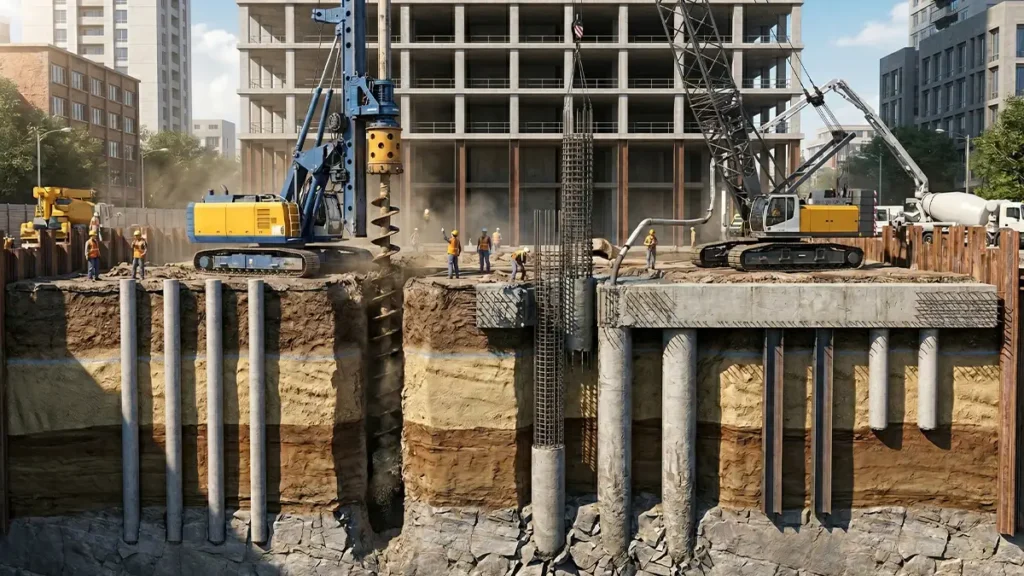
Types of Piling Foundations in Construction: Complete Guide
Introduction
A strong structure starts with a strong foundation. In many construction projects, the surface soil may not be strong enough to carry the load of the building. This is where piling foundations are used.
A piling foundation is a type of deep foundation that transfers the load of a structure to stronger soil or rock layers below the ground. It is commonly used in high-rise buildings, bridges, industrial projects, commercial spaces, and infrastructure developments.
Understanding the different types of piling foundations helps in choosing the right foundation system based on soil condition, load requirement, site location, and construction needs.
What Is a Piling Foundation?
A piling foundation uses long structural elements called piles. These piles are placed deep into the ground to support the structure above.
Piles transfer load in two main ways:
End bearing: The pile transfers the building load to a hard layer of soil or rock at the bottom.
Skin friction: The pile transfers load through friction between the pile surface and the surrounding soil.
In many projects, piles work through a combination of both methods.
Types of Piling Foundations
1. End Bearing Piles
End bearing piles transfer the load of a structure to a strong soil or rock layer deep below the surface. These piles act like columns that carry the load downward.
They are often used for heavy structures such as bridges, towers, high-rise buildings, and industrial foundations.
2. Friction Piles
Friction piles transfer load through the friction developed between the pile surface and the soil around it. These piles are useful when a strong bearing layer is too deep to reach easily.
They are commonly used in soft clay, loose sand, and compressible soil conditions.
3. Driven Piles
Driven piles are prefabricated piles that are pushed or hammered into the ground using piling equipment. They can be made from concrete, steel, or timber.
These piles are often used in bridges, marine structures, and large infrastructure projects. However, noise and vibration during installation may need to be considered in urban areas.
4. Bored Piles
Bored piles are constructed by drilling a hole into the ground, placing steel reinforcement, and filling it with concrete.
They are widely used in high-rise buildings, metro projects, commercial complexes, and bridge foundations. Since they create less vibration than driven piles, they are suitable for many city-based projects.
5. Cast-in-Situ Piles
Cast-in-situ piles are made directly at the construction site. A hole is created in the ground, reinforcement is placed, and concrete is poured to form the pile.
These piles are useful where pile length, diameter, and reinforcement need to be adjusted according to site conditions.
6. Precast Concrete Piles
Precast concrete piles are manufactured before being brought to the construction site. Once ready, they are driven into the ground.
They offer consistent quality because they are made in controlled conditions. These piles are often used in bridges, industrial projects, and infrastructure works.
7. Steel Piles
Steel piles are made using steel sections such as pipes or H-sections. They are strong, durable, and suitable for deep foundations.
They are commonly used in ports, marine projects, bridges, and heavy industrial structures. In coastal or aggressive environments, corrosion protection is usually considered during design.
8. Timber Piles
Timber piles are made from treated wood. They are generally used for lighter structures, temporary works, or specific waterlogged conditions.
Although they are not as common in modern large-scale construction, they still have use in selected applications.
9. Composite Piles
Composite piles are made using two or more materials, such as concrete and steel. They are used when different soil layers or exposure conditions require different material performance.
These piles are useful in complex site conditions, especially in marine or infrastructure projects.
10. Sheet Piles
Sheet piles are mainly used to retain soil or water. They form a continuous wall and are commonly used in basements, retaining walls, cofferdams, riverbanks, and waterfront construction.
Unlike regular foundation piles, sheet piles are often used for support and protection during excavation or water-retaining works.
11. Screw Piles
Screw piles, also called helical piles, have spiral plates attached to a steel shaft. They are rotated into the ground like a screw.
They are used in light structures, solar projects, modular buildings, temporary works, and sites where quick installation is helpful.
12. Micropiles
Micropiles are small-diameter piles reinforced with steel and grout. They are useful where space is limited or where existing foundations need strengthening.
They are often used in repair works, retrofitting, bridge rehabilitation, and restricted urban sites.
13. Under-Reamed Piles
Under-reamed piles have enlarged bulb-shaped sections near the base. These bulbs improve load transfer and help resist movement in certain soil conditions.
They are commonly used in expansive soils, such as black cotton soil, where moisture changes can affect the ground.
Role of Steel in Piling Foundations
In reinforced concrete piles, steel reinforcement helps handle tensile stress, bending, and lateral forces. Reinforcement cages are commonly used in bored piles, cast-in-situ piles, and pile caps.
Using quality TMT bars supports the strength and durability of foundation systems. ET TMT bars from Electrotherm Steel are designed for residential, commercial, and infrastructure construction, making them suitable for projects where reliable reinforcement is important.
Conclusion
Piling foundations are an important part of construction when surface soil is weak or when a structure needs deeper support. Different types of piling foundations, such as end bearing piles, friction piles, bored piles, driven piles, steel piles, micropiles, and under-reamed piles, serve different purposes based on soil and structural requirements.
The right pile foundation depends on soil condition, load demand, groundwater level, site access, and engineering design. Along with correct execution, quality reinforcement also plays a key role in creating strong and stable foundations.