
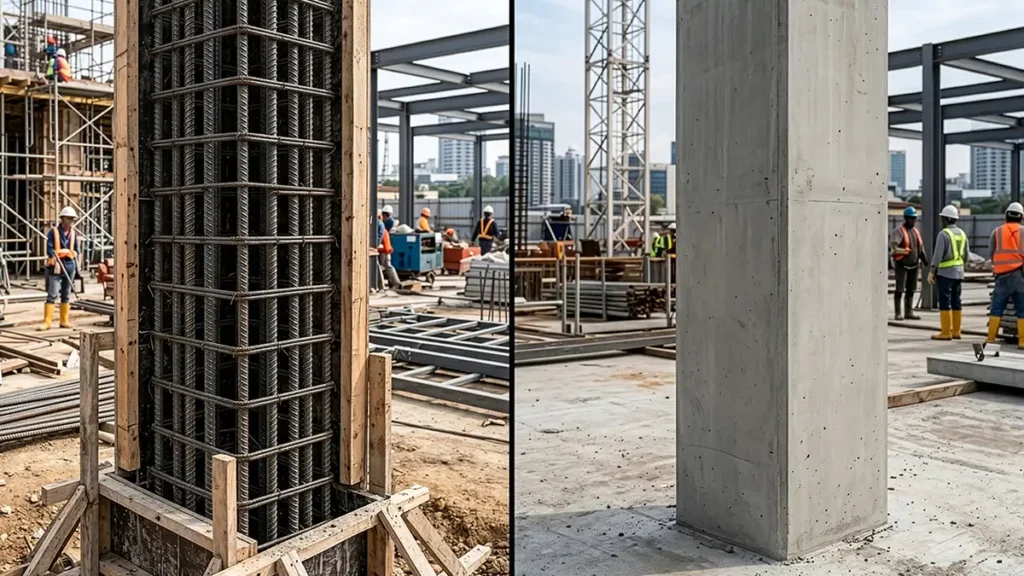
When you look at any building – whether it’s a house, mall, or skyscraper – what you don’t see is often what matters most. Hidden inside the concrete columns is a powerful system called column reinforcement, which plays a crucial role in keeping structures strong, stable, and safe.
In this beginner’s guide, we’ll break down what column reinforcement is, why it matters, its types, and how it works in modern construction.
What Is Column Reinforcement?
Column reinforcement refers to the steel bars (rebars) embedded inside concrete columns to enhance their strength and durability.
Concrete is naturally strong in compression but weak in tension. To overcome this limitation, steel reinforcement is added to carry tensile forces and improve structural performance.
In simple terms:
Concrete handles the weight
Steel reinforcement handles the stress
Together, they form reinforced concrete columns, which are essential load-bearing elements in buildings.
Why Is Column Reinforcement Important?
Columns are the backbone of any structure. They transfer loads from slabs, beams, and roofs down to the foundation.
Without proper reinforcement, columns can crack, deform, or even collapse.
Key benefits of column reinforcement:
- Increases strength and load-bearing capacity
- Prevents cracking and structural failure
- Improves resistance to earthquakes and wind loads
- Enhances durability and lifespan of buildings
- Controls expansion and shrinkage of concrete
In short, reinforcement ensures safety, stability, and long-term performance.
Types of Column Reinforcement
Column reinforcement isn’t just about adding steel – it’s about placing the right type in the right way.
1. Longitudinal Reinforcement (Vertical Bars)
These are the main steel bars placed vertically inside the column.
- Carry the primary load
- Provide axial strength
- Improve stiffness
2. Lateral Reinforcement (Ties or Stirrups)
These are horizontal or spiral reinforcements that:
- Hold vertical bars in position
- Prevent buckling
- Control cracking due to expansion
When lateral reinforcement is provided using ties, the column is called a tied column, while a continuous spiral results in a spiral column.
Common Types of Reinforced Columns
Depending on reinforcement style and design, columns are classified into:
✔ Tied Columns
- Most commonly used
- Reinforced with separate ties at intervals
- Suitable for residential and commercial buildings
✔ Spiral Columns
- Use continuous helical reinforcement
- Offer better confinement and ductility
- Ideal for high-load or seismic areas
✔ Composite Columns
- Combine steel and concrete for higher strength
- Used in heavy infrastructure projects
Key Components of Column Reinforcement
A properly reinforced column includes:
- Rebars (TMT bars): Provide tensile strength
- Ties/Stirrups: Prevent buckling and hold bars together
- Clear Cover: Protects steel from corrosion
- Lap Splices: Ensure continuity of reinforcement
Each element plays a vital role in ensuring the column performs efficiently under load.
Basic Rules for Column Reinforcement
While exact specifications depend on standards like IS 456, some general guidelines include:
- Proper spacing between bars
- Adequate concrete cover (usually ~40 mm)
- Correct lap length for load transfer
- Use of high-quality steel (like TMT bars)
- Accurate alignment during construction
Mistakes like improper spacing or low-quality steel can significantly reduce structural safety.
How Column Reinforcement Works
When a load is applied:
- Concrete carries compressive forces
- Steel reinforcement resists tensile forces
- Lateral ties prevent expansion and cracking
This combination creates a balanced structural system capable of handling both vertical and lateral stresses.
Role of High-Quality Steel in Column Reinforcement
The quality of reinforcement steel directly impacts the performance of columns.
High-grade TMT bars:
- Provide better bonding with concrete
- Offer higher strength and flexibility
- Improve resistance to corrosion and seismic forces
For construction projects, choosing trusted steel manufacturers like Electrotherm Steel ensures reliability, consistency, and long-term durability.
Conclusion
Column reinforcement is one of the most critical aspects of modern construction. It transforms simple concrete into a high-strength structural element capable of supporting massive loads and resisting environmental forces.
Whether you’re building a home or a high-rise structure, understanding column reinforcement helps you make smarter, safer construction decisions.