
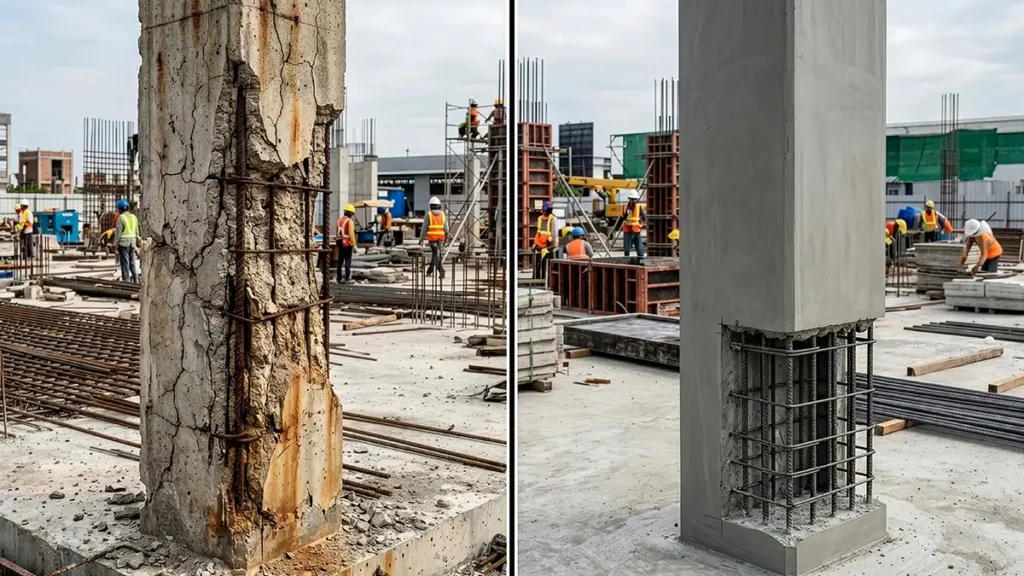
Reinforced Cement Concrete (RCC) columns are the backbone of any structure, carrying loads safely from slabs and beams to the foundation. However, cracks in RCC columns are a common concern that can compromise structural integrity, durability, and safety if not addressed early.
In this blog, we explore the causes of RCC column cracks, practical prevention techniques, and the role of proper reinforcement using high-quality steel in ensuring long-lasting performance.
Why Do RCC Columns Crack?
Cracks in RCC columns occur due to multiple factors ranging from design flaws to environmental exposure. While minor cracks may not always be dangerous, structural cracks demand immediate attention.
1. Shrinkage and Temperature Effects
Concrete naturally shrinks as it cures and undergoes expansion and contraction due to temperature changes. These movements generate internal stresses, leading to cracks.
2. Poor Concrete Quality
Incorrect mix proportions, high water-cement ratio, or inadequate compaction can result in porous concrete, making it more vulnerable to cracking.
3. Corrosion of Reinforcement
When steel reinforcement corrodes, it expands and creates internal pressure, causing cracks and even spalling of concrete.
4. Insufficient Reinforcement or Cover
Improper reinforcement detailing or inadequate concrete cover exposes steel bars to environmental elements, accelerating deterioration.
5. Overloading and Structural Stress
Excess loads beyond design capacity can induce tensile stresses, leading to structural cracks in columns.
6. Poor Construction Practices
Errors such as improper curing, misaligned reinforcement, and inadequate supervision during casting can significantly increase crack formation.
Types of Cracks in RCC Columns
Understanding crack types helps in identifying their severity and treatment approach:
- Hairline Cracks – Surface-level and usually non-structural
- Shrinkage Cracks – Occur during early curing stages
- Structural Cracks – Due to load or design failure (serious concern)
- Corrosion Cracks – Caused by rusting reinforcement
RCC Column Crack Prevention: Best Practices
Preventing cracks is always more effective and economical than repairing them later. Here are key strategies:
1. Use High-Quality Steel Reinforcement
The strength and durability of RCC columns heavily depend on the quality of reinforcement steel. Using high-strength TMT bars ensures:
- Better tensile strength
- Improved bonding with concrete
- Resistance to corrosion
High-grade steel like Fe500/Fe550 TMT bars plays a crucial role in minimizing crack formation.
2. Ensure Proper Mix Design
- Maintain an optimal water-cement ratio
- Use quality aggregates and cement
- Avoid excess water, which weakens concrete
3. Adequate Concrete Cover
Providing sufficient concrete cover protects reinforcement from moisture, chlorides, and environmental exposure – reducing corrosion risks.
4. Correct Reinforcement Detailing
Proper placement, spacing, and anchorage of rebars help distribute stresses evenly and control crack widths.
5. Effective Curing Practices
Proper curing prevents rapid moisture loss and ensures:
- Improved strength development
- Reduced shrinkage cracks
6. Control Structural Loads
Ensure that the structure is designed for expected loads and avoid overloading during usage.
7. Use Expansion Joints and Planning Techniques
Strategic placement of joints and structural layout planning allows controlled movement, reducing crack formation.
Reinforcement Techniques to Control Cracking
Even with preventive measures, some cracking is inevitable in concrete. The goal is to control crack width and distribution, not eliminate cracks entirely.
Key Reinforcement Strategies:
1. Minimum Reinforcement Ratio
Providing the required minimum reinforcement ensures that cracks remain fine and distributed rather than large and concentrated.
2. Use of High-Ductility TMT Bars
Ductile reinforcement absorbs stress effectively and prevents sudden brittle failure.
3. Corrosion-Resistant Steel
Modern TMT bars with anti-corrosive properties increase the lifespan of RCC columns in aggressive environments.
4. Proper Anchorage and Lapping
Correct lapping lengths and anchorage improve load transfer and structural stability.
Repair Methods for RCC Column Cracks
If cracks appear, timely repair is essential:
- Epoxy Injection – For structural cracks
- Grouting – To fill voids and restore integrity
- Surface Sealing – For minor cracks
- Cathodic Protection – To prevent further corrosion
Why Steel Quality Matters in RCC Columns
The performance of RCC structures is directly linked to the quality of reinforcement steel used. Inferior steel can lead to:
- Early corrosion
- Reduced load-bearing capacity
- Increased crack formation
Using trusted steel manufacturers like Electrotherm Steel ensures:
- Consistent quality
- Superior strength
- Long-term durability
Conclusion
Cracks in RCC columns are not just cosmetic – they can signal deeper structural issues. By focusing on proper design, quality materials, and advanced reinforcement techniques, engineers and builders can significantly reduce the risk of cracking.
Investing in high-quality TMT steel and best construction practices is the key to building structures that stand strong for decades.