
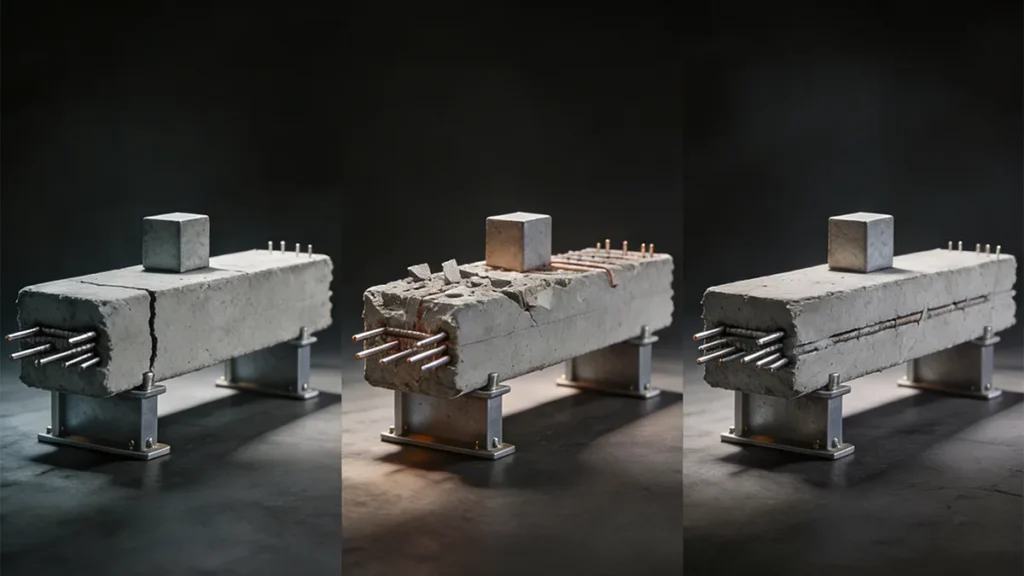
When it comes to structural engineering, beams play a critical role in supporting loads and ensuring the stability of a building or infrastructure. However, like any material, beams are susceptible to various types of failure, especially when subjected to excessive loads or improper design. One of the most common failures that engineers deal with is shear failure, which can significantly compromise the integrity of a structure.
In this blog, we’ll explore the different types of shear failure in beams, including diagonal tension, shear compression, and other related issues. Let’s dive into the world of structural safety and see why understanding these failures is essential for ensuring the long-term performance of any construction project. If you haven’t already, check out our previous post Shear Failure in Beams: Causes, Types, Prevention & Structural Design Solutions for an in-depth look at the causes and prevention techniques for shear failure in beams.
1. Diagonal Tension Failure (Shear Cracking)
Diagonal tension failure, often referred to as shear cracking, is one of the most common shear failures seen in beams. This occurs when a beam is loaded in such a way that the shear stress at certain points exceeds the material’s capacity to resist tension. When this happens, cracks form diagonally across the beam, typically at an angle of 45 degrees.
This type of shear failure is most commonly seen in beams without adequate shear reinforcement or in beams with large spans. The cracks can spread rapidly, weakening the beam’s structural capacity and potentially leading to failure if left untreated.
Preventive Measures:
To prevent diagonal tension failure, engineers often add shear reinforcement like stirrups or ties to the beam. These reinforcements help absorb the diagonal tensile stresses, keeping the beam’s integrity intact.
2. Shear Compression Failure
Shear compression occurs when the shear stress in a beam leads to the compression of the material at certain points, typically near the supports or under concentrated loads. This compression results in the crushing of the concrete or the buckling of the steel reinforcement, both of which weaken the beam.
Unlike diagonal tension failure, which occurs due to tensile stresses, shear compression failure arises from compressive forces combined with shear stresses. The material’s ability to withstand compressive forces is a key factor in preventing this type of failure.
Preventive Measures:
Proper beam design, including the selection of high-strength materials and the strategic placement of reinforcement, can prevent shear compression failure. Ensuring that the beam is adequately supported along its length will also help in distributing the forces more evenly.
3. Shear and Flexural Failure (Combined Failure)
In some cases, shear and flexural failure can occur simultaneously. This combined failure happens when the shear force exceeds the beam’s capacity to resist both shear and bending stresses. Typically, the failure begins at the point where the bending stress is highest (usually near the support) and extends diagonally along the beam.
This type of failure can be particularly dangerous because it combines the effects of both shear and bending, leading to a rapid degradation of the beam’s overall strength.
Preventive Measures:
To mitigate the risk of combined shear and flexural failure, it is essential to properly design beams to handle both shear and bending moments. This involves choosing the right material properties, ensuring proper reinforcement, and optimizing the beam’s geometry.
4. Web Crushing Failure
Web crushing failure occurs in the web of the beam (the vertical portion between the top and bottom flanges) when the shear force exceeds the compressive strength of the concrete or steel. This results in the crushing of the web material, weakening the beam and potentially causing a structural collapse.
Web crushing is typically observed in deep beams where the shear force is concentrated in a small area. In these cases, the depth of the beam and the material used in the web must be carefully considered.
Preventive Measures:
Web crushing can be prevented by increasing the size of the beam’s web or by using higher-strength materials in the web. Proper reinforcement placement, especially along the web area, can also help resist compressive forces and prevent crushing.
5. Fatigue Shear Failure
Over time, beams that are subjected to repeated loading and unloading cycles may develop fatigue shear failure. This occurs when the beam undergoes cyclical stresses that gradually weaken the material, leading to shear cracks and eventual failure.
Fatigue shear failure is more common in beams subjected to dynamic loads, such as in bridges or buildings with heavy foot traffic. The repetitive nature of the loads can cause microscopic cracks to form, which eventually grow and lead to failure.
Preventive Measures:
To avoid fatigue shear failure, engineers must design beams to handle dynamic loads appropriately. Using materials that are resistant to fatigue, such as high-strength steel or reinforced concrete, and ensuring proper maintenance and inspection of structures can help minimize the risk of fatigue-related failures.
6. Punching Shear Failure
Punching shear failure happens when a concentrated load (such as a column or a heavy machinery base) is applied to a beam, causing a localized failure in the concrete around the area of the load. The force causes the beam to “punch through” the material, creating a shear failure at the point of contact.
This type of failure is more common in slabs or beams with high point loads. The failure can spread quickly and may lead to catastrophic structural damage if not properly addressed.
Preventive Measures:
To prevent punching shear, designers often use larger beam sections, increase the depth of the slab, and place additional reinforcement around the concentrated load areas. Careful load distribution and material selection also play a significant role in mitigating punching shear failure.
Conclusion
Shear failure in beams is a serious concern that requires careful attention during the design and construction phases. By understanding the different types of shear failure—such as diagonal tension, shear compression, and more—engineers can take the necessary precautions to ensure the safety and longevity of a structure. Using quality materials, adding proper reinforcements, and following best practices in design are key strategies in preventing shear failure and enhancing the performance of beams.
For a reliable source of high-quality steel reinforcement, such as TMT bars, consider Electrotherm’s ET TMT. With advanced technology and stringent quality control processes, Electrotherm offers superior strength and durability, ensuring the resilience of your structural projects.
By considering all these factors and incorporating robust safety measures, you can ensure that your structures remain strong, reliable, and safe for years to come.