
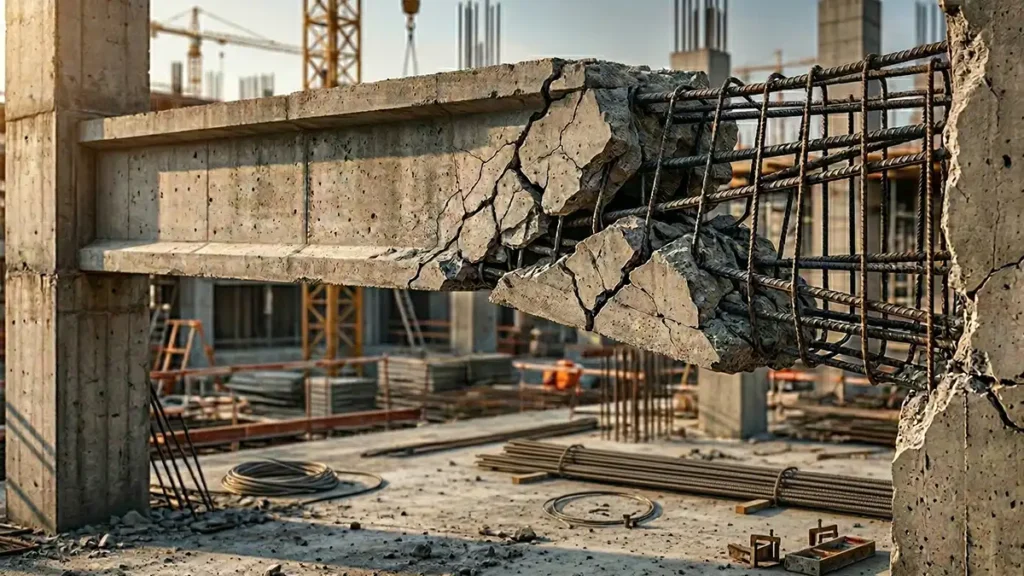
Beams are fundamental structural elements in buildings, bridges, flyovers, and almost every civil construction project. When loads are applied, beams resist bending and shear forces to keep a structure safe and stable. However, if these forces exceed the beam’s capacity – especially shear forces – shear failure can occur, sometimes suddenly and without much warning. Understanding this failure mode is crucial for designers, builders, and anyone involved in construction.
What is Shear Failure in Beams?
In simple terms, shear failure happens when the internal forces trying to slide one part of a beam past another become too high for the material to resist. This typically results in diagonal cracks near the supports of the beam. Unlike bending (flexural) failure, which often shows visible deflection and warning signs, shear failure can be brittle and sudden.
Shear forces arise because of vertical loads like people, furniture, vehicles, or equipment and act perpendicular to the beam’s axis. While all structural elements must be designed to resist both bending and shear, shear capacity is particularly critical near supports and concentrated load points.
Why Shear Failure Matters in Construction
Shear failure is dangerous because it can occur rapidly and without much visible deformation. In reinforced concrete beams, the concrete itself is inherently weak in shear compared to its compressive strength, making it essential to rely on steel reinforcement like ET TMT bars – to help carry shear stresses safely.
That’s where high‑quality TMT reinforcement plays a vital role. ET TMT bars are engineered with superior ductility, strength, and consistent mechanical properties – thanks to controlled thermo‑mechanical treatment and strict quality standards making them excellent for resisting not just bending but also shear and dynamic loads in beams and slabs.
Common Types of Shear Failure in Beams
Structural engineers identify several shear failure modes, depending on how and where the beam fails:
1. Diagonal Tension Failure
This is the most typical shear failure. A crack starts near the lower part of the beam close to a support and propagates diagonally upwards toward the load point. It happens when the shear demand overwhelms the beam’s shear resistance.
2. Diagonal Compression Failure
In this case, cracking occurs at a steeper angle – often between supports and mid‑span – due to simultaneous high compression and shear forces. It typically occurs in beams with high shear reinforcement but still overloaded beyond capacity.
3. Splitting Shear (True Shear)
Seen often in deep beams, this mode arises when shear forces are transmitted directly to the supports with little opportunity for bending. The compression zone adjacent to the support cracks and fails.
Each failure mode is linked to how loads and reinforcement are arranged. Recognizing these patterns on site is a key part of assessing potential structural issues.
Root Causes of Shear Failure
Shear failure doesn’t usually happen in isolation – it’s often the result of design, material, or construction insufficiencies:
- Inadequate shear reinforcement: Without enough stirrups or properly placed transverse bars, shear cracks can grow unchecked.
- Design miscalculations: If the anticipated shear forces are underestimated, the beam may lack enough reserve capacity.
- High or concentrated loads near supports: Point loads or closely spaced loads increase shear significantly, particularly near supports.
- Poor material quality: Weak concrete mix, low‑grade steel, or inconsistent reinforcement quality makes beams less capable of resisting shear forces.
Prevention & Structural Design Solutions
To avoid shear failure in beams, the approach must be both design‑centric and execution‑oriented:
1. Adequate Shear Reinforcement
Transverse reinforcement (stirrups or bent‑up bars) is designed to carry shear stresses that concrete alone cannot. High‑quality TMT bars like those from ET TMT ensure strong, ductile reinforcement that holds up under shear demands.
2. Proper Shear Capacity Checks in Design
Engineers must evaluate shear force diagrams and ensure section capacity is well above expected demands – especially at supports and load introduction points.
3. High‑Quality Materials
Using certified TMT reinforcement such as ET TMT bars – manufactured with strict quality control and refined steel – improves reliability and structural resilience across load cases.
4. Attention to Construction Practices
Even the best design can fail if stirrups are poorly placed, tied loosely, or if concrete compaction is inadequate. Field supervision and quality checks are essential.
Why Choosing Quality TMT Bars Matters
Steel reinforcement isn’t just about tensile strength – it also contributes to ductility, load redistribution, and crack control. ET TMT bars are produced using a rigorous thermo‑mechanical process that yields a tough outer surface and ductile core, making them ideal for resisting dynamic and shear stresses in reinforced concrete beams.
With certified grades like Fe 500, Fe 500 D, Fe 550 and Fe 600, and options like epoxy‑coated or cut & bend bars, ET TMT provides designers and builders the flexibility to choose the right reinforcement for every beam type and load condition.
Conclusion
Shear failure in beams is a serious structural concern but it’s also highly manageable with correct design, quality materials, and sound construction practice. Reinforced concrete beams must be designed with careful attention to shear forces near supports and load points. By combining smart structural design with reliable reinforcement like ET TMT bars, builders can minimize risk, enhance safety, and deliver structures that stand strong for generations.