
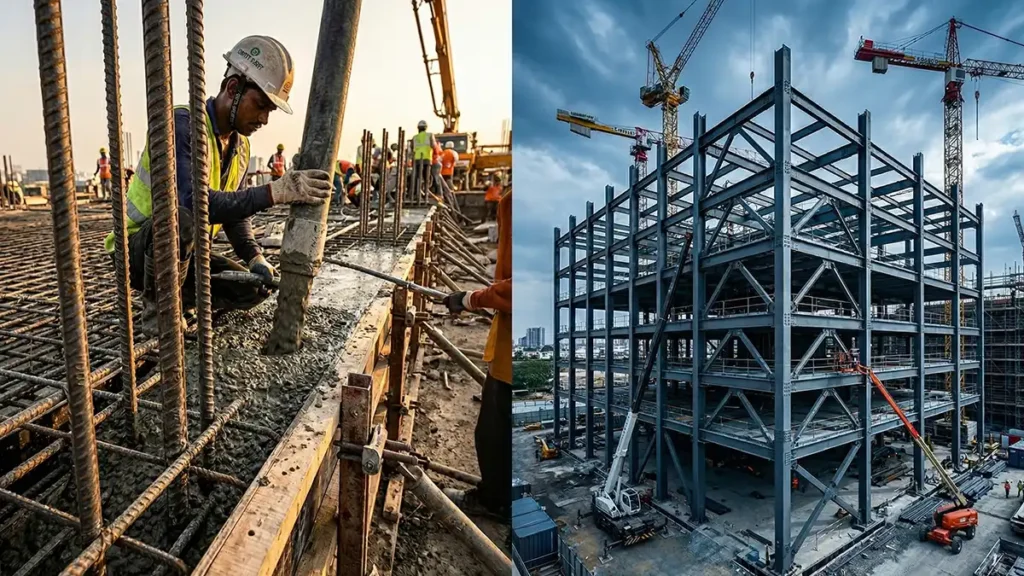
When it comes to building anything from your dream home to large infrastructure, one question that always comes up early is: what’s the best steel for construction? Two contenders often come into focus – TMT bars and structural steel. Each has a role to play, but understanding where and why you should use one over the other can make all the difference in strength, durability, and long‑term performance.
In this article, we’ll break down both materials in a clear and practical way – helping you choose the right steel for your next project.
What Is TMT Steel and Why It Matters in Construction?
TMT stands for Thermo‑Mechanically Treated steel bars. These are rebars made through advanced processes that give the bar a highly strong outer surface and a ductile core that bends without breaking.
At ET TMT, we produce a range of TMT bars – from CRS to refined and epoxy‑coated variants – each designed to meet specific structural demands and environmental conditions.
Why TMT Bars Are Strong and Reliable:
- High tensile strength and ductility: Better resistance against tension and bending.
- Superior bonding with concrete: Ribbed surface helps concrete grip tightly.
- Earthquake‑friendly: Ductility lets the structure absorb shock without brittle failure.
- Corrosion protection options: Epoxy‑coated variants enhance lifespan in harsh environments.
In reinforced concrete construction (RCC), these attributes make TMT bars the go‑to steel choice for columns, beams, slabs, foundations, and walls.
What Is Structural Steel?
Unlike TMT bars which are mainly long rods, structural steel refers to engineered steel shapes such as I‑beams, channels, angles, columns, and hollow sections used in load‑bearing frameworks of buildings and industrial structures.
These are typically used in steel frame construction – where the building skeleton is exposed steel rather than reinforced concrete.
Key features of structural steel:
- High load‑bearing capacity
- Versatile shapes and sizes
- Quick assembly with bolting/welding
- Often used in industrial or large‑span spaces
Head‑to‑Head: TMT Bars vs Structural Steel
Here’s how both materials perform across key construction needs:
1. Primary Use
- TMT Bars: Ideal for RCC structures – houses, apartments, schools, and bridges where steel works with concrete.
- Structural Steel: Best for steel frame structures – warehouses, factories, long‑span halls, and some high‑rise designs.
2. Strength & Ductility
TMT bars offer a unique combination of strength and flexibility thanks to their thermo‑mechanical treatment, making them well‑suited for withstanding dynamic forces (like earthquakes). Structural steel is also strong but behaves differently due to its shape and application.
3. Construction Speed
Structural steel elements can be fabricated off‑site and assembled rapidly, reducing on‑site time. TMT bar – reinforced concrete requires formwork and curing time, which can extend schedules slightly.
4. Corrosion and Finish
TMT bars – especially epoxy‑coated variants – resist corrosion inherently better than ordinary steel. Structural steel needs protective painting or galvanization to prevent rust.
5. Cost Considerations
TMT bars are generally cost‑effective for typical building projects due to simpler fabrication and installation in concrete. Structural steel frames can be more expensive due to precision fabrication, welding, and protective coatings.
When to Choose What? (Practical Scenarios)
Choose TMT Bars if:
- You are building homes, apartments, or commercial buildings with reinforced concrete.
- Earthquake resilience and long‑term durability are critical.
- You prefer a steel option that integrates seamlessly with concrete.
This is where ET TMT bars shine – engineered to meet stringent strength and safety standards and trusted by major infrastructure players across India.
Choose Structural Steel if:
- Your project is a pre‑engineered building (PEB), warehouse, hangar, or industrial structure.
- You need large clear spans without internal columns.
- Speed of erection and modular adaptability are priorities.
Final Verdict: Best Steel for Construction
There’s no one‑size‑fits‑all answer – the best steel depends on your project type.
For reinforced concrete structures –TMT bars are generally the preferred choice due to their strength, ductility, and reliable performance with concrete.
Structural steel, however, remains indispensable for steel frame constructions that demand unique shapes and rapid assembly.
Conclusion
Choosing the right steel can make the difference between a structure that withstands the test of time and one that doesn’t. Whether it’s the backbone strength of ET TMT bars for your RCC project or the engineered versatility of structural steel for frame builds, understanding your needs ensures you make the safest, most cost‑effective choice.