
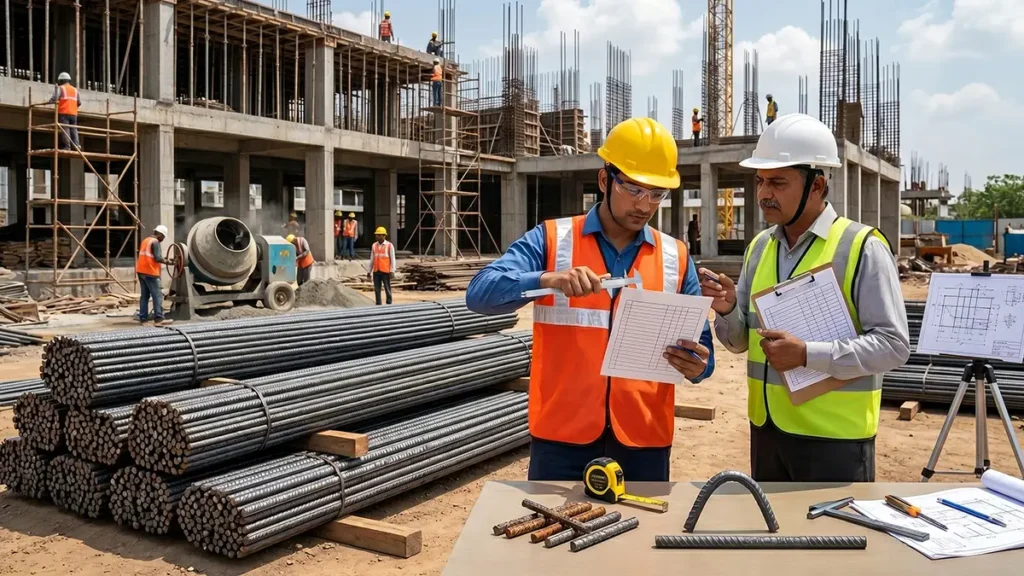
TMT bars form the backbone of any reinforced concrete structure. Whether it is a home, commercial building, bridge, industrial project or infrastructure development, the quality of reinforcement steel plays an important role in the strength, stability and service life of the structure.
For many buyers, TMT bars may look similar from the outside. But the actual difference lies in their grade, ductility, corrosion resistance, chemical composition, bonding ability and quality control. Choosing the right TMT bars is not only about price; it is about understanding what goes inside the structure and how it performs over time.
Here are the top qualities of good TMT bars to look for before making a purchase.
1. Correct Grade for the Project
The grade of a TMT bar indicates its strength level. Common grades used in construction include Fe 500, Fe 500D, Fe 550, Fe 550D and Fe 600. Each grade has a different role depending on the type of structure, load requirement and project design.
For residential construction, Fe 500 and Fe 500D are commonly preferred because they offer a balance of strength and ductility. For larger infrastructure and heavy-load projects, higher grades may be considered based on the engineer’s recommendation.
The “D” in grades like Fe 500D and Fe 550D indicates improved ductility. This means the bar has better elongation properties, which helps it absorb stress and deformation more effectively. For areas where structural flexibility is important, ductile grades can be a practical choice.
2. High Strength with Good Ductility
Strength is important, but strength alone is not enough. A good TMT bar also needs ductility. Ductility allows the steel to bend or stretch to a certain extent without breaking suddenly.
In construction, this matters because structures are exposed to different types of loads, including dead loads, live loads, wind pressure, vibrations and occasional impact. TMT bars with good ductility help the structure respond better to stress.
A quality TMT bar offers a reliable combination of yield strength, tensile strength and elongation. This balance helps the structure stay strong while also allowing controlled flexibility.
3. Better Corrosion Resistance
Corrosion is one of the major reasons behind long-term damage in reinforced concrete structures. When steel starts rusting inside concrete, it expands and can create cracks, weakening the structure over time.
Good TMT bars are designed to resist corrosion better, especially in areas exposed to moisture, humidity, chemicals or coastal conditions. Corrosion-resistant steel, also known as CRS TMT bars, can be a suitable option for such environments.
For projects near marine areas, industrial zones or locations with high moisture exposure, corrosion resistance becomes an important quality to consider. Epoxy-coated TMT bars can also be considered where additional protection against corrosive elements is required.
4. Strong Bonding with Concrete
TMT bars and concrete work together in reinforced cement concrete structures. For this combination to perform well, the steel bar needs to bond properly with concrete.
Good TMT bars have a ribbed surface pattern that improves grip with concrete. This rib structure helps transfer load more efficiently between steel and concrete. A stronger bond reduces the chances of slippage and supports better structural performance.
While checking TMT bars, the ribs should appear uniform and well-defined. Poor rib formation can affect bonding and may reduce reinforcement efficiency.
5. Consistent Size and Weight
TMT bars are available in different diameters such as 8 mm, 10 mm, 12 mm, 16 mm, 20 mm and higher sizes depending on project needs. A good quality bar maintains consistency in diameter, length and weight.
Inconsistent size can affect design calculations, steel consumption and overall construction quality. Reliable manufacturers follow controlled production processes to maintain uniformity across batches.
Before buying, it is useful to check whether the bars match the required diameter and weight tolerance. This helps avoid unnecessary wastage and supports accurate material planning at site.
6. Low Impurities and Controlled Composition
The quality of steel depends heavily on its chemical composition. Excess impurities such as sulphur and phosphorus can affect strength, ductility and weldability.
Good TMT bars are made through controlled manufacturing processes where the composition is monitored carefully. Lower impurity levels help improve the overall performance of the bar and reduce the chances of brittleness.
This is where refined steel and proper testing become important. Bars made with controlled raw material selection and quality checks offer better consistency from batch to batch.
7. Bendability and Workability at Site
During construction, TMT bars are cut, bent and shaped as per structural drawings. Good TMT bars allow bending without cracking or breaking. This makes on-site work easier and supports accurate reinforcement placement.
Bendability is especially important for stirrups, hooks, beams, columns and slab reinforcement. Bars that are too brittle can create difficulties during fabrication and may affect construction quality.
A good TMT bar offers both strength and workability, making it suitable for practical site conditions.
8. Weldability Where Required
In some construction applications, steel bars may need welding. Not every project requires welded reinforcement, but where it is needed, weldability becomes an important factor.
TMT bars with controlled carbon content and low impurities generally offer better weldability. This allows stronger joints and safer fabrication when welding is part of the project requirement.
It is always better to follow the structural engineer’s guidance before welding reinforcement bars at site.
9. Clean Surface Finish
The surface of a TMT bar can tell a lot about its quality. Good TMT bars usually have a clean and uniform surface, without visible cracks, deep rust, oil, paint, loose scales or surface defects.
A small amount of superficial rust may appear during storage or transportation, especially in humid conditions. However, heavy rusting, flaking or pitting can affect the bonding of steel with concrete and needs careful evaluation.
Before purchasing, it is worth inspecting the physical condition of the bars and checking how they have been stored.
10. Proper Testing and Certification
Quality TMT bars go through testing for strength, elongation, bendability, re-bend performance, chemical composition and dimensional accuracy. These tests help confirm whether the bars meet the required standards for construction use.
Buyers can ask for test certificates, batch details and relevant quality documents before purchase. This adds confidence and helps verify that the material supplied matches the project requirement.
A trusted manufacturer usually follows a structured quality control process and provides clear product information.
11. Suitability for the Construction Environment
Every project has different exposure conditions. A house in a dry inland area, a building in a coastal city and an industrial project exposed to chemicals may not have the same reinforcement needs.
For normal construction, standard TMT bars may work well when selected as per design. For moisture-heavy or corrosion-prone locations, CRS TMT bars or epoxy-coated TMT bars may offer added protection.
The right choice depends on the project location, exposure level, structural design and long-term durability expectations.
12. Reliable Brand and Manufacturing Process
The brand behind the TMT bar matters because reinforcement steel becomes a permanent part of the structure. A reliable manufacturer focuses on raw material quality, manufacturing control, testing and product consistency.
ET TMT offers a range of TMT bar options such as CRS TMT bars, refined steel TMT bars, superior quality steel TMT bars, epoxy-coated TMT bars and cut & bend TMT bars. These options help buyers choose reinforcement steel based on strength, corrosion resistance, project scale and site requirement.
When buying TMT bars, it is better to look beyond short-term savings and consider long-term performance, durability and structural reliability.
Final Thoughts
Good TMT bars are identified by more than just their appearance. The grade, ductility, corrosion resistance, rib pattern, chemical composition, bendability, surface finish and testing process all play an important role in construction quality.
Before buying TMT bars, take time to check the project requirement, consult the engineer and choose a reliable brand that provides consistent quality. The right TMT bar can support a stronger, safer and more durable structure for years to come.