
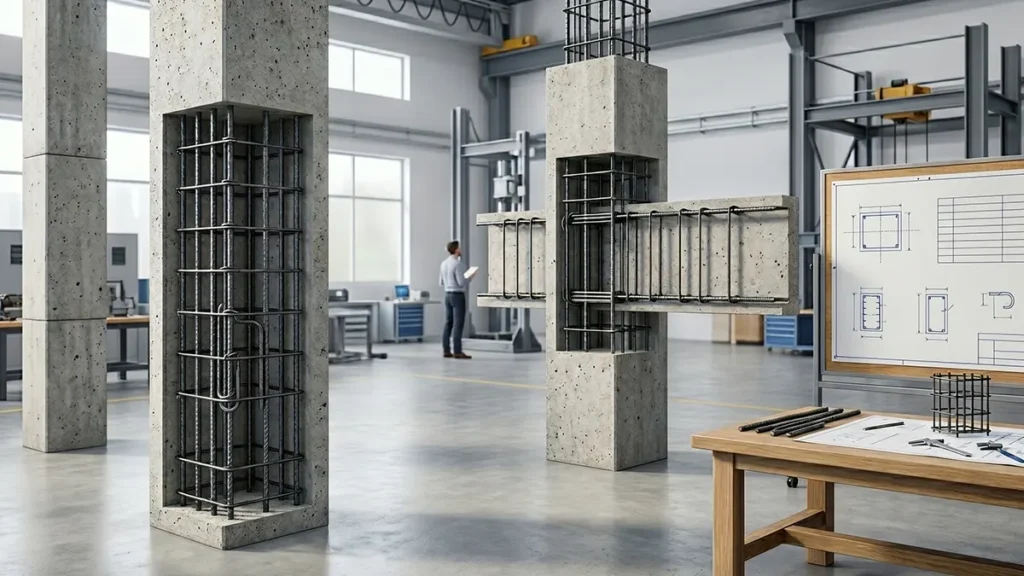
RCC columns are one of the most important structural elements in any building. They carry loads from slabs and beams and transfer them safely to the foundation. Since columns support a large part of the structure, their reinforcement detailing plays a major role in strength, stability, and long-term durability.
Concrete performs well under compression, while steel reinforcement helps the column handle tension, bending, lateral forces, and movement. When both materials work together correctly, the RCC column becomes stronger and more reliable.
RCC column reinforcement details include the size and number of vertical bars, tie spacing, concrete cover, lap length, anchorage, and placement accuracy. Along with good design, the quality of TMT bars and site workmanship also affects the final performance of the column.
What Is RCC Column Reinforcement?
RCC column reinforcement is the arrangement of steel bars placed inside a reinforced cement concrete column. It generally includes main vertical bars and lateral ties.
Longitudinal Bars
Longitudinal bars are the main vertical bars placed along the height of the column. These bars help the column resist compression, bending, and stresses caused by load movement or frame action.
Lateral Ties
Lateral ties are closed steel links placed around the vertical bars. They help hold the main bars in position, reduce the chances of bar buckling, and improve confinement of the concrete core.
Helical Reinforcement
In circular columns, spiral or helical reinforcement may be used instead of rectangular ties. It provides continuous support around the column and improves confinement.
Why RCC Column Reinforcement Details Matter
A column may be designed correctly, but poor reinforcement detailing can affect its performance on site. Correct detailing helps improve:
- Load transfer from beams and slabs to the foundation
- Stability of the column under different loads
- Bond between concrete and steel
- Ductility during lateral movement
- Control of cracks and deformation
- Protection of reinforcement from corrosion
- Quality of concrete placement and compaction
Good detailing also helps avoid common site issues such as honeycombing, bar displacement, insufficient cover, and weak lap zones.
Key Design Considerations for RCC Columns
RCC column reinforcement is planned based on different structural and site conditions.
Column Size
The size of the column depends on the load it carries, number of floors, span arrangement, and building layout. Higher loads generally require a larger column section or more reinforcement, depending on the structural design.
Concrete Grade
The grade of concrete affects the load-carrying capacity of the column. Higher grade concrete may be used in multi-storey buildings, commercial projects, and heavy-load structures based on design requirements.
Steel Grade
TMT bars used in RCC columns are selected based on strength, ductility, bendability, and project specifications. Fe 500 and Fe 500D are commonly used in RCC construction. In certain projects, higher grades or corrosion-resistant bars may be considered.
Exposure Conditions
Columns exposed to moisture, coastal air, chemicals, or aggressive environments need greater attention to cover and steel quality. Corrosion-resistant TMT bars can support better durability when used with good concrete quality and proper execution.
Seismic Requirements
In earthquake-prone zones, ductile detailing becomes important. This includes closer tie spacing in critical zones, better confinement, suitable lap locations, and proper anchorage as per the structural drawing.
Important RCC Column Reinforcement Rules
The final RCC column reinforcement details are always taken from approved structural drawings. However, some general rules are commonly followed in RCC column detailing.
1. Minimum Longitudinal Reinforcement
RCC columns require a minimum amount of longitudinal reinforcement so that the column can perform safely under load. The reinforcement percentage is kept within standard design limits to balance strength and constructability.
2. Maximum Reinforcement Limit
Using too much steel can create congestion inside the column. Congested reinforcement makes concrete placement and compaction difficult, which may lead to honeycombing or voids. A practical reinforcement layout allows concrete to flow properly around the bars.
3. Minimum Number of Bars
Rectangular columns generally have at least four longitudinal bars, usually placed near the corners. Circular columns generally have at least six longitudinal bars arranged around the perimeter.
4. Minimum Bar Diameter
The longitudinal bars used in RCC columns are generally not smaller than 12 mm in diameter. The final bar diameter depends on column size, loads, reinforcement area, and design requirements.
5. Spacing of Bars
The spacing between longitudinal bars needs to allow proper concrete flow and compaction. Very close spacing can create congestion, while very wide spacing may affect confinement and crack control.
6. Lateral Tie Spacing
Ties are placed at regular intervals along the column height. Tie spacing depends on the column dimensions, main bar diameter, and structural design. Closer spacing is often provided near beam-column joints, lap zones, and column ends.
7. Concrete Cover
Concrete cover is the distance between the outer surface of reinforcement and the outer face of the concrete. It protects steel from corrosion, fire, and environmental exposure. Proper cover blocks help maintain the required cover during concreting.
8. Lap Length
Lap splices are provided when column bars need to continue from one floor to another. Lap length and lap location depend on bar diameter, steel grade, concrete grade, and design requirements. In seismic areas, lap detailing needs extra care.
9. Anchorage and Hooks
Proper anchorage helps steel develop bond with concrete. Hooks, bends, and tie closures are detailed as per the structural drawing to keep the reinforcement cage stable and effective.
Step-by-Step RCC Column Reinforcement Detailing
Step 1: Check the Structural Drawing
The column size, bar diameter, number of bars, tie spacing, lap length, and cover details are taken from the structural drawing and bar bending schedule.
Step 2: Mark the Column Position
The column location is marked according to grid lines. Accurate marking helps avoid alignment issues with beams, slabs, and upper-floor columns.
Step 3: Place Starter Bars
Starter bars from the footing or lower floor are aligned properly before fixing the main reinforcement cage. This helps maintain continuity between levels.
Step 4: Fix Longitudinal Bars
The main vertical bars are placed according to the drawing. Corner bars and side bars are positioned with the required spacing and alignment.
Step 5: Fix Lateral Ties
Lateral ties are fixed around the main bars at the specified spacing. Extra attention is given near joints, laps, and column ends where closer ties may be shown in the drawing.
Step 6: Maintain Concrete Cover
Cover blocks are placed to keep the reinforcement away from formwork. This helps maintain uniform concrete cover around the column.
Step 7: Check Lap and Anchorage
Lap length, lap location, hooks, bends, and tie closures are checked before shuttering. Any mismatch can be corrected before concreting begins.
Step 8: Inspect Before Concreting
Before concrete is poured, the reinforcement cage is checked for bar size, number of bars, tie spacing, alignment, cover, cleanliness, and stability.
Step 9: Concrete Placement and Compaction
Concrete is placed carefully so it flows around the reinforcement. Proper compaction helps reduce voids and improves the final strength and finish of the column.
Best Practices for RCC Column Reinforcement
Use Quality TMT Bars
The strength and durability of RCC columns depend heavily on reinforcement quality. TMT bars with consistent strength, ductility, and bendability support better structural performance.
Avoid Overcrowding of Bars
Excess steel inside a column can make concreting difficult. A clean and practical reinforcement arrangement helps improve concrete flow and compaction.
Maintain Proper Tie Spacing
Tie spacing affects the stability of vertical bars and confinement of concrete. Irregular spacing can reduce the effectiveness of reinforcement detailing.
Use Correct Cover Blocks
Proper cover blocks help maintain uniform cover. Random materials such as stones, broken tiles, or wood pieces can disturb cover accuracy and are not reliable for structural work.
Follow the Bar Bending Schedule
A bar bending schedule helps reduce cutting errors, wrong placement, and steel wastage. It also improves speed and accuracy during reinforcement fixing.
Keep Steel Clean
Reinforcement should be free from mud, oil, paint, and loose rust before concreting. Clean steel helps improve the bond between concrete and reinforcement.
Check Alignment Before Shuttering
Column alignment is easier to correct before shuttering. Once formwork is fixed, adjustment becomes difficult and may affect the final column position.
Select Steel Based on Site Conditions
For regular RCC construction, good-quality TMT bars are widely used. For moisture-heavy, coastal, or corrosion-prone areas, CRS or epoxy-coated TMT bars may be considered based on project requirements.
Common Mistakes in RCC Column Reinforcement
Incorrect Concrete Cover
Less cover can expose reinforcement to corrosion and fire risk. Excess cover can also affect the effective placement of reinforcement. Maintaining the specified cover improves durability.
Wrong Tie Spacing
If ties are placed too far apart or missed in critical zones, the main bars may not receive proper lateral support. This can affect column behaviour under load.
Poor Lap Placement
Random lap locations can create weak zones in the column. Lap locations are usually shown in structural drawings and need to be followed carefully.
Misaligned Starter Bars
Starter bars that are not aligned properly can disturb the verticality of the column cage. This may lead to bending, offsets, or site-level corrections.
Reinforcement Congestion
Too many bars in a small column section can block concrete flow. This may lead to honeycombing and poor compaction.
Using Unverified Steel
Steel quality directly affects column performance. Reinforcement used on site needs to match the grade and specifications mentioned in the design.
Role of TMT Bars in RCC Column Reinforcement
TMT bars are widely used in RCC construction because they offer strength, ductility, and better bonding with concrete. In RCC columns, they help resist loads, absorb stresses, and support the structural frame.
A good TMT bar for RCC column reinforcement generally offers:
- Consistent yield strength
- Good ductility
- Better bendability
- Strong bond with concrete
- Resistance to corrosion, depending on product type
- Suitability for residential, commercial, and infrastructure projects
ET TMT offers reinforcement solutions such as Superior Quality Steel TMT Bars, CRS TMT Bars, Epoxy-Coated TMT Bars, Refined Steel TMT Bars, and Cut & Bend TMT Bars. The right option can be selected based on the project type, exposure condition, design requirement, and site application.
RCC Column Reinforcement Site Checklist
Before concreting, site teams can check the following points:
- Column size matches the drawing
- Bar diameter and number of bars are correct
- Tie diameter and spacing are as per drawing
- Cover blocks are placed properly
- Lap length and lap location are correct
- Reinforcement cage is vertical and aligned
- Ties are closed and fixed properly
- Bars are clean and free from mud or oil
- Shuttering is stable and leak-proof
- Concrete has enough space to flow around the bars
This checklist can help reduce site errors and improve the quality of RCC column construction.
Conclusion
RCC column reinforcement details play an important role in the strength, safety, and durability of a structure. Correct bar placement, tie spacing, lap length, concrete cover, and steel quality all contribute to better performance.
A reliable RCC column is the result of good structural design, accurate detailing, quality TMT bars, and careful site execution. By following approved drawings and practical reinforcement practices, builders can achieve stronger and more durable RCC construction.