
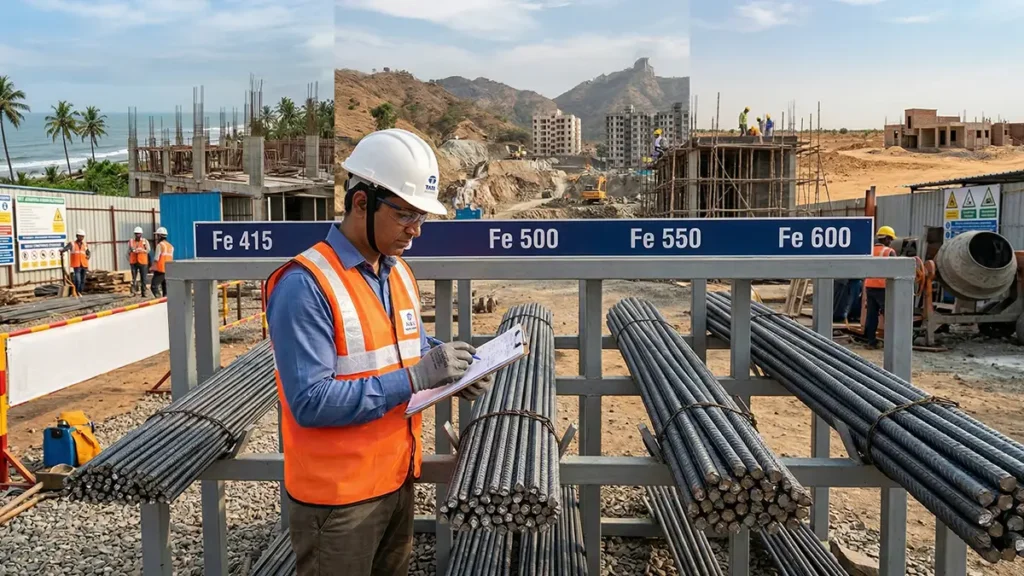
When building a structure, the rebar you choose plays a crucial role in determining its strength, durability, and safety. For construction projects in India, understanding rebar selection is essential to ensure long-lasting foundations and resilient buildings.
Whether you’re in a seismic zone in the Himalayas or a coastal area in the south, the type of rebar you choose can greatly affect the outcome of your project.
Let’s explore types of rebars, the difference between TMT and HYSD bars, and which works best for different regions of India.
What is Rebar and Why Does it Matter?
Rebar, or reinforcing bar, is used to strengthen concrete, as concrete alone is strong in compression but weak in tension. Rebar adds tensile strength and helps concrete withstand various forces, making it an essential component for any construction project.
Key Benefits of Rebar:
- Improved Structural Strength
- Prevents Cracking and Shrinkage
- Increases Durability
- Supports Load-Bearing Capacity
Types of Rebars Used in India
The most common types of rebar used in India are:
1. TMT (Thermo-Mechanically Treated) Bars
TMT bars are highly preferred in modern construction due to their superior strength, ductility, and corrosion resistance. They undergo a unique heat treatment process that makes them stronger and more flexible compared to conventional bars.
Key Features:
- High Strength: TMT bars are designed to handle higher loads and are ideal for high-rise buildings, bridges, and other large infrastructure projects.
- Corrosion Resistance: TMT bars have a hard outer surface and a soft inner core, which offers better bonding with concrete and resistance to rust and corrosion.
- Ductility: They bend without breaking, which is particularly useful in earthquake-prone areas.
TMT bars are widely used in construction for their reliability, cost-effectiveness, and long-term performance.
2. HYSD (High Yield Strength Deformed) Bars
HYSD bars are another popular type of rebar, especially in older constructions. These bars are treated to create a deformed surface, which helps them bond better with concrete.
Key Features:
- High Yield Strength: HYSD bars have high yield strength but lower ductility when compared to TMT bars.
- Harder but Less Flexible: They are known for their strength but may fail under dynamic loads like those experienced in earthquakes.
While HYSD bars are cheaper than TMT bars, they lack the flexibility and corrosion resistance needed for modern construction, especially in seismic zones or areas with high humidity.
Regional Rebar Selection Tips: What Works Best in Different Parts of India
India’s vast geographical diversity means that soil conditions, weather, and seismic activity differ from region to region. This makes rebar selection a region-specific decision.
1. North India (Himalayan Region & Urban Areas)
- Soil Type: Rocky and clayey soils
- Weather: Cold winters, heavy snowfall in the north
- Seismic Zone: High seismic risk in Himalayan regions
Best Rebar Choice: TMT Bars (Fe 500D/Fe 550). These bars provide the ductility and seismic resistance needed to withstand tremors and shifting ground in the Himalayan region.
2. Coastal Regions (West & South India)
- Soil Type: Sandy soils, high water table
- Weather: Humid, coastal air causing higher corrosion
- Seismic Zone: Low to moderate seismic activity
Best Rebar Choice: TMT Bars (Fe 500D) with corrosion-resistant properties. The corrosion resistance of TMT bars is essential in these regions, where high humidity and salt content can cause rusting in other materials.
3. Central India (Madhya Pradesh, Maharashtra)
- Soil Type: Black cotton soil (expansive soil with high shrink-swell potential)
- Weather: Hot summers, moderate winters
- Seismic Zone: Low to moderate seismic risk
Best Rebar Choice: TMT Bars (Fe 500D). These bars’ high ductility ensures that they bend without breaking, which is important in black cotton soils known for movement during the rainy season.
How to Select the Right Rebar for Your Construction Project
When buying rebar in India, follow these essential steps:
✅ Step 1: Identify Soil Conditions
Understand your region’s soil behavior. For example, black cotton soil (expansive soil) requires high ductility bars like TMT for flexibility and movement.
✅ Step 2: Consider Structural Requirements
- High-rise buildings require high-strength bars like Fe 500D or Fe 550 for strength.
- Seismic zones demand ductile TMT bars to absorb shock.
✅ Step 3: Check for ISI Mark and Certifications
Only buy ISI-certified TMT rebars to ensure compliance with Indian standards and guaranteed quality.
Conclusion: Choose Wisely for Stronger, Safer Homes
The right rebar selection is critical to the strength, durability, and safety of your construction project. By understanding soil conditions, regional challenges, and the differences between TMT and HYSD bars, you can make informed decisions.
For modern construction, ET TMT bars offer the best mix of strength, flexibility, and corrosion resistance, making them the ideal choice for seismic-resistant homes and infrastructure.