
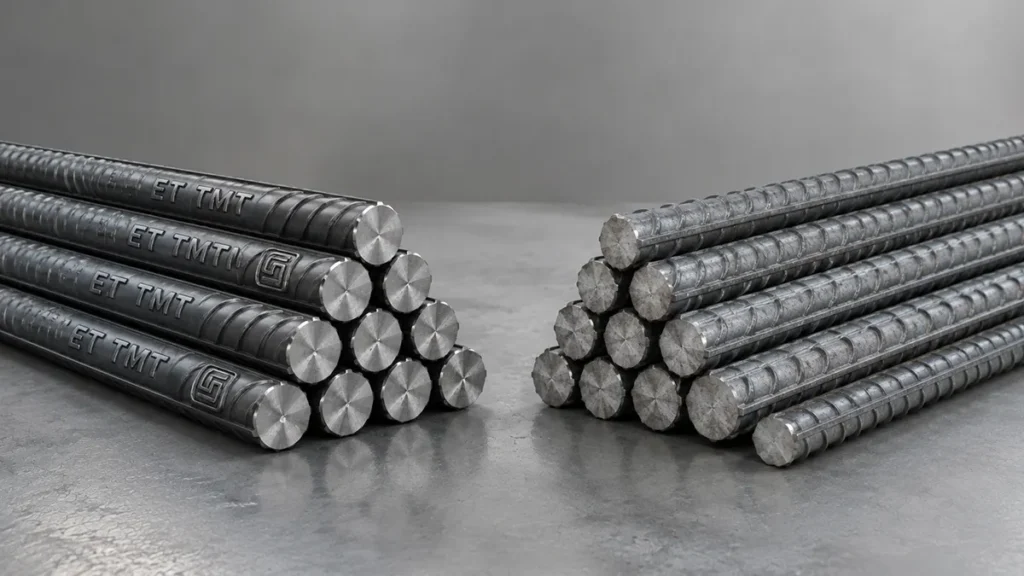
When you are building a home, commercial property, or infrastructure project, TMT steel becomes one of the most important materials going into the structure. It reinforces concrete, carries tensile forces, and contributes directly to the strength and stability of beams, columns, slabs, and foundations.
During procurement, you may come across another distinction: primary TMT steel and secondary TMT steel.
The terms can sound technical, yet the basic idea is fairly straightforward. They generally describe differences in the steelmaking route, raw-material control, manufacturing setup, and traceability. For a buyer, the more useful question is how these factors translate into the quality and consistency of the TMT bars arriving at the site.
Here is a practical look at the difference and what you should actually check before choosing TMT steel.
What Is Primary TMT Steel?
In common industry usage, primary steel generally refers to steel manufactured through an integrated and closely controlled steelmaking process. The manufacturer controls major stages of production, from preparing the steel to casting billets and rolling them into finished TMT bars.
This level of process control helps manufacturers maintain the required chemical composition and mechanical properties from one production batch to another.
For construction applications, consistency matters because engineers design reinforced concrete structures around specified properties such as:
- Yield strength
- Tensile strength
- Elongation
- Bend and rebend performance
- Chemical composition
- Carbon equivalent
- Nominal mass and dimensions
These are among the characteristics covered under the applicable BIS requirements for high-strength deformed reinforcement bars. IS 1786 specifies requirements for grades of reinforcement steel and includes testing for properties such as yield strength, tensile strength and elongation.
What Is Secondary TMT Steel?
The term secondary steel is used broadly in the market and can refer to steel produced through routes that rely more heavily on recycled metallic inputs or smaller steelmaking and rolling operations.
That distinction needs some context.
Using recycled steel as a raw material does not automatically determine the performance of the finished TMT bar. Modern steelmaking can use recycled metallic inputs effectively when chemistry, melting, refining, casting, rolling and testing are properly controlled.
For a construction buyer, the important consideration is the quality and traceability of the finished TMT steel, rather than judging a bar solely by the broad label of primary or secondary.
There is, however, an important regulatory distinction. IS 1786 states that deformed bars produced by re-rolling finished products such as plates and rails, or from material whose metallurgical history is insufficiently documented or unknown, are unacceptable under the standard.
This makes raw-material traceability and manufacturing control especially relevant when evaluating reinforcement steel.
Primary vs Secondary TMT Steel: Key Differences
| Factor | Primary TMT Steel | Secondary TMT Steel |
| Manufacturing setup | Generally produced through an integrated, closely controlled manufacturing route | Manufacturing routes and levels of integration can vary |
| Raw-material control | Typically offers strong control over input material and steel chemistry | Depends considerably on the producer and source of metallic inputs |
| Chemical consistency | Generally easier to maintain across production heats | Depends on melting, refining and quality-control practices |
| Traceability | Usually supported by organised batch and heat-level records | Traceability varies between manufacturers |
| Quality testing | Usually supported by systematic testing at different production stages | Depends on the manufacturer’s testing infrastructure |
| Suitability | Determined by grade, certification, test results and project requirements | Should equally be evaluated through certification, testing and engineering requirements |
The table highlights an important point: “primary” should never become the only quality test for TMT steel.
The actual properties of the finished bar remain the stronger basis for selection.
Why Manufacturing Control Matters in TMT Steel
TMT bars go through a carefully managed thermo-mechanical treatment process. After hot rolling, the bars undergo controlled cooling that develops the desired combination of strength and ductility.
The effectiveness of this process depends on several factors, including steel chemistry, rolling conditions, temperature control and cooling parameters.
When these variables are closely monitored, manufacturers can achieve more consistent mechanical properties across production batches.
This consistency becomes particularly important for large construction projects where thousands of bars from different production heats may eventually become part of the same structural system.
Does Primary vs Secondary TMT Steel Really Matter?
Yes, but the label alone gives only part of the answer.
The real objective is to procure TMT steel that meets the structural engineer’s specifications and the relevant Indian Standards.
A well-informed buyer should therefore look beyond the primary-versus-secondary terminology and evaluate measurable factors such as:
1. BIS Compliance
For reinforcement steel in India, check whether the product complies with the applicable BIS standard and specified grade.
IS 1786 covers high-strength deformed steel bars and wires used for concrete reinforcement and specifies requirements across several mechanical, dimensional and chemical parameters.
2. Correct TMT Grade
Different projects require different grades of TMT steel depending on structural design.
Common grades include Fe 415, Fe 500, Fe 500D, Fe 550 and Fe 550D, among others covered under applicable standards. The number indicates the specified minimum yield/proof stress associated with the grade, while the “D” designation is associated with enhanced minimum elongation requirements.
The structural engineer should specify the appropriate grade for the project.
3. Mill Test Certificate
Ask the supplier or manufacturer for relevant quality documentation, such as a Mill Test Certificate where applicable.
It provides useful batch-level information about the material and can help verify important chemical and mechanical properties.
For contractors and developers handling larger quantities of TMT steel, documentation also makes material traceability easier.
4. Yield and Tensile Strength
Yield strength indicates the stress level at which steel begins to undergo permanent deformation. Tensile strength reflects its ability to withstand tensile loading before failure.
Both properties form part of the performance requirements for reinforcement bars under IS 1786.
5. Elongation and Ductility
Strength receives plenty of attention when buying TMT steel, while ductility deserves equal consideration.
Ductility allows reinforcement steel to deform and absorb energy before failure. This characteristic becomes particularly relevant in structures designed for demanding loading conditions and seismic performance.
BIS requirements therefore include elongation-related criteria alongside strength parameters.
6. Bend and Rebend Performance
TMT bars often need to be bent during reinforcement fabrication at the construction site.
Bend and rebend testing helps assess how the steel behaves during deformation. BIS testing for reinforcement steel includes these performance checks along with tensile, dimensional and chemical requirements.
7. Rib Pattern and Bond with Concrete
The ribs on a TMT bar serve an important structural purpose. They help the steel develop mechanical grip with the surrounding concrete and support effective load transfer between the two materials.
IS 1786 includes requirements related to deformation and surface characteristics, while bond performance can also be evaluated through prescribed testing.
What Should Homeowners Check Before Buying TMT Steel?
A homeowner rarely needs to understand every detail of steel metallurgy. A few practical checks can make the buying process much more reliable.
Before placing an order, verify:
- The TMT grade specified by your structural engineer
- Applicable BIS certification and standard
- Manufacturer and brand identification on the bars
- Diameter and quantity mentioned on the invoice
- Batch or heat traceability where available
- Relevant test certificates
- Purchase from an authorised or reliable dealer
- Physical condition of the bars at delivery
For larger projects, engineers may also recommend independent testing of samples based on project specifications.
Price Should Be Viewed Alongside Performance
Steel forms a significant part of the structural cost of a reinforced concrete building, so price naturally influences procurement decisions.
Comparing TMT steel purely on the basis of the lowest per-tonne quotation can leave out factors such as manufacturing consistency, certification, traceability, mechanical properties and technical support.
A better comparison looks at price together with verified performance and project suitability.
The reinforcement eventually becomes embedded inside concrete and is expected to perform throughout the service life of the structure. That makes dependable quality an important consideration during procurement.
Choosing TMT Steel for Long-Term Construction
The primary-versus-secondary discussion is useful because it encourages buyers to understand where their steel comes from and how it is manufactured.
At the same time, construction decisions should ultimately be based on verified specifications.
Look for TMT steel with the required grade, documented manufacturing controls, appropriate chemical composition, mechanical properties, traceability and compliance with applicable standards.
Electrotherm Steel offers a range of TMT bar solutions for construction applications. Its product portfolio includes ET Refined Steel TMT Bars in Fe 500, Fe 500D, Fe 550 and Fe 550D grades, along with other specialised reinforcement solutions.
Final Thoughts
So, does the difference between primary and secondary TMT steel matter?
It matters because the manufacturing route can influence raw-material control, chemistry, process consistency and traceability. Yet the most meaningful decision comes from examining the finished TMT bar itself.
For builders, contractors and homeowners, the safest approach is straightforward: choose TMT steel according to structural requirements, applicable BIS standards, verified test properties and reliable manufacturing practices.
A building may be designed on paper, but its performance ultimately depends on how well those specifications translate into the materials used on site.