
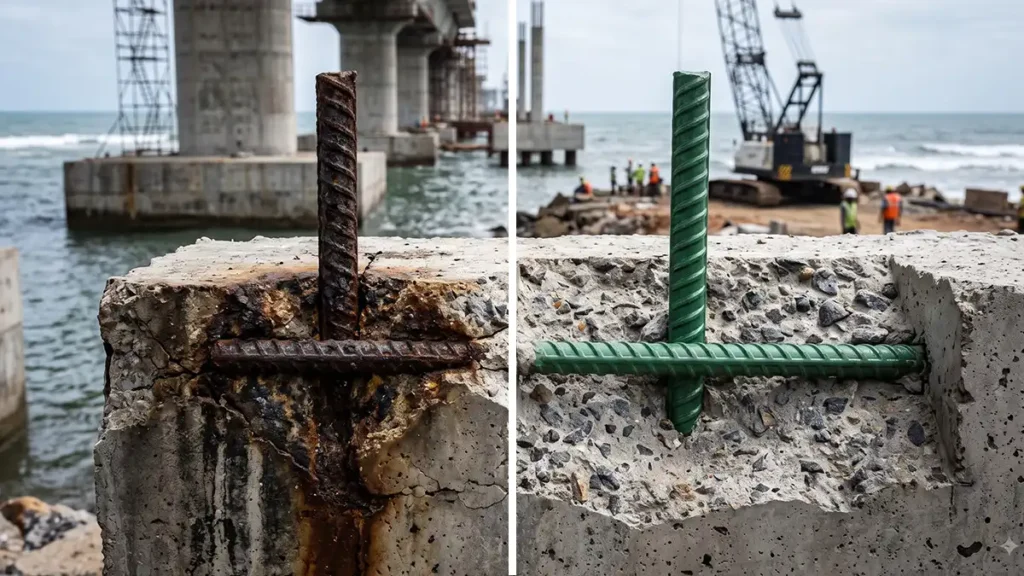
Concrete gives reinforcement a strong layer of protection, yet it remains a porous material. Over time, moisture and chloride salts can travel through pores and fine cracks until they reach the embedded steel. Once corrosion begins, the resulting rust occupies more space than the original metal. This creates pressure around the reinforcement and can lead to cracking, delamination and spalling of the surrounding concrete.
This is where epoxy coated TMT bars become valuable. A fusion-bonded epoxy layer creates a protective barrier around the bar, reducing direct contact with chloride ions and slowing the electrochemical process responsible for corrosion.
ET TMT states that its epoxy-coated bars can deliver up to 12 times longer life than bare TMT bars under suitable conditions. The actual service life depends on the project environment, concrete quality, coating integrity, structural design and site execution.
What Are Epoxy Coated TMT Bars?
Epoxy coated TMT bars are conventional TMT reinforcement bars covered with a fusion-bonded epoxy coating.
During manufacturing, the steel surface is prepared carefully and the TMT bar is pre-heated. Dry epoxy powder is then applied electrostatically. The heat melts and cures the powder, forming a continuous protective layer around the steel.
ET TMT describes its epoxy-coated bars as fusion-bonded products in which the epoxy is applied electrostatically to pre-heated bars and cured. The coating acts as an electrical insulator and creates a barrier against chloride ions.
The TMT bar continues to provide the required strength and ductility, while the epoxy layer focuses on corrosion protection.
Why Do TMT Bars Corrode Inside Concrete?
Fresh, well-designed concrete creates an alkaline environment around the steel. This environment forms a thin passive film on the reinforcement and helps protect it from corrosion.
Aggressive elements can gradually disturb this protection. Common sources include:
- Sea salt and coastal air
- Saline soil or groundwater
- De-icing chemicals
- Industrial chemicals
- Sewage and wastewater exposure
- Moisture entering through cracks
- Carbonation over a long period
Chlorides are especially important in coastal and marine construction. Once enough chloride reaches the steel surface, it can disrupt the passive layer and begin active corrosion. The expanding corrosion products then create tensile pressure within the concrete, resulting in visible cracks and spalling.
Epoxy coated TMT bars delay this sequence by keeping aggressive elements away from the steel surface for a longer period.
How Epoxy Coating Extends TMT Bar Lifespan
1. It Creates a Barrier Against Chloride Ions
Chloride ions are among the main causes of reinforcement corrosion in marine and salt-exposed structures. They can enter concrete through its pores, joints and cracks.
The fusion-bonded epoxy layer separates the steel from these chlorides. Even when chloride-containing moisture reaches the reinforcement level, the coating reduces direct contact with the steel surface.
ET TMT specifically identifies the fusion-bonded epoxy layer as a barrier against chloride entry, making the bars suitable for structures exposed to aggressive environments.
2. It Slows the Electrochemical Corrosion Process
Steel corrosion needs an electrochemical circuit. Moisture acts as an electrolyte, while different areas of the reinforcement behave like anodes and cathodes.
Epoxy is electrically insulating. By covering the reinforcement, it increases electrical resistance and limits the reactions involved in corrosion.
Federal Highway Administration research has found that epoxy-coated reinforcement can reduce corrosion susceptibility considerably. Improved performance has been linked to higher electrical resistance, smaller cathodic areas and a reduced cathodic reaction.
3. It Delays Corrosion-Related Concrete Damage
Corroding steel gradually loses its cross-sectional area. At the same time, the corrosion products expand around the bar.
This expansion puts pressure on the surrounding concrete and can eventually create:
- Longitudinal cracks along the reinforcement
- Delamination within concrete members
- Surface spalling
- Reduced bond performance
- Higher repair requirements
By delaying reinforcement corrosion, epoxy coating also delays the internal pressure that causes these forms of concrete deterioration.
The benefit reaches beyond the steel bar itself. It supports the durability of the complete reinforced concrete member.
4. Factory Application Provides Controlled Coating Coverage
The performance of any protective coating depends on its continuity and quality. Factory application offers better control over surface preparation, heating, coating thickness and curing.
ET TMT highlights factory-based application as a way to achieve uniform coating thickness. Its quality infrastructure includes an epoxy coating plant, spectrometry facilities and protocol-driven physical and chemical testing in NABL-accredited in-house laboratories.
A properly prepared steel surface helps the epoxy adhere more effectively. Consistent thickness gives the reinforcement more uniform protection across the ribs, curved surfaces and bar length.
5. It Can Reduce Future Repair Cycles
Corrosion damage often requires concrete removal, reinforcement treatment, patch repairs and protective rehabilitation. Such work can become particularly disruptive in bridges, flyovers, industrial facilities and marine infrastructure.
By delaying corrosion initiation, epoxy coated TMT bars can reduce the frequency of corrosion-related intervention over the structure’s service period. The value becomes more visible in projects where access is difficult, shutdowns are expensive or exposure remains continuously aggressive.
Lifecycle value should be assessed using the project’s exposure conditions, design life, initial material cost and expected maintenance requirements.
What Does “Up to 12x Longer Life” Actually Mean?
The 12x figure is best understood as a comparative corrosion-performance benchmark under defined conditions.
ET TMT states that its epoxy-coated bars have twelve times longer life than bare TMT bars. A Virginia Transportation Research Council review also described a laboratory configuration in which concrete decks with epoxy-coated top reinforcement required 12 times more time to consume the same amount of iron as decks constructed with bare bars. The study linked this performance to a major reduction in corrosion rate.
This figure reflects the potential to delay corrosion progression. It should be viewed in relation to the conditions under which the comparison was made.
Actual project lifespan varies according to:
- Severity of chloride or chemical exposure
- Concrete permeability and water-cement ratio
- Concrete cover over reinforcement
- Quality and continuity of the epoxy coating
- Storage, bending and handling practices
- Crack control and drainage
- Structural detailing
- Workmanship during placement and concreting
For this reason, project engineers calculate service life using the complete structural system rather than the reinforcement coating alone.
Epoxy Coated TMT Bars vs Bare TMT Bars
| Factor | Bare TMT Bars | Epoxy Coated TMT Bars |
| Surface protection | Steel surface relies primarily on concrete alkalinity and cover | Fusion-bonded coating adds a physical and electrical barrier |
| Chloride exposure | Chlorides can contact steel after reaching reinforcement depth | Coating reduces direct chloride contact |
| Corrosion initiation | Can begin earlier in saline or chemically aggressive exposure | Usually delayed when coating remains continuous |
| Site handling | Standard reinforcement handling practices | Additional care protects the coating from chips and scratches |
| Initial material cost | Usually lower | Usually higher due to coating and quality-control processes |
| Lifecycle consideration | Repair exposure can increase in aggressive environments | Longer corrosion-initiation period can reduce maintenance requirements |
| Suitable applications | Mild and controlled exposure conditions | Coastal, marine, industrial and high-moisture structures |
Factors That Help Epoxy Coated TMT Bars Perform Better
Good Concrete Quality
Dense, low-permeability concrete slows the movement of moisture and chlorides. A suitable concrete mix, proper compaction and adequate curing work together with the coated reinforcement.
The strongest durability strategy combines high-quality steel, a sound coating system and carefully designed concrete.
Adequate Concrete Cover
Concrete cover creates the first distance that aggressive elements must travel before reaching the reinforcement. Cover depth should match the exposure category and applicable structural code.
Careful Storage and Handling
Coated bars should be stored on raised supports and protected from rough surfaces. Padded lifting arrangements help preserve the coating during unloading and placement.
Dragging bars across the ground, dropping bundles or striking them against sharp edges can create coating damage. A controlled handling plan protects the barrier from the factory to the final reinforcement cage.
Inspection Before Concreting
The reinforcement cage should be inspected for coating continuity, damaged areas, cut ends and exposed steel. Approved touch-up materials and repair procedures should be used wherever required by the manufacturer or project specification.
Proper Structural Detailing
Lap lengths, development lengths, bending procedures and spacing should follow the structural drawings and applicable codes. The structural engineer should account for the reinforcement system selected for the project.
Where Are Epoxy Coated TMT Bars Commonly Used?
The greatest value usually appears in structures with frequent exposure to salt, moisture or aggressive chemicals.
Coastal Buildings
Homes, high-rise buildings, hotels and commercial structures near the sea face airborne salt, humid conditions and saline groundwater. Epoxy coated TMT bars add a protective layer for foundations, basements, podiums and exposed structural members.
Bridges and Flyovers
Bridge decks, piers and approach structures can experience water exposure, traffic-related cracking and chloride contamination. Fusion-bonded epoxy-coated reinforcement has been widely studied for this type of application.
Ports and Marine Infrastructure
Jetties, docks, seawalls, piers and harbour structures operate in highly aggressive environments. Saltwater splash, tidal wetting and continuous humidity make corrosion protection a central design consideration.
ET TMT identifies marine infrastructure as a special application for its epoxy-coated reinforcement.
Basements and Foundations
Foundations constructed in saline soil or exposed to aggressive groundwater can benefit from coated reinforcement, particularly when long-term moisture exposure is expected.
Water and Wastewater Infrastructure
Water-treatment plants, sewage-treatment facilities, tanks and channels regularly operate in wet or chemically active environments. Epoxy coating helps separate the reinforcement from substances that may reach the steel through the concrete.
Industrial Structures
Chemical plants, processing facilities, cooling towers and industrial floors may face acids, salts, moisture or chemical vapours. The reinforcement specification should be selected according to the exact chemical exposure.
How to Choose the Right Epoxy Coated TMT Bars
Start with the structural design. The engineer should specify the required bar grade, diameter, coating standard and application area.
In India, IS 13620:1993 is the BIS specification for fusion-bonded epoxy-coated reinforcing bars. BIS lists the standard under mandatory certification, and its standards portal shows that the specification was reviewed in 2025.
Before procurement, review:
- Declared TMT grade: Confirm the grade stated in the structural drawing.
- Applicable certification: Ask for product certification and batch test documents.
- Coating quality: Check uniformity, adhesion and visible surface condition.
- Manufacturer’s quality control: Review coating, testing and traceability systems.
- Delivery condition: Inspect bundles when they reach the project site.
- Site handling procedure: Brief contractors and reinforcement workers before unloading and fabrication.
- Repair procedure: Keep the approved coating repair material available at the site.
ET Epoxy-Coated TMT Bars are listed across multiple base-bar categories and grades, including Fe 500, Fe 500D, Fe 550, Fe 550D and Fe 600 options depending on the selected product line. The final grade and diameter should always match the structural specification.
Why Consider ET Epoxy-Coated TMT Bars?
ET TMT uses fusion-bonded epoxy coating applied electrostatically to pre-heated bars. According to the company’s product information, the cured coating acts as an insulating barrier against chloride ions and is applied through a factory-controlled process for uniform thickness.
Its manufacturing and quality infrastructure includes:
- An integrated steel manufacturing facility
- A dedicated epoxy coating plant
- Spectrometry facilities
- Automated production processes
- Physical and chemical testing
- NABL-accredited in-house laboratories
These systems support control over the base steel, coating process and finished-bar testing.
For projects facing marine exposure, salinity or persistent moisture, ET Epoxy-Coated TMT Bars can be evaluated with the structural consultant as part of the project’s durability strategy.