
Introduction
Steel has always been one of the strongest foundations of modern construction. From homes and commercial buildings to bridges, roads, railways, and large infrastructure projects, steel quietly carries the weight of progress.
Today, the conversation around steel is changing. Builders, engineers, developers, and homeowners are looking beyond basic strength. They want steel that is consistent, tested, durable, corrosion-resistant, and suitable for long-term structural safety.
That shift is raising the bar for the entire steel industry.
In India, this is especially important for TMT bars used in reinforced concrete structures. A TMT bar is hidden inside the concrete, yet its quality directly affects the strength, durability, and safety of the structure. This is why responsible steel manufacturers are focusing on better raw material control, modern manufacturing, strict testing, corrosion protection, and safer handling practices.
For brands like ET TMT, quality is not treated as a final checkpoint. It starts from the manufacturing process and continues through testing, grading, product selection, and application-based solutions.
Why Quality In Steel Matters So Much
A building is only as dependable as the materials used inside it. Cement, concrete, design, workmanship, and steel all play their part. Among these, TMT bars are critical because they reinforce concrete and help structures handle load, stress, bending, and movement.
Poor-quality steel can create serious risks. It may have inconsistent strength, poor bendability, lower ductility, surface defects, or weak resistance to corrosion. These issues may not be visible during construction, yet they can affect the structure over time.
That is why the steel industry is moving toward a more disciplined quality-first approach. The focus is now on measurable performance, certified standards, controlled chemistry, and reliable testing.
1. Stronger Standards Are Creating Better Steel
One of the biggest ways the steel industry is improving quality is through stronger standardisation.
For TMT bars in India, IS 1786:2008 defines the requirements for high-strength deformed steel bars and wires used in concrete reinforcement. This standard covers important aspects such as mechanical properties, chemical composition, deformation, surface characteristics, elongation, tensile strength, and bend performance.
This matters because construction steel cannot be judged by appearance alone. Two bars may look similar from the outside, yet perform very differently under load or stress.
A standard-driven approach helps bring consistency to the market. It gives engineers, builders, and buyers a clear framework to evaluate steel quality. It also supports safer construction by reducing the risk of substandard material entering important projects.
2. Testing Has Become A Core Part Of Steel Quality
Modern steel quality depends on testing at multiple levels.
BIS product guidance for IS 1786 includes checks such as chemical testing, physical testing, pull-out testing, proof stress, elongation, tensile strength, bend test, re-bend test, nominal size, mass, and surface characteristics.
These tests are important because every structure needs steel that behaves predictably. A TMT bar should have the right strength, required ductility, proper bonding with concrete, and the ability to bend without cracking during construction work.
Testing helps answer practical questions such as:
Is the bar strong enough for the intended grade?
Can it bend properly at site?
Does it have the right elongation?
Does it meet the required size and mass tolerance?
Is the steel chemistry controlled?
When steel goes through these checks, quality becomes less dependent on guesswork and more dependent on measurable performance.
3. Better Steel Chemistry Is Improving Structural Reliability
Steel quality starts with chemistry.
The presence of unwanted impurities can affect the performance of steel. Elements such as sulphur, phosphorus, and other unwanted tramp elements need careful control because they can influence strength, ductility, weldability, and long-term reliability.
This is why advanced steel manufacturers focus on raw material quality, refining, and process control.
ET Refined Steel TMT Bars, for example, are described by ET TMT as being made through an integrated iron-ore induction furnace and ladle refining furnace route. The brand also mentions the use of in-house refined steel from iron ore without steel scrap, with control over tramp elements.
For construction buyers, this matters because controlled chemistry leads to more predictable steel. Predictability is a major part of safety. Engineers need materials that perform as expected across batches, projects, and structural applications.
4. Ductility And Bendability Are Getting More Attention
Strength is important, yet strength alone is not enough.
A good TMT bar also needs ductility. Ductility is the ability of steel to deform without sudden rupture. In real construction conditions, steel may face bending, load transfer, stress, vibration, and movement. Ductility helps the reinforcement handle these forces in a safer and more controlled way.
This is especially important in areas where structures may face dynamic loads or seismic forces. Engineers choose grades based on the project’s structural design, safety needs, and applicable standards.
Bendability is equally important at the construction stage. TMT bars are often cut, bent, shaped, and fixed as per drawings. If steel does not bend properly, it can create cracks, wastage, delays, and site-level quality issues.
This is one reason why the industry is paying more attention to bars that offer a balance of strength, ductility, and workability.
5. Corrosion Resistance Is Becoming A Bigger Quality Priority
Corrosion is one of the biggest long-term threats to reinforced concrete structures.
When steel reinforcement corrodes, it can expand, crack the surrounding concrete, weaken bonding, and reduce structural durability. The risk becomes higher in coastal regions, marine infrastructure, bridges, basements, water-retaining structures, industrial areas, and places exposed to moisture or chlorides.
To address this, steel manufacturers are offering corrosion-focused solutions.
ET CRS TMT Bars are positioned as corrosion-resistant bars with high yield strength, ductility, and bendability. ET TMT also offers epoxy-coated TMT bars, where a fusion-bonded epoxy layer acts as a barrier against corrosive elements.
This kind of application-led product development shows how the industry is moving from one-size-fits-all steel to steel chosen according to the environment and structural need.
For a regular residential project, the requirement may be different. For a bridge, coastal project, or infrastructure exposed to aggressive conditions, corrosion resistance becomes a much bigger part of quality planning.
6. Cut-And-Bend Steel Is Reducing Site-Level Errors
Quality does not end at the factory. It also depends on how steel is handled at the construction site.
Traditional site cutting and bending can lead to wastage, inconsistent shapes, measurement errors, extra labour, and handling challenges. Factory-made cut-and-bend TMT bars help reduce these issues by supplying reinforcement in ready-to-use shapes as per project drawings.
ET Cut & Bend TMT Bars are described as pre-fabricated, ready-to-use bars available across ET TMT grades. The brand highlights machine-based cutting and bending for better efficiency, accuracy, and uniformity.
This improves construction discipline. When bars arrive in the required shape and size, contractors can reduce manual errors, speed up fixing work, and improve reinforcement accuracy.
For large projects, this can make a clear difference in time management, material control, and site safety.
7. Safety Is Becoming A Culture, Not A Checklist
The steel industry is also improving safety inside manufacturing plants.
Steel manufacturing involves high temperatures, heavy equipment, moving material, electrical systems, rolling processes, and complex operations. A safer steel industry needs more than helmets and signboards. It needs systems, training, technology, leadership, risk identification, and a culture where safety is treated as a daily responsibility.
Global steel bodies such as the World Steel Association have been focusing on safety and health principles, zero harm, learning exchanges, and better safety management. This shows that the industry is shifting from reactive safety to preventive safety.
For buyers, plant safety may feel distant from the final product. In reality, safe and disciplined manufacturing often reflects a larger culture of process control. The same mindset that values worker safety usually values product consistency, testing, and operational discipline.
8. Technology Is Making Quality More Consistent
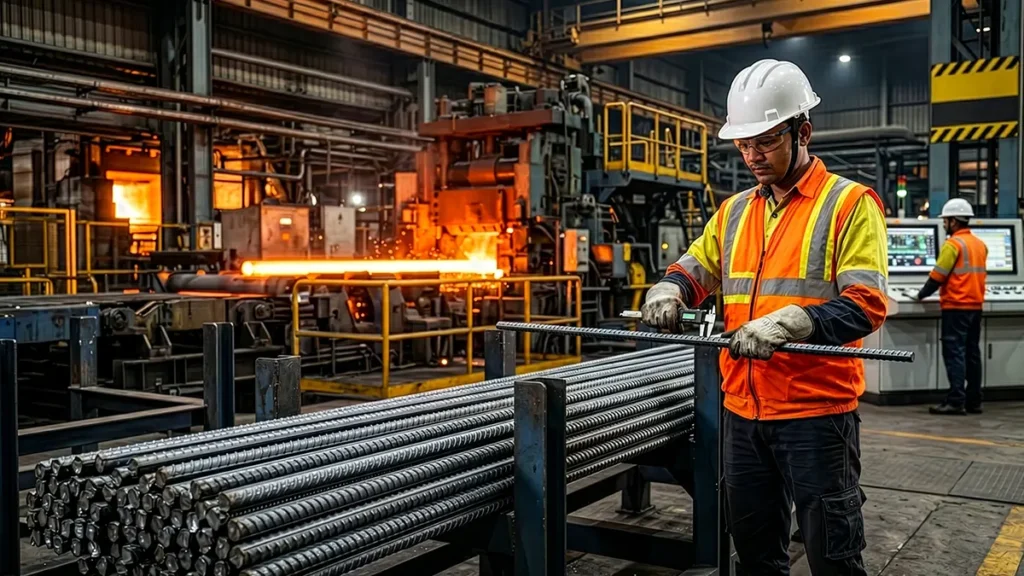
Modern steel plants are using better equipment, process monitoring, refining technology, continuous casting systems, spectrometry testing, and controlled rolling practices to improve consistency.
For TMT bars, this matters because each batch must meet the required grade and performance expectations. Consistent production helps reduce variation in strength, chemistry, surface quality, and workability.
ET TMT’s website mentions process-led advantages such as ladle refining, electro-magnetic stirring during continuous casting, spectrometry testing at multiple stages, and compact rolling stands. These are part of a larger industry movement toward cleaner, more controlled, and more reliable steel production.
In simple terms, better technology helps manufacturers make steel with fewer surprises.
9. Quality Steel Supports Safer Construction Decisions
Builders and homeowners often focus on visible parts of construction such as elevation, flooring, paint, and interiors. Steel stays hidden inside concrete, so it is easy to overlook.
That can be a costly mistake.
Choosing the right TMT bar should involve basic checks:
Ask for the correct grade as per structural design.
Check whether the steel follows relevant standards.
Choose corrosion-resistant options where the environment demands it.
Prefer reliable manufacturers with clear product information.
Review test certificates wherever required.
Use cut-and-bend solutions for projects where accuracy and speed matter.
Store and handle steel properly at site.
Quality steel does not replace good engineering or workmanship. It supports them.
A safe structure needs the right design, the right material, the right execution, and the right supervision.
ET TMT’s Role In This Shift
ET TMT’s product range reflects many of the quality and safety priorities shaping the modern steel industry.
The brand offers CRS TMT Bars, Refined Steel TMT Bars, Superior Quality Steel TMT Bars, Epoxy-Coated TMT Bars, and Cut & Bend TMT Bars. These products address different construction needs such as corrosion resistance, refined chemistry, ductility, bendability, ready-to-use reinforcement, and long-term durability.
ET TMT also positions its manufacturing around stringent quality requirements and a 5 LTPA facility. This supports the brand’s larger promise of helping customers build structures with dependable reinforcement.
For builders, contractors, engineers, and homeowners, this makes product selection more practical. Instead of choosing steel only by price or grade name, they can choose based on structure type, exposure condition, project scale, and performance requirement.
Conclusion
The steel industry is raising the bar because construction demands have changed.
Today’s structures need strength, consistency, ductility, corrosion resistance, certified quality, safer manufacturing, and better site execution. Standards such as IS 1786, stricter quality control, improved testing, refined manufacturing, and application-specific TMT solutions are helping the industry move in the right direction.
For every project, steel is more than a raw material. It is a long-term safety decision.
That is why choosing quality TMT bars from a trusted manufacturer matters. The right steel may stay hidden inside the structure, yet its impact stays visible for generations.