
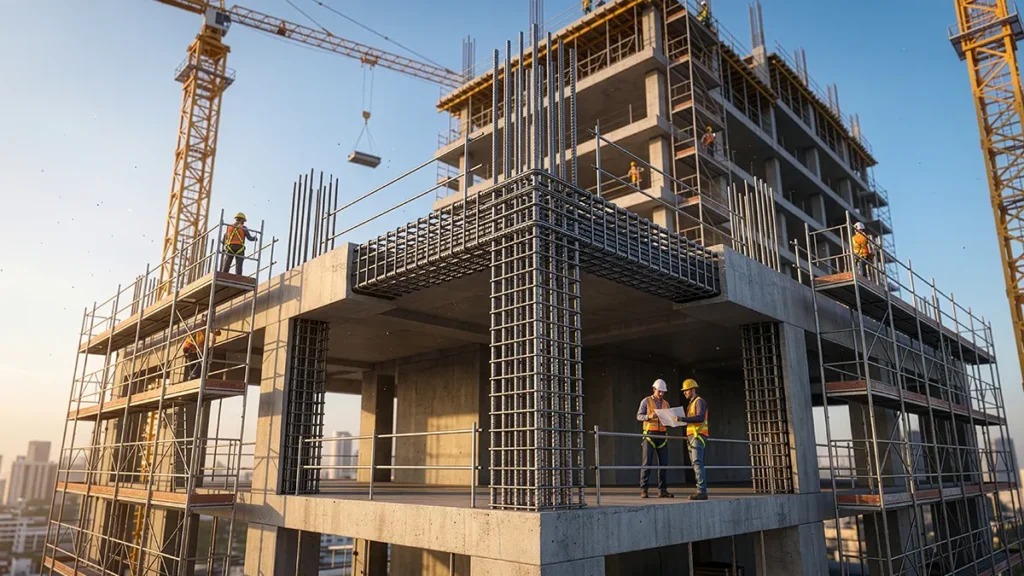
When people think about a strong building, concrete usually gets the attention. It forms the slabs, beams, columns, and foundations we see during construction. Still, the real strength of a structure comes from the way concrete and steel work together.
Concrete is strong under compression. That means it can handle forces that press down on it. Tension, bending, movement, and load changes need another kind of support. This is where TMT rebars become essential.
TMT rebars are placed inside concrete to help the structure handle tensile forces, control cracking, improve ductility, and support long-term durability. For homes, commercial spaces, bridges, industrial structures, and infrastructure projects, the choice of TMT bars has a direct impact on how safely and reliably the structure performs over time.
For ET TMT, the idea is simple: building strength starts with the right reinforcement.
What Are TMT Rebars?
TMT stands for Thermo-Mechanically Treated. TMT rebars are high-strength deformed steel bars used in reinforced cement concrete construction. Their ribbed surface helps create a better grip with concrete, allowing both materials to act together under load.
The thermo-mechanical treatment process gives TMT bars a balanced combination of strength and ductility. Strength helps the bar carry heavy loads. Ductility helps it bend, stretch, and absorb stress without sudden failure.
In real construction, this balance matters. A structure does not face one type of force throughout its life. It carries dead loads, live loads, wind forces, vibrations, temperature effects, and sometimes seismic movement. TMT rebars help the RCC framework respond to these forces in a controlled manner.
Why Concrete Needs TMT Rebars
Concrete has excellent compressive strength. That is why it is widely used in foundations, columns, beams, and slabs. The challenge begins when a concrete member faces tension or bending.
Imagine a beam carrying a load. The upper part of the beam gets compressed, while the lower part stretches. Plain concrete can crack under this stretching force. Steel reinforcement takes up this tensile stress and helps the beam perform safely.
This is the main purpose of TMT rebars in RCC construction. They support concrete where it is naturally weak and help the entire structure behave as one strong system.
The Role of TMT Rebars in Building Strength
1. They Improve Tensile Strength
A building is never under compression alone. Beams bend, slabs flex, columns transfer loads, and foundations deal with soil pressure. TMT rebars help resist tensile forces that concrete alone cannot manage effectively.
This makes them a core material in reinforced concrete construction. Without proper reinforcement, cracks can widen, structural members can weaken, and the building may lose its designed performance.
2. They Help Control Cracks
Cracks in concrete can happen due to shrinkage, bending, temperature changes, settlement, or load movement. Properly designed and placed TMT rebars help control crack width and distribution.
This does not mean rebars make concrete completely crack-free. It means they help manage cracking in a way that keeps the structure safer and more serviceable when designed and executed correctly.
3. They Add Ductility
Ductility is the ability of steel to deform under stress without breaking suddenly. This is a critical property in construction.
In a well-designed RCC structure, ductile reinforcement gives warning before failure. It allows the structure to absorb stress, redistribute forces, and perform better under sudden load changes. This is especially important for structures in seismic zones, heavy-load areas, and critical infrastructure.
4. They Create Better Bond With Concrete
TMT rebars have a deformed surface. These ribs help the bar grip the surrounding concrete. A strong bond between concrete and steel is important because both materials need to transfer forces to each other.
Good bond strength helps beams, slabs, columns, and foundations act as unified structural elements. Poor bonding can reduce the effectiveness of reinforcement, even when the steel itself is strong.
5. They Support Long-Term Durability
Strength at the time of construction is one part of the story. A structure must also handle years of exposure, moisture, temperature changes, and environmental conditions.
Corrosion is one of the major concerns in reinforced concrete structures. When steel corrodes, it can expand, create internal pressure, damage surrounding concrete, and reduce the effective strength of the reinforcement.
This is why corrosion-resistant TMT bars, epoxy-coated TMT bars, and quality-tested steel matter in projects exposed to moisture, coastal air, industrial environments, or aggressive site conditions.
Why Quality Testing Matters in TMT Bars
A TMT bar should not be selected by price alone. Its performance depends on chemical composition, tensile strength, elongation, bendability, rebend performance, surface quality, and consistency across batches.
Standards such as IS 1786 define requirements for high-strength deformed steel bars and wires used in concrete reinforcement. These checks help ensure that reinforcement steel meets expected performance parameters.
For a builder or contractor, this means one clear thing: always choose TMT bars from a brand that follows a disciplined manufacturing and testing process.
ET TMT: Built for Stronger RCC Construction
ET TMT offers a range of TMT solutions for different construction needs, including CRS TMT Bars, Refined Steel TMT Bars, Superior Quality Steel TMT Bars, Epoxy-Coated TMT Bars, and Cut & Bend TMT Bars.
Each range serves a practical construction purpose.
ET CRS TMT Bars are designed for corrosion resistance, high yield strength, ductility, and bendability. This makes them relevant for RCC structures where durability and corrosion protection are important.
ET Refined Steel TMT Bars are made using an integrated steelmaking process with refined steel. The focus is on purity, consistency, and quality of input material.
ET Superior Quality Steel TMT Bars are positioned for RCC construction in buildings and concrete structures where force resistance, ductility, bendability, weldability, and dynamic load response matter.
ET Epoxy-Coated TMT Bars are used for structures exposed to corrosive environments, such as marine exposure, deicing salt exposure, heavy structures, and cantilever structures.
ET Cut & Bend TMT Bars help improve site efficiency by providing reinforcement in required shapes and angles, reducing manual handling and on-site wastage when planned correctly.
How to Choose the Right TMT Rebar for Your Project
Choosing TMT rebars should be a technical decision, not a last-minute purchase decision. Before finalising the steel, look at these points:
Check the Structural Requirement
The grade and diameter of the TMT bar should match the structural drawings and engineer’s recommendation. Every building has different load requirements, soil conditions, and design needs.
Look for Standard Compliance
Select bars that follow relevant Indian standards for reinforced concrete steel. Ask for test certificates where required.
Consider the Environment
For coastal regions, water-exposed areas, basements, bridges, industrial zones, and high-moisture sites, corrosion resistance becomes more important.
Check Bendability and Ductility
Bars often need cutting, bending, and shaping at the site. Good ductility and bendability help improve workability during construction and performance inside the structure.
Choose a Reliable Brand
A TMT bar stays hidden inside concrete for the life of the structure. Once the concrete is cast, replacing poor-quality steel is almost impossible. This makes brand reliability, manufacturing control, and testing discipline extremely important.
TMT Rebars Are the Hidden Strength of RCC Structures
The strength of a building is not defined by concrete alone. It depends on the correct combination of concrete, reinforcement, design, detailing, workmanship, curing, and quality control.
TMT rebars play one of the most important roles in this system. They help concrete resist tension, manage bending, control cracks, absorb stress, and perform better over the structure’s life.
For builders, engineers, and homeowners, the lesson is clear: never treat TMT bars as a basic commodity. They are a structural investment.
With ET TMT’s range of TMT solutions, builders can choose reinforcement suited to different construction needs, from regular RCC buildings to corrosion-prone and critical structures.
Conclusion
Concrete gives a structure its form. TMT rebars give it the strength to stand, carry, bend, resist, and last.
A strong structure begins below the surface, inside the concrete, where the right reinforcement does its job quietly every day. Choosing quality TMT rebars is one of the most important decisions in building safer and more durable RCC structures.
When you build, build with steel that supports strength from within.