
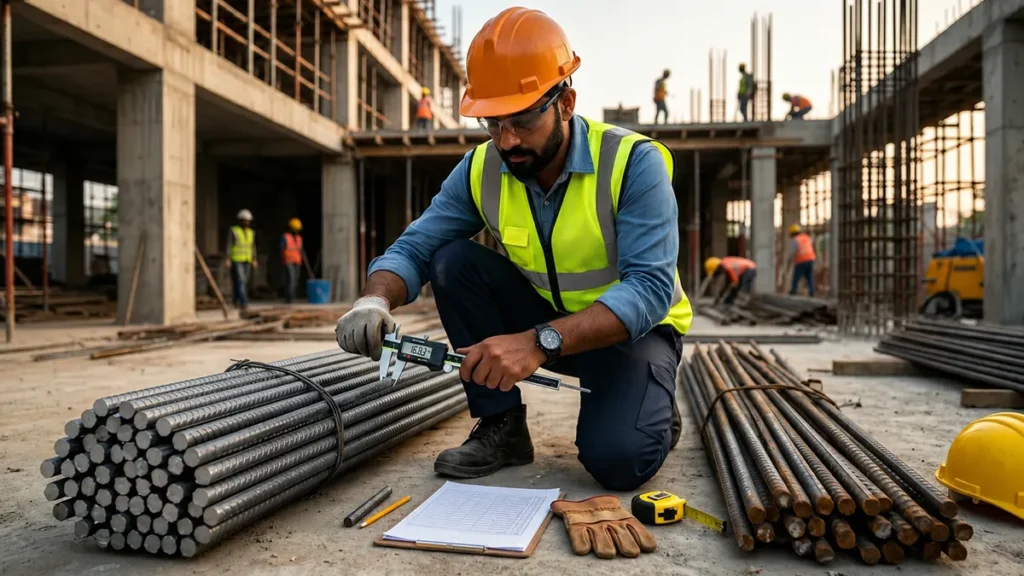
TMT rebars are hidden inside concrete, yet they carry a major part of the structure’s strength. Once the construction is complete, replacing poor-quality or duplicate rebars is almost impossible without heavy cost and damage. That is why checking the authenticity of TMT bars before purchase is a serious step for homeowners, contractors, engineers, and developers.
Duplicate or substandard rebars may look similar from a distance, yet they can differ in strength, ductility, surface finish, chemical composition, and traceability. A genuine TMT rebar should come with proper marking, correct grade details, valid documentation, and reliable source verification.
Here is a practical guide to help you identify genuine TMT rebars and avoid duplicates before they reach your construction site.
1. Check the BIS Certification Mark
The first thing to check is whether the TMT rebar carries a valid BIS certification mark. In India, high-strength deformed steel bars for concrete reinforcement are covered under IS 1786:2008. This standard defines important quality parameters related to chemical composition, mechanical properties, bend performance, rebend performance, surface characteristics, and dimensional tolerance.
A genuine TMT bar should be traceable to a BIS-certified manufacturer. Do not rely on verbal claims from a dealer. Ask for the BIS licence number and verify it through official BIS channels.
What to check:
- BIS/ISI mark
- IS 1786 reference
- CM/L licence number
- Manufacturer name
- Product grade
- Bar size
- Licence validity
A missing or unclear BIS licence number is a warning sign. If the seller avoids sharing the licence details, it is safer to stop the purchase.
2. Use the BIS Care App for Verification
BIS provides the BIS Care App to help buyers verify product authenticity. You can use the “Verify Licence Details” feature to check whether the licence number belongs to the claimed manufacturer.
This is one of the simplest ways to reduce the risk of buying duplicate TMT bars.
Basic verification steps:
- Open the BIS Care App.
- Select “Verify Licence Details.”
- Enter the CM/L number printed on the bundle tag or documents.
- Match the manufacturer name with the brand being sold.
- Check whether the licence is valid.
- Check whether the grade and product category match your requirement.
Do this before unloading large quantities at the site. A few minutes of checking can prevent major construction risk later.
3. Look for Brand Marking on the Bar
Genuine TMT rebars should carry identifiable markings introduced during rolling. These markings help trace the bar back to the manufacturer. The brand name or trade mark, grade, and identification details should appear clearly on the bar at regular intervals.
If the bar has no visible brand marking, uneven marking, or confusing symbols, treat it carefully. Duplicate bars often try to imitate the appearance of branded steel, yet the rolling marks may look irregular, shallow, incomplete, or inconsistent.
Site-level check:
- Is the brand marking clearly visible?
- Is the grade mentioned properly?
- Are the markings repeated consistently?
- Does the marking match the bundle tag and invoice?
- Does the physical branding match the brand you ordered?
Never accept loose, untagged, or mixed rebars without proper verification.
4. Verify the Bundle Tag
A bundle tag gives important identity details about the TMT bars supplied to your site. It helps connect the physical material with the manufacturer’s records, invoice, and test certificate.
A proper bundle tag should mention:
- Manufacturer name
- Brand name
- Grade
- Size or diameter
- Cast/lot number
- Bundle weight or quantity
- BIS licence number
- Batch or heat details, where applicable
The cast or lot number is important because it supports traceability. If there is a quality issue later, this number helps identify the production batch.
Avoid accepting bundles with torn, missing, overwritten, or mismatched tags.
5. Ask for the Test Certificate
For BIS-certified TMT bars, the test certificate should show whether the supplied material conforms to the required standard. It should mention chemical and mechanical test results for the relevant batch or lot.
A test certificate may include:
- Test certificate number
- Date
- Manufacturer details
- BIS/ISI details
- CM/L number
- Cast or heat number
- Nominal size
- Grade
- Chemical composition
- Proof stress or yield strength
- Tensile strength
- Elongation
- Bend test result
- Rebend test result
- Surface defect status
Do not accept a generic certificate that does not match your supplied batch. The details on the certificate, invoice, and bundle tag should connect with each other.
6. Match the Grade With the Structural Requirement
TMT bars are available in different grades such as Fe 500, Fe 500D, Fe 550, Fe 550D, and higher grades depending on the manufacturer’s certified range. The grade should match the structural design and engineer’s recommendation.
The “D” in grades such as Fe 500D and Fe 550D indicates higher ductility requirements under the standard. Ductility is important because the bar needs to bend and absorb stress without sudden failure.
Never replace one grade with another just because it is cheaper or easily available. Always follow the structural consultant’s specification.
7. Inspect the Surface Quality
A quick visual inspection cannot replace laboratory testing, yet it can help spot obvious red flags.
Genuine TMT rebars should generally have:
- Uniform rib pattern
- Clear rolling marks
- Consistent diameter
- Firm metallic feel
- No deep cracks
- No heavy rust scaling
- No visible splits
- No flaky surface
- No oil, paint, or unknown coating unless specified
Light surface rust can occur during storage and transport, especially in humid conditions. Heavy rust scaling, pitting, deep corrosion, and flaky layers need proper engineering review before use.
8. Check Diameter and Weight
Duplicate or low-quality bars may appear similar in length and surface finish, yet the actual diameter or weight can differ. This affects the steel quantity used in the structure.
Ask your site engineer to check random samples from the supplied lot. The measured diameter and weight should fall within the permitted tolerance for the relevant size and standard.
Simple site checks include:
- Measuring diameter with a vernier caliper
- Checking weight per bundle
- Matching size with invoice
- Comparing random bars from different bundles
- Ensuring there is no mix of different grades or brands
If the supplied bars feel unusually light for the stated size, stop the use and get the material checked.
9. Buy From Authorised and Reliable Sources
Many duplicate steel issues start at the purchase stage. Buying from unknown traders, unverified stockists, or price-led channels increases the risk of wrong material, mixed stock, or fake branding.
Safer buying practices:
- Buy from authorised dealers or trusted distributors.
- Ask for a GST invoice.
- Match the invoice with supplied material.
- Avoid cash purchases without proper records.
- Keep bundle tags until the material is consumed.
- Take delivery photos for site records.
- Store certificates and invoices safely.
If the price is much lower than the normal market rate, check the reason before placing the order. Steel is a critical structural material, so suspiciously low pricing should be examined carefully.
10. Avoid Mixed or Loose Rebars
Loose rebars without tags are harder to trace. Mixed bundles can create confusion at site because different grades or sizes may get used in the wrong structural members.
For safer site control:
- Keep different sizes separately.
- Keep different grades separately.
- Do not mix old and new stock without marking.
- Keep duplicate-looking or doubtful bars aside.
- Let the engineer approve the material before cutting and bending.
Good site discipline protects both construction quality and accountability.
11. Choose a Brand With Process Control and Traceability
A genuine TMT brand should offer more than a name. It should have controlled manufacturing, quality testing, product traceability, and clear product information.
ET TMT offers a range of TMT solutions for different construction needs, including refined steel TMT bars, CRS TMT bars, superior quality steel TMT bars, epoxy-coated TMT bars, and cut & bend TMT bars. For buyers, this makes it easier to select the right type of reinforcement based on project requirements such as strength, corrosion resistance, fabrication needs, and site application.
While buying, always match the product type, grade, and documentation with your project’s structural requirement.
12. Red Flags That May Indicate Duplicate TMT Rebars
Watch out for these warning signs:
- No BIS/ISI details
- Missing CM/L number
- No visible brand marking on the bar
- Bundle tag missing or damaged
- Invoice does not mention grade or size clearly
- Test certificate unavailable
- Test certificate does not match the batch
- Grade marking differs from invoice
- Inconsistent rib pattern
- Heavy rust, cracks, or splits
- Seller refuses verification
- Price looks unusually low
- Material is supplied as loose bars without traceability
One red flag may need clarification. Multiple red flags should be treated as a serious risk.
Conclusion
Identifying genuine TMT rebars is not complicated when you know what to check. Start with BIS certification, verify the licence, inspect the rolling marks, check the bundle tag, ask for the test certificate, match the grade, and buy from reliable sources.
A structure is expected to stand for decades. The steel inside it should be genuine, traceable, and suitable for the design. Choosing verified TMT rebars from a trusted brand like ET TMT helps builders, engineers, and homeowners make a safer and more informed construction decision.