
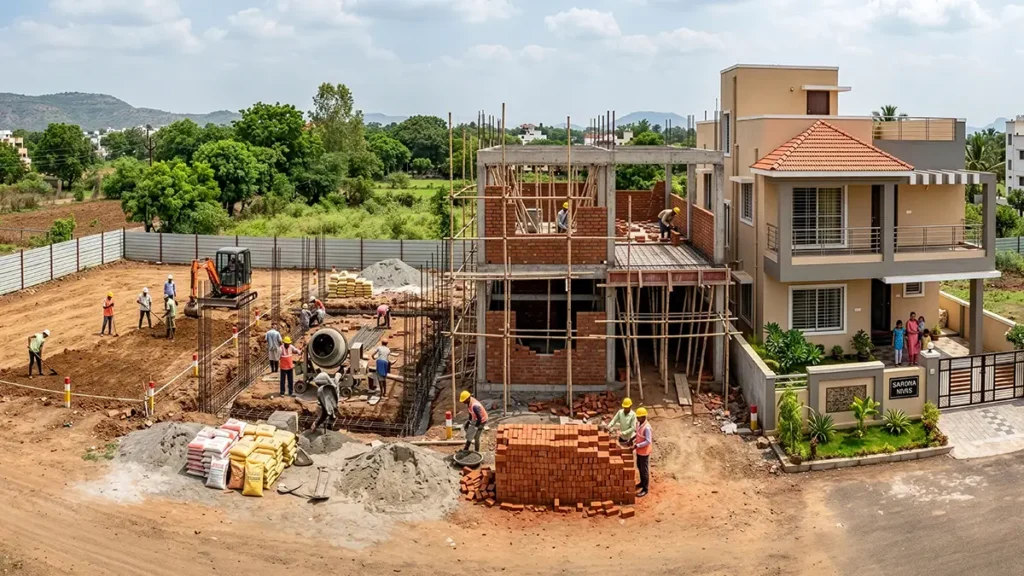
Building a house in India is more than just a construction project – it’s a lifelong investment. From planning and approvals to structural work and finishing, every stage plays a critical role in ensuring durability, safety, and long-term value.
In this guide, we break down the complete house construction process in India, helping homeowners, builders, and developers understand each step clearly.
1. Pre-Construction Phase: Planning the Foundation of Your Dream
Before any physical work begins, proper planning ensures smooth execution and cost control.
✔ Planning & Budgeting
Start by defining your requirements – number of rooms, floors, parking, and future expansion. Experts recommend keeping a contingency budget of 15–20% to handle unexpected costs.
✔ Land Selection & Soil Testing
Choose a plot with good connectivity, drainage, and legal clearance. Soil testing determines the load-bearing capacity, which directly impacts foundation design.
✔ Architectural Design & Structural Planning
Collaborate with architects and structural engineers to finalize layouts, elevation, and structural drawings. This step ensures both aesthetics and safety.
✔ Legal Approvals
Obtain permissions from local authorities, including building plan approval, environmental clearance, and utility permissions.
2. Site Preparation & Foundation Work
Once approvals are in place, the construction begins on-site.
✔ Site Clearing & Excavation
The land is cleared of debris and leveled. Excavation is carried out as per foundation design.
✔ Laying the Foundation
The foundation is the most critical structural element. It supports the entire building load and prevents settlement issues.
High-quality construction materials like TMT steel bars are essential at this stage to ensure strength and durability.
3. Substructure & Plinth Work
After the foundation:
- Footings and columns are constructed
- Plinth beam is laid
- Waterproofing is done to protect against moisture
This stage forms the base of the building above ground level.
4. Superstructure Construction
This is where the structure of the house becomes visible.
✔ Column & Beam Framework
Reinforced Cement Concrete (RCC) columns and beams provide the structural skeleton.
✔ Slab Casting
Floor slabs are cast using concrete and steel reinforcement.
✔ Brickwork / Wall Construction
External and internal walls are built using bricks or blocks.
At this stage, steel plays a vital role in ensuring structural strength, earthquake resistance, and long-term stability.
5. Plumbing, Electrical & MEP Work
Before finishing begins:
- Electrical wiring is installed
- Plumbing lines are laid
- HVAC or ventilation systems are planned
These services are embedded within walls and slabs.
6. Finishing Work
This phase transforms the structure into a livable home.
✔ Plastering & Flooring
Walls are plastered and flooring (tiles, marble, or granite) is installed.
✔ Doors, Windows & Woodwork
Installation of frames, shutters, and fittings.
✔ Painting & Exterior Finishing
Interior and exterior painting enhances aesthetics and protects surfaces.
7. Final Inspection & Handover
Before moving in:
- Structural and safety checks are conducted
- Electrical and plumbing systems are tested
- Final touch-ups are completed
After inspection, the house is ready for occupancy.
Timeline of House Construction in India
Typically, house construction is divided into three phases:
- Pre-construction: 3–8 months
- Construction: 8–18 months
- Post-construction: 1–3 months
Timelines may vary based on project size, location, and material availability.
Why Quality Materials Matter in House Construction
A strong home begins with strong materials. Among all materials, steel is the backbone of modern construction.
- Ensures structural integrity
- Enhances load-bearing capacity
- Improves earthquake resistance
- Increases lifespan of the building
Using high-quality steel like TMT bars from trusted manufacturers such as Electrotherm Steel ensures your home stands strong for generations.
Conclusion
The house construction process in India involves multiple stages – from planning and approvals to structural work and finishing. Each step must be executed with precision, proper materials, and expert supervision.
By understanding this process, homeowners can:
- Avoid costly mistakes
- Ensure timely completion
- Build safer, stronger homes
Whether you’re building your first home or investing in real estate, following a structured construction process and choosing reliable materials – makes all the difference.