
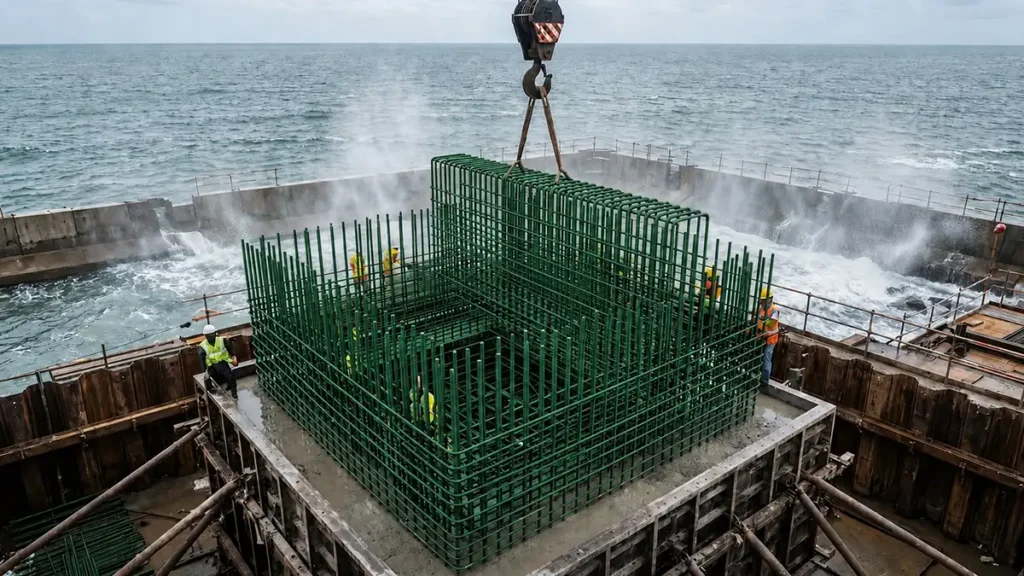
A building near the sea lives around salt every day. Salt-laden air, high humidity, sea spray and repeated wetting-and-drying cycles create a demanding environment for reinforced concrete. These conditions can allow chlorides to travel through concrete and reach the embedded reinforcement.
IS 456:2000 classifies sheltered salt air, open coastal exposure, seawater spray and tidal contact under progressively higher exposure categories. This makes the site’s actual exposure an important starting point when choosing the best TMT bars for coastal construction.
The right steel selection brings together corrosion resistance, strength, ductility, verified quality and project-specific engineering. Concrete grade, cover, curing and workmanship then complete the durability system.
Why Is Salinity a Concern in Coastal Construction?
Concrete creates an alkaline environment around reinforcement, which helps form a protective layer on the steel. Chloride ions from sea air, spray and seawater can gradually move through pores and cracks in the concrete. Once the chloride concentration reaches a critical level around the reinforcement, active corrosion may begin.
Corrosion products build up around the bar and create internal pressure at the steel-concrete interface. This process can contribute to cracking, spalling, reduced bonding and a gradual loss of steel section. NIST and the Federal Highway Administration identify chloride-induced corrosion as a major cause of deterioration in reinforced concrete infrastructure.
Exposure also varies across coastal sites:
- A structure sheltered from saturated salt air may face moderate exposure.
- A structure exposed to an open coastal environment may face severe exposure.
- A surface receiving seawater spray may fall under very severe exposure.
- A member placed in the tidal zone may face extreme exposure.
This classification shows why distance from the shoreline offers one data point. Wind direction, sea spray, tidal contact, drainage, humidity and the building’s intended design life also influence the final steel specification.
What Makes the Best TMT Bars Suitable for Coastal Areas?
The strongest grade on paper may serve a different purpose from a corrosion-resistant reinforcement system. Coastal construction requires the mechanical grade and the corrosion-protection approach to work together.
Here are the key factors to consider.
1. Enhanced Corrosion Resistance
Corrosion-resistant steel, commonly called CRS, is developed for structures exposed to aggressive conditions. Its controlled chemistry can support improved resistance to corrosion and pitting.
ET CRS TMT Bars are made using high-quality sponge iron with copper, chromium, phosphorus and vanadium-based additions. The available range includes:
- CRS Fe 500
- CRS Fe 500D
- CRS Fe 550
- CRS Fe 550D
- CRS Fe 600
ET TMT highlights corrosion resistance, pitting-corrosion resistance, ductility and bendability as key characteristics of this range.
For residential buildings, hotels, warehouses, commercial developments and infrastructure projects in salt-laden environments, CRS TMT bars can form an important part of the durability design.
2. A Grade That Matches the Structural Design
The grade of a TMT bar represents its mechanical performance. Options such as Fe 500D and Fe 550D give structural designers different combinations of yield strength and ductility.
Both grades are available within the ET CRS range. The structural consultant can align the grade with:
- Building height
- Member dimensions
- Design loads
- Wind conditions
- Seismic detailing
- Bar bending requirements
- Concrete grade
- Project life expectations
The best TMT bars for one coastal home may differ from those selected for a port, jetty, sea-facing tower or industrial structure. A project-specific design provides the clearest basis for selection.
3. Barrier Protection for High-Chloride Exposure
Fusion-bonded epoxy coating adds a protective barrier around the reinforcement. It helps reduce direct contact between the steel and chloride-bearing moisture that reaches the bar level.
ET Epoxy-Coated TMT Bars receive an electrostatically applied fusion-bonded epoxy layer on preheated bars, followed by curing. The company positions these bars for corrosive environments and marine infrastructure applications.
Epoxy-coated reinforcement may be considered for:
- Marine structures
- Sea-facing structural members
- Bridges near coastal belts
- Ports and jetties
- Water-retaining structures
- Industrial projects with aggressive exposure
- Elements exposed to frequent salt spray
Coating integrity during transportation, cutting, bending, tying and concreting supports the performance of the system. Site teams should follow the approved handling and repair procedure included in the project specification.
4. BIS Compliance and Product Traceability
BIS lists IS 1786:2008 as the mandatory Indian Standard for high-strength deformed steel bars and wires used in concrete reinforcement. The standard was reviewed in 2023.
Before procurement, buyers and contractors can verify:
- ISI or BIS marking
- Manufacturer identification
- Grade marking
- Diameter and nominal mass
- Batch or heat identification
- Mill test certificate
- Chemical composition results
- Yield and tensile strength results
- Elongation values
- Bend and rebend test results
The BIS testing scope for IS 1786 covers parameters such as chemical composition, nominal mass, surface characteristics, yield stress, tensile strength, elongation, bend performance and rebend performance.
This documentation helps the project team confirm that the supplied reinforcement matches the approved structural specification.
5. Consistent Manufacturing and Quality Control
Reliable performance begins with controlled raw materials, steelmaking, rolling, treatment and testing.
ET TMT states that its manufacturing and quality setup includes sponge iron kilns, induction melting furnaces, ladle refining furnaces, continuous casting, high-speed rolling, thermo-mechanical treatment, spectrometry facilities, physical and chemical testing and an epoxy-coating plant.
For coastal projects, consistency in chemical and mechanical properties gives engineers greater confidence while planning reinforcement, bending schedules and site execution.
Concrete Quality Plays an Equal Role
The reinforcement works as part of a complete reinforced-concrete system. Dense concrete, adequate cover and disciplined execution help control the movement of chlorides toward the steel.
IS 456 connects concrete durability with:
- Environmental exposure
- Concrete cover
- Constituent materials
- Cement content
- Water-cement ratio
- Compaction
- Curing
- Member shape and drainage
The code also states that higher chloride content and warm, moist conditions increase the risk of corrosion in embedded steel.
Concrete Grade for Coastal Exposure
Under the conditions stated in Table 5 of IS 456:2000, the minimum reinforced-concrete grades are listed as:
- M30 for severe exposure
- M35 for very severe exposure
- M40 for extreme exposure
The same table provides exposure-specific guidance for cement content and maximum free water-cement ratio. The structural consultant and concrete technologist should finalise the mix according to the complete project conditions.
Concrete Cover for Reinforcement
Concrete cover creates distance between the external environment and the reinforcement.
As a general durability reference, Table 16 of IS 456:2000 lists minimum nominal cover values of:
- 45 mm for severe exposure
- 50 mm for very severe exposure
- 75 mm for extreme exposure
The table includes specific conditions and exceptions. Member type, bar diameter, fire requirements, concrete grade and structural drawings also guide the final cover.
Correctly sized cover blocks, reinforcement chairs and regular inspection before pouring help maintain the specified cover throughout the member.
Site Practices That Support Coastal Durability
Choosing corrosion-resistant TMT bars creates a strong starting point. Site execution carries that protection through the construction process.
Store the Bars Carefully
Keep reinforcement on raised supports in a clean, covered and well-drained area. Separation from soil, standing water and direct seawater contact helps maintain the condition of the steel before placement.
Use Approved Water and Concrete Materials
Mixing water, aggregates and admixtures should meet the project’s chloride limits. Concrete materials can carry chlorides into the structure, so source verification and testing deserve attention.
Maintain the Specified Cover
Use durable cover blocks of the correct size. Check bar position, chairs and spacers before concreting. Reinforcement movement during pouring can change the intended cover.
Focus on Compaction
Proper vibration reduces voids and honeycombing around reinforcement. Dense, well-compacted concrete creates a more effective barrier against moisture and chloride movement.
Complete the Curing Period
Curing supports cement hydration and helps develop denser concrete. Follow the curing method and duration specified for the concrete mix and weather conditions.
Control Cracks and Water Collection
Good detailing, drainage slopes, waterproofing and joint treatment help manage water movement. Timely attention to visible cracks supports the protective function of the concrete cover.
Protect Epoxy-Coated Bars
Use approved lifting and fabrication methods for coated reinforcement. Coating damage observed during inspection should receive the specified repair treatment before concreting.
A Practical Checklist for Buying the Best TMT Bars
Before placing an order for a coastal project, discuss these points with the structural consultant and supplier:
- What is the site’s exposure category?
Confirm whether the structure faces salt air, sea spray, splash-zone exposure or tidal contact. - Which corrosion-protection system suits the project?
Choose between CRS TMT bars, epoxy-coated TMT bars or an engineer-specified combination. - Which grade is shown in the structural drawings?
Match the supplied material with the approved Fe grade and ductility designation. - Does the product follow the relevant Indian Standard?
Verify BIS or ISI details and supporting documentation. - Is a mill test certificate available?
Review the chemical and mechanical test results for the supplied batch. - Can the supplier provide full traceability?
Check manufacturer marks, heat identification and authorised supply channels. - Is the site prepared for correct storage and handling?
Plan covered storage, raised supports, coating care and pre-pour inspection.
ET TMT Options for Coastal Construction
ET TMT offers two product routes that may suit coastal durability specifications:
ET CRS TMT Bars
The range includes CRS Fe 500, Fe 500D, Fe 550, Fe 550D and Fe 600. ET TMT positions these bars for corrosion resistance, pitting resistance, ductility and bendability.
ET Epoxy-Coated TMT Bars
These bars use a fusion-bonded epoxy coating designed to act as a barrier against chloride ions. ET TMT highlights their application in corrosive environments and marine infrastructure.
These options allow engineers and builders to align reinforcement selection with the project’s structural demands and coastal exposure conditions.
Conclusion
Coastal durability begins with a clear, site-specific specification. The best TMT bars for coastal construction combine suitable mechanical strength, ductility, corrosion resistance, quality verification and proper traceability.
CRS TMT bars and epoxy-coated reinforcement can help address salinity and chloride exposure. Dense concrete, adequate cover, controlled water-cement ratio, proper compaction, complete curing and careful site handling strengthen the overall protection system.
ET TMT’s CRS and epoxy-coated ranges provide options for coastal buildings and marine applications. The structural engineer should finalise the grade, diameter, coating system, concrete mix and cover according to the exposure category and design requirements.