
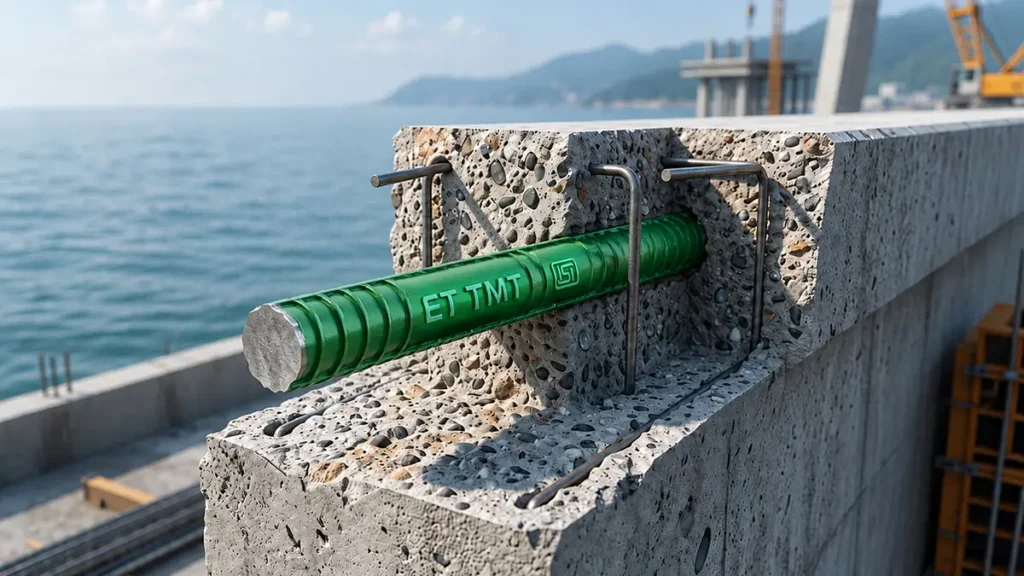
Steel reinforcement spends its entire service life inside concrete. In ordinary conditions, good-quality concrete provides a protective environment around the steel. Projects near the sea, saline soil, industrial zones or continuously wet locations face a higher level of corrosion exposure.
This is where epoxy coated TMT bars can support long-term structural durability. These bars have a factory-applied epoxy layer that acts as a barrier between the steel and corrosive elements such as chloride ions, moisture and chemicals.
They are especially relevant for structures where corrosion protection, maintenance planning and service life carry greater importance.
What Are Epoxy Coated TMT Bars?
Epoxy coated TMT bars are regular thermo-mechanically treated reinforcement bars covered with a protective fusion-bonded epoxy layer.
During manufacturing, the prepared TMT bar is preheated, coated electrostatically with epoxy powder and cured under controlled conditions. The process forms a continuous protective layer around the bar. According to ET TMT, this fusion-bonded coating works as an insulating barrier that helps restrict the entry of chloride ions.
The TMT bar inside the coating continues to provide the required strength and ductility. The epoxy layer adds another level of protection against aggressive environmental exposure.
In simple terms:
TMT bar = structural strength
Epoxy coating = corrosion protection barrier
Why Does Reinforcement Corrode Inside Concrete?
Concrete naturally creates an alkaline environment around reinforcement steel. This environment develops a passive protective film on the steel surface. The quality of concrete, cover depth, compaction and curing all influence how effectively this protection continues over time.
In coastal and chemically aggressive environments, chloride ions and moisture may gradually move through concrete pores and cracks. Once they reach the reinforcement, they can disturb the protective layer around the steel.
Corrosion products occupy more volume than the original steel. This expansion creates internal pressure within the concrete and may lead to:
- Surface cracks
- Concrete delamination
- Spalling around reinforcement
- Reduction in the effective steel cross-section
- Higher repair and maintenance requirements
Epoxy coated TMT bars help slow this process by creating a barrier between the reinforcement and the surrounding concrete environment.
How Does the Epoxy Coating Protect TMT Bars?
Fusion-bonded epoxy has high electrical resistance and low permeability. Once applied properly, the coating limits direct contact between steel and corrosion-causing elements.
Its protection works in three main ways:
1. Restricting Chloride Contact
Chloride ions are a major concern in marine construction, coastal buildings and structures exposed to salt. The epoxy layer helps reduce their direct contact with the steel surface.
2. Reducing Moisture Exposure
Moisture supports the electrochemical reactions involved in corrosion. A continuous coating restricts moisture movement towards the reinforcement surface.
3. Electrically Isolating the Steel
The epoxy coating acts as an electrical insulator. This helps reduce the electrochemical activity that contributes to reinforcement corrosion.
A recent transportation engineering review describes epoxy-coated reinforcement as part of a wider corrosion-protection system involving quality concrete and adequate concrete cover.
Key Benefits of Epoxy Coated TMT Bars
Enhanced Protection in Corrosive Environments
The primary benefit of epoxy coated TMT bars is their ability to protect reinforcement in areas exposed to salts, chlorides, water and certain industrial contaminants.
This makes them a practical choice for coastal developments, marine infrastructure and selected industrial structures.
Support for Longer Service-Life Planning
Corrosion-related cracking and spalling can create recurring maintenance requirements. Limiting corrosion exposure at the reinforcement level can support a structure’s long-term durability plan.
The actual service life depends on several factors, including concrete quality, coating condition, exposure severity, structural detailing and workmanship.
Factory-Controlled Coating
Fusion-bonded epoxy is applied in a controlled factory environment. This helps achieve consistent coating thickness and coverage across the reinforcement surface. ET TMT also highlights factory-based application as an important factor in coating uniformity.
Availability Across Different TMT Grades
Epoxy coating can be applied over different reinforcement grades, allowing engineers to select a combination based on structural strength and exposure requirements.
ET Epoxy-Coated TMT Bars are available across selected ET CRS, ET Refined Steel and ET Superior Quality Steel grades.
Suitable for Challenging Project Locations
The coating is particularly useful in structures where reinforcement replacement or major repairs would involve complex access, operational disruption or higher life-cycle costs.
When Do You Need Epoxy Coated TMT Bars?
The decision should come from the structural engineer after reviewing the environmental exposure, concrete design and intended service life. Epoxy coated reinforcement is commonly considered in the following situations.
1. Coastal Buildings
Buildings located close to the sea face airborne salt, humid weather and chloride-rich conditions. Over time, these elements can enter concrete and reach the reinforcement.
Epoxy coated TMT bars can be considered for:
- Residential towers near the coast
- Coastal villas
- Hotels and resorts
- Sea-facing commercial buildings
- Foundations in saline coastal soil
- Basements exposed to saline groundwater
Distance from the coastline, wind direction, humidity, soil condition and exposure level should guide the final specification.
2. Marine Infrastructure
Marine structures regularly face saltwater, waves, spray and tidal movement. Components in splash and tidal zones often experience particularly demanding exposure.
Common applications include:
- Ports and harbours
- Jetties and piers
- Sea walls
- Coastal bridges
- Marine terminals
- Offshore support structures
- Berthing and loading facilities
ET TMT identifies marine infrastructure as a special application area for its epoxy-coated reinforcement.
3. Bridges, Flyovers and Road Infrastructure
Bridge decks, flyovers and road structures experience water ingress, traffic-related wear and repeated environmental exposure. In colder regions, de-icing salts create an additional chloride source.
Epoxy coated rebar has been widely studied for bridge decks and transportation infrastructure, where it is generally used alongside good-quality concrete and adequate cover.
Relevant structural elements may include:
- Bridge decks
- Flyover slabs
- Approach structures
- Crash barriers
- Cantilever portions
- Drainage-facing components
- Roadside retaining structures
4. Water and Wastewater Structures
Water-retaining and wastewater facilities operate in continuously damp environments. Wastewater may also contain aggressive substances that increase durability concerns.
Epoxy coated TMT bars may be evaluated for:
- Sewage treatment plants
- Effluent treatment plants
- Water treatment facilities
- Underground tanks
- Drainage channels
- Pumping stations
- Selected water-retaining RCC components
The chemical composition of the stored or treated water should form part of the material-selection process.
5. Industrial Construction
Industrial facilities may expose concrete to chemicals, vapours, high humidity, process water or contaminated soil.
Suitable applications can include:
- Chemical processing facilities
- Fertiliser plants
- Industrial foundations
- Cooling-water structures
- Storage and processing zones
- Factory drainage systems
- Industrial floors exposed to corrosive substances
The project consultant should study the exact chemicals, concentrations and exposure frequency before finalising the reinforcement system.
6. Foundations in Saline Soil
Soil chemistry directly affects underground structural components. Foundations constructed in saline soil or exposed to chloride-rich groundwater may require an enhanced durability approach.
Epoxy coated TMT bars may be considered for:
- Pile foundations
- Raft foundations
- Pile caps
- Retaining walls
- Underground RCC structures
- Coastal basements
A soil investigation report helps engineers understand chloride, sulphate and moisture conditions before specifying materials.
7. Structures with Difficult Maintenance Access
Some structural elements become challenging to inspect or repair after construction. In these cases, investing in corrosion protection during the construction stage can support life-cycle planning.
Examples include deep foundations, underwater components, bridge elements, treatment plants and continuously operating industrial structures.
Standard quality TMT bars remain suitable for many ordinary building environments. Epoxy coated TMT bars become more relevant as the exposure to chlorides, salts, moisture or aggressive substances increases.
Epoxy Coated TMT Bars vs CRS TMT Bars
Both products aim to improve reinforcement performance in corrosive conditions, although their protection methods differ.
CRS TMT Bars
Corrosion-resistant steel or CRS bars gain improved corrosion resistance through controlled steel chemistry and selected alloying elements. ET CRS TMT Bars, for example, use additives such as copper, chromium, phosphorus and vanadium to enhance corrosion resistance.
Epoxy Coated TMT Bars
These bars rely on an external fusion-bonded barrier that restricts direct contact between the steel and corrosive elements.
An epoxy coating can also be applied over CRS TMT bars. ET TMT offers epoxy-coated options across selected CRS grades, allowing the project team to evaluate a combined protection approach for specific exposure conditions.
The project engineer should select the reinforcement system based on exposure classification, structural requirements, expected service life and project budget.
Site Handling Matters
The coating should remain continuous from the factory to the final concrete placement. Careful handling helps preserve its protective function.
Important practices include:
- Using padded lifting and handling equipment
- Keeping bars away from sharp edges and abrasive surfaces
- Storing reinforcement on suitable supports
- Inspecting the coating before placement
- Using appropriate tying and support accessories
- Applying compatible epoxy repair material to cut ends
- Repairing affected coating areas according to the approved specification
- Following the manufacturer’s fabrication and bending guidance
Guidance from the Concrete Reinforcing Steel Institute recommends coating cut ends with a compatible two-part epoxy patching material after cutting epoxy-coated reinforcement.
Quality Checks Before Purchasing
Before selecting epoxy coated TMT bars, review the following points with the manufacturer, contractor and structural consultant:
Applicable Standard
In India, fusion-bonded epoxy-coated reinforcing bars are covered under IS 13620:1993. BIS currently lists this standard under mandatory certification and records its review in 2025.
Coating Continuity
The coating should offer consistent coverage across the bar surface, ribs and ends as required by the applicable specification.
Coating Thickness
Specified coating thickness helps provide protection while supporting the required bond with concrete. Test reports should confirm compliance with the relevant project standard.
Adhesion and Flexibility
The coating should remain properly bonded during handling and approved fabrication. Adhesion and bend tests help assess coating performance.
Bar Grade and Diameter
The reinforcement grade and diameter should match the structural drawings and bar bending schedule.
Traceability and Test Certificates
Batch identification, test certificates and manufacturing records help confirm product quality and specification compliance.
Site Repair System
The project team should arrange approved repair material and establish an inspection process before reinforcement work begins.
Choosing the Right Reinforcement for Your Project
The requirement for epoxy coated TMT bars depends on the complete project environment rather than the building type alone.
Before making a decision, consider:
- The project’s distance from the sea
- Chloride and sulphate levels in soil and groundwater
- Humidity and rainfall conditions
- Direct exposure to saltwater or industrial chemicals
- Required design service life
- Accessibility for future inspection and repairs
- Concrete grade and permeability
- Specified reinforcement cover
- Structural engineer’s recommendation
- Life-cycle cost of the structure
This assessment creates a clearer basis for choosing between standard TMT, CRS TMT, epoxy-coated reinforcement or another project-specific corrosion-protection system.
ET Epoxy-Coated TMT Bars
ET Epoxy-Coated TMT Bars use a fusion-bonded epoxy layer applied electrostatically over preheated TMT reinforcement and cured under controlled conditions. The coating helps create a protective barrier against chloride exposure.
The range is available across selected ET CRS TMT Bars, ET Refined Steel TMT Bars and ET Superior Quality Steel TMT Bars, giving project teams multiple grade options according to structural design requirements.
The final grade, diameter, coating specification and quantity should follow the approved structural drawings and the project engineer’s recommendations.
Conclusion
Epoxy coated TMT bars offer a practical corrosion-protection option for structures exposed to coastal air, saltwater, saline soil, chloride-rich moisture and selected industrial conditions.
Their performance comes from the combination of a strong TMT reinforcement core and a carefully applied fusion-bonded epoxy barrier. Good concrete quality, adequate cover, proper curing, careful site handling and regular quality checks further support the durability strategy.
For coastal buildings, marine infrastructure, bridges, treatment plants and difficult-to-maintain structural components, epoxy-coated reinforcement can be evaluated during the early design stage. A structural engineer can determine the appropriate bar grade and protection system based on the project’s exposure conditions.