
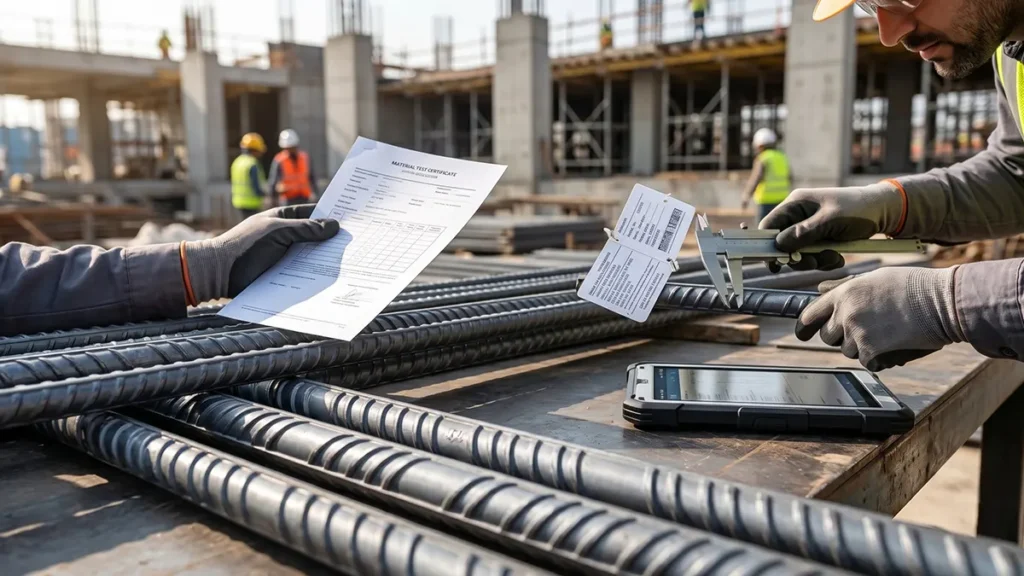
TMT bars eventually disappear inside concrete, yet they continue to support the structure for decades. This makes quality verification essential before reinforcement work begins.
When people search for the best quality TMT bars in India, they often compare grades, prices and brand names. A better buying decision also includes checking whether the supplied bars are authentic, traceable and supported by valid quality documents.
The Bureau of Indian Standards lists high-strength deformed steel bars used for concrete reinforcement under IS 1786:2008 within its compulsory Scheme-I certification framework. The standard covers important factors such as chemical composition, surface characteristics, nominal size, mass, tensile properties, elongation, and bend performance.
Here are five warning signs that deserve closer attention before the bars reach your construction site.
1. The Rolled Markings Look Incomplete or Inconsistent
Begin by looking closely at the markings embossed or rolled onto the bars.
According to the BIS product manual for IS 1786, TMT bars should carry permanent identification at intervals of up to three metres. The required details include:
- Manufacturer’s brand name or trademark
- Grade of the bar
- A six-digit identification number connected with the BIS licence
These markings create traceability between the physical bar and its manufacturer.
Warning signs include faint lettering, changing spellings, uneven embossing, missing grade details or different identification numbers within the same supplied batch. A copied brand name by itself provides limited assurance. All identifying details should correspond with the bundle tag, invoice and test certificate.
Inspect several bars from different parts of the bundle. Consistency across the consignment gives you a stronger basis for verification.
2. The BIS Licence Details Fail to Match
An ISI-style logo printed on a tag can be reproduced easily. Licence verification gives the mark meaning.
Use the BIS Care application’s Verify Licence Details feature to check the licence number provided by the seller or manufacturer. The application displays information connected with the licence, allowing buyers to compare the manufacturer, product category and applicable Indian Standard. BIS also provides access to standards, licence lists and testing laboratories through its consumer tools.
Check whether:
- The licence is active
- The manufacturer’s name matches the invoice
- The listed product covers TMT or high-strength deformed reinforcement bars
- The applicable standard is IS 1786
- The supplied grade and size fall within the licence scope
A seller who avoids sharing the licence number or offers details that lead to another company deserves further scrutiny. Pause the purchase until the information is verified.
3. The Test Certificate Is Missing or Its Details Conflict
A proper test certificate helps connect the supplied steel with a specific manufacturing batch.
The BIS product manual states that each consignment of certified material conforming to IS 1786 should be accompanied by a test certificate. This certificate should include the Standard Mark, cast or lot number, grade, size and corresponding test results.
A typical certificate may contain results for:
- Carbon, sulphur and phosphorus
- Carbon equivalent
- Yield or proof stress
- Tensile strength
- Tensile-to-yield strength ratio
- Elongation
- Bend and re-bend tests
- Surface condition and mass tolerance
These fields form part of the BIS test-certificate format for high-strength deformed reinforcement bars.
Ask your dealer for the manufacturer-issued test certificate or mill test certificate. Then compare the cast or heat number, diameter and grade with the bundle tag and purchase invoice.
For example, a certificate mentioning Fe 500D and 16 mm bars should correspond with the actual consignment. A certificate carrying another heat number, another grade or a generic photocopy provides weak batch traceability.
The project engineer can review the reported values against the structural specifications and applicable standard.
4. The Ribs and Surface Show Irregularities
The ribs on a TMT bar help it develop a strong mechanical bond with concrete. Their pattern should appear consistent along the bar and across bars of the same size and batch.
Look for clear and reasonably uniform ribs. Pay attention to:
- Flattened or damaged ribs
- Sudden changes in rib spacing
- Cracks or visible seams
- Deep pits
- Flaky scale
- Sharp surface laps
- Significant section loss
- Oil, paint or other surface contamination
BIS inspection requirements cover freedom from defects, deformation, surface characteristics and nominal dimensions. Manufacturers operating under the certification framework are expected to inspect these characteristics as part of production control.
A thin and even layer of surface oxidation may develop during transport or storage. Deep pitting, loose flakes and visible reduction in the bar’s section require closer examination by the site engineer.
Surface inspection works best when combined with marking checks, licence verification and batch documents. Appearance alone provides an initial screening check rather than a complete quality assessment.
5. The Diameter, Mass, Length and Invoice Details Fail to Align
Substandard material may contain less steel than the quantity shown on the invoice. This can appear through short lengths, inconsistent bars or a noticeable difference in bundle weight.
Ask the site engineer to select bars from different bundles and check their length and mass. Simple TMT Bar Buying Checklist
Before confirming a TMT bar order, follow this sequence:
- Follow the structural drawing. Purchase the grade and diameter specified by the structural engineer.
- Choose a traceable seller. Buy from an authorised or established dealer and collect a proper tax invoice.
- Inspect the bars. Compare the brand, grade and identification markings across several pieces.
- Verify the BIS licence. Check the licence details through BIS Care and confirm that they match the manufacturer and product.
- Match the documents. Compare the bar markings, bundle tag, invoice, grade, diameter, heat number and test certificate.
- Check the physical supply. Ask the engineer to review the ribs, surface condition, length and sample weight.
- Arrange laboratory testing when required. A BIS-recognised, government-empanelled or suitably accredited laboratory can perform detailed chemical and mechanical tests. BIS maintains information about laboratories capable of testing products against specific Indian Standards.
How to Choose the Best Quality TMT Bars in India
The phrase best quality TMT bars in India should lead to a practical question: which bars offer the right verified properties for your specific project?
The answer depends on the structural design, building height, loading conditions, seismic requirements, environmental exposure and construction method. A coastal project may require a different corrosion-protection approach from a regular residential structure. Grade selection should always remain aligned with the structural engineer’s design.
A dependable TMT bar purchase usually offers four things: verified compliance, clear product identity, consistent manufacturing and complete batch traceability.
According to its official quality information, ET TMT operates an integrated manufacturing facility with sponge iron kilns, induction melting furnaces, ladle refining furnaces, continuous casting, high-speed rolling and three-stage thermo-mechanical treatment. The company also states that protocol-driven quality checks are carried out in its NABL-accredited in-house physical and chemical laboratories.
ET TMT’s current portfolio includes CRS TMT Bars, Refined Steel TMT Bars, Superior Quality Steel TMT Bars, Epoxy-Coated TMT Bars and ready-to-use Cut & Bend TMT Bars. Its refined steel range is listed in Fe 500D, Fe 550, Fe 550D and Fe 600 grades, while product selection should remain based on project specifications and professional guidance.
Conclusion
Duplicate or substandard TMT bars rarely reveal their full story through appearance alone. Markings, BIS licence verification, batch certificates, rib consistency and weight checks create a more dependable picture.
For anyone comparing the best quality TMT bars in India, the safest approach is to look beyond the quoted price. Choose bars with verifiable identification, consistent physical characteristics, proper documentation and a grade approved by your structural engineer.
A few careful checks before concreting can support better material control throughout the construction process.