
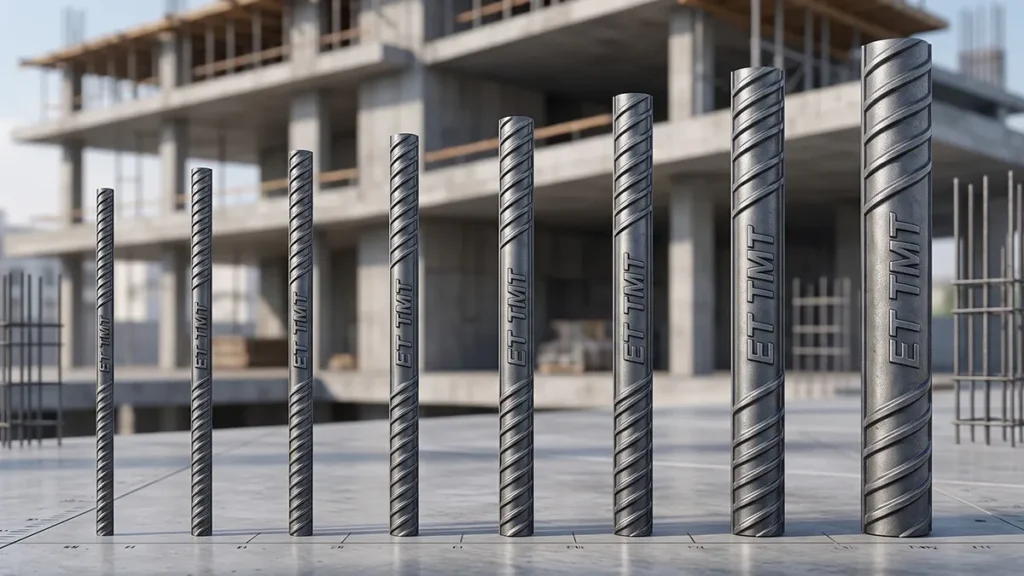
When you start building a house, TMT bars may look fairly similar at first glance. Look closer, and you will find bars ranging from slim 8 mm sections to much heavier 25 mm and 32 mm options. Each TMT bar diameter serves a different structural purpose.
The diameter influences how reinforcement is planned for slabs, beams, columns, foundations and other RCC elements. The final selection depends on structural design, load requirements, building height, concrete grade, soil conditions and reinforcement detailing.
For a homeowner, understanding the common TMT bar sizes makes conversations with contractors, engineers and suppliers much easier. Here is a simple guide to TMT bar diameters from 8 mm to 32 mm and where they are generally used.
What Does TMT Bar Diameter Mean?
TMT bar diameter refers to the nominal thickness of a reinforcement bar, measured in millimetres.
Common sizes used in construction include:
8 mm, 10 mm, 12 mm, 16 mm, 20 mm, 25 mm, 28 mm and 32 mm.
These sizes are recognised under IS 1786 for high-strength deformed steel bars used in concrete reinforcement.
As the diameter increases, the cross-sectional area and weight of the bar also increase. Structural engineers select a combination of diameters according to the forces each part of a structure is expected to carry.
TMT Bar Diameter Guide: 8mm to 32mm
8mm TMT Bars
An 8 mm TMT bar is among the lighter reinforcement sizes commonly seen in residential construction.
It may be used for:
- Stirrups and rings
- Distribution reinforcement
- Secondary reinforcement
- Smaller structural elements
- Certain slab reinforcement details
Its relatively smaller diameter makes it convenient for reinforcement layouts where bars need to be placed at closer spacing.
The exact use and spacing should follow the structural drawings prepared for the house.
10mm TMT Bars
A 10 mm bar is another commonly used size in residential RCC work. It offers a useful combination of reinforcement capacity and handling convenience.
Typical applications may include:
- Residential slabs
- Distribution reinforcement
- Staircases
- Smaller beams
- Secondary reinforcement
Depending on the design, engineers may specify 10 mm bars as main or secondary reinforcement in slabs.
12mm TMT Bars
For many house construction projects, 12 mm is a familiar TMT bar diameter.
It can commonly be specified for:
- Slabs
- Beams
- Columns
- Footings
- Staircases
Its application varies considerably according to the span and load carried by the structural member. A 12 mm bar used in one part of a house may serve a completely different reinforcement requirement in another.
16mm TMT Bars
As structural loads increase, larger reinforcement sections may be required. This makes 16 mm bars a common choice for primary reinforcement in several RCC elements.
Typical applications include:
- Main reinforcement in beams
- Columns
- Footings
- Larger structural members
- Heavily reinforced residential sections
For multi-storey homes or structures with larger spans, engineers may use 16 mm bars alongside other diameters to create the required reinforcement arrangement.
20mm TMT Bars
A 20 mm TMT bar diameter provides a larger steel cross-sectional area and is generally associated with structural members carrying higher loads.
It may be specified for:
- Major beams
- Columns
- Foundations
- Large footings
- Heavier structural sections
The number of bars, spacing and arrangement are calculated as part of the structural design.
25mm TMT Bars
25 mm bars are heavier reinforcement bars and are generally considered where the structural design demands greater reinforcement capacity.
Applications can include:
- Heavy columns
- Major beams
- Foundations
- Large residential or commercial structures
- Structural members carrying substantial loads
Their use in a typical independent home depends entirely on the structural requirements of the project.
28mm TMT Bars
28 mm is another recognised nominal size under IS 1786.
It is generally considered for heavier structural reinforcement, including large columns, beams, foundations and specialised structural elements.
For standard low-rise houses, engineers may find smaller diameters sufficient depending on the design. Larger residential projects can have different reinforcement requirements.
32mm TMT Bars
32 mm TMT bars provide a substantial reinforcement section and are usually associated with heavily loaded structural elements.
Possible applications include:
- Large foundations
- Heavy columns
- Major structural beams
- High-load RCC structures
- Larger multi-storey construction
A structural engineer determines whether a project requires this diameter based on engineering calculations and reinforcement detailing.
How Is the Right TMT Bar Diameter Selected?
Choosing reinforcement involves several factors working together.
1. Structural Load
Every structural member carries a different load. Beams, columns, slabs and foundations therefore require different reinforcement arrangements.
Greater structural loads can require larger bar diameters, additional bars or a different reinforcement layout.
2. Type of Structural Member
A slab performs differently from a column, while a footing transfers building loads into the ground.
This is why one house may contain several TMT bar diameters rather than a single size throughout the structure.
3. Building Height
The reinforcement requirements of a ground-floor house can differ significantly from those of a multi-storey residence.
As the height and structural complexity increase, engineers calculate the reinforcement required for each level and structural element.
4. Span of Beams and Slabs
Longer spans influence bending forces and reinforcement requirements.
The engineer considers span length, loading conditions, member dimensions and concrete strength before finalising the required reinforcement.
5. Soil and Foundation Design
Soil conditions influence the type and dimensions of the foundation. The resulting foundation design determines the reinforcement arrangement, including bar diameter and spacing.
A soil investigation and structural design provide a stronger basis for planning foundation reinforcement.
Does a Bigger TMT Bar Diameter Mean a Better House?
Structural performance comes from using the appropriate reinforcement according to engineering calculations.
A well-designed RCC structure may use smaller bars at closer spacing in one location and larger bars in another. Diameter, spacing, steel grade, concrete grade, cover, anchorage and workmanship all form part of the overall structural system.
That is why homeowners should treat structural drawings as the primary reference when purchasing TMT bars.
TMT Bar Diameter and Steel Grade Work Together
Diameter tells you the physical size of the bar, while the grade describes its mechanical properties.
So when buying reinforcement steel, look at both factors.
For example, a structural drawing may specify a particular bar diameter along with a TMT grade such as Fe 500D or Fe 550D.
ET TMT currently offers multiple TMT steel options and lists diameters from 8 mm to 40 mm across its product range. Its refined steel range includes grades such as Fe 500D, Fe 550, Fe 550D and Fe 600, giving project teams options according to structural specifications.
What Should Homeowners Check Before Buying TMT Bars?
Before placing an order, keep these points handy:
- Refer to the structural engineer’s bar bending schedule or reinforcement drawings.
- Check the specified TMT bar diameter carefully.
- Confirm the required TMT grade.
- Estimate quantities according to approved structural drawings.
- Purchase from an authorised and reliable supplier.
- Check relevant quality markings and documentation.
- Store reinforcement properly at the construction site.
- Ask your engineer before making any changes to diameter or reinforcement quantity.
This approach keeps material purchasing aligned with the structural design.
Final Thoughts
From 8 mm TMT bars used in lighter reinforcement applications to 32 mm TMT bars used for heavier structural requirements, every diameter has a purpose.
For homeowners, the most useful approach is to understand what each size generally does and then follow the reinforcement schedule provided by a qualified structural engineer. The right TMT bar diameter, combined with the specified steel grade, concrete quality and proper construction practices, helps the entire RCC system perform as designed.
When selecting reinforcement for your house, focus on the right steel in the right diameter for the right structural application.
With TMT bar options across multiple grades and diameters, ET TMT by Electrotherm provides reinforcement choices suited to a range of construction requirements.