
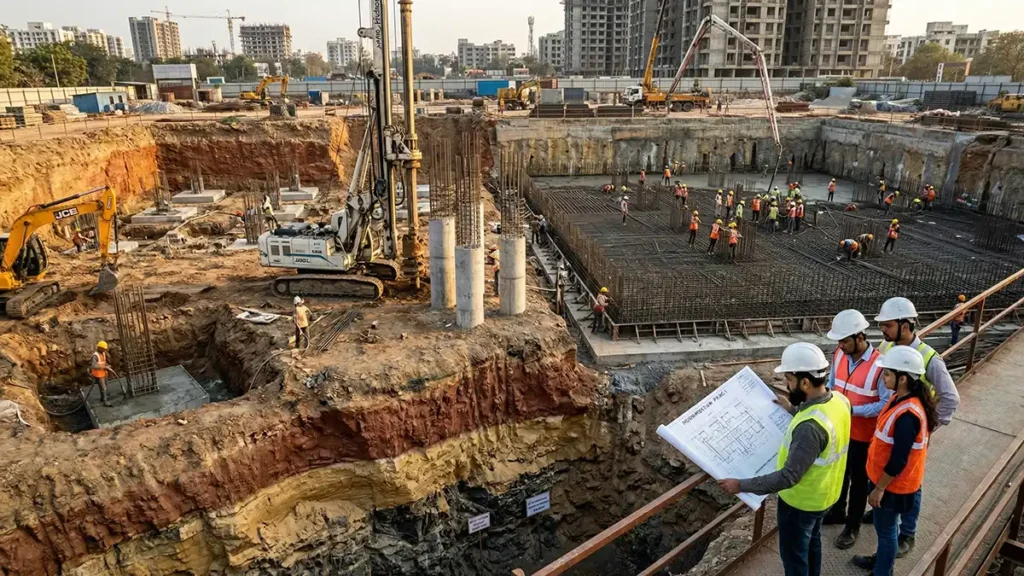
Selecting the right foundation for a home in India isn’t just about digging a hole and pouring concrete. It’s about understanding soil behavior, structural demands, and long‑term durability – because the foundation is literally what everything else rests on.
Before we dive into specific foundation types, let’s ask the most important question:
Why does foundation choice matter so much?
Because soil conditions vary widely across India, and an unsuitable foundation can lead to:
- differential settlement
- cracks in walls and slabs
- moisture damage
- costly repairs down the line
Understanding Soil Types in India
Different parts of India have very different soils and each behaves differently under load.
Here’s a breakdown based on commonly used geotechnical classifications and regional soil behavior:
🔹 Alluvial Soil
Found in: Indo‑Gangetic plains (UP, Bihar, Punjab, Haryana)
Characteristics: fine particles, fertile, good for agriculture but can be weakbearing under load without proper compaction.
Construction tip: Needs careful bearing capacity evaluation before foundation design.
🔹 Black Cotton Soil
Found in: Central & Western India (Maharashtra, MP, Gujarat)
Characteristics: expands when wet and shrinks when dry – leads to high shrink‑swell potential.
Construction tip: Requires deep foundations (e.g., pier and beam, raft) to limit movement.
🔹 Lateritic Soil
Found in: Western Ghats, parts of Kerala, Karnataka
Characteristics: reddish, porous, variable strength; decent drainage.
Construction tip: Often good for shallow foundations, but must be checked locally.
🔹 Rocky or Gravelly Soil
Found in: Himalayan foothills, hilly terrains
Characteristics: high bearing capacity, low settlement; ideal for foundations.
Construction tip: Can require specialized excavation, but offers excellent support.
Types of Foundations Commonly Used in India
The foundation type you choose depends primarily on soil condition, load, water table, and structure type. Here are the main types:
1. Shallow Foundations (Footing Foundations)
Best For: Stable soils with adequate bearing capacity
Types Include:
✔ Isolated Footings – for individual columns
✔ Combined Footings – when columns are closely placed
✔ Strip Footings – for wall loads
➡ When to use:
Good for alluvial, lateritic, or firm soils where the safe bearing capacity is sufficient.
2. Raft (Mat) Foundations
Best For: Soils with low bearing capacity or differential settlement risk
What It Is: A large slab under the entire structure that distributes loads evenly
➡ When to use:
• Soil with weak layers near the surface
• Heavy or tall structures
• Black cotton soil with potential shrink‑swell behavior
3. Pile Foundations
Best For: Unstable topsoil or high water table
What It Is: Long, slender columns driven into deeper, stronger strata
➡ When to use:
• Coastal regions
• Soft alluvial plains
• Areas with flood‑prone water tables
Why Good Foundations Matter with TMT Reinforcement
Modern foundations are rarely plain concrete. They almost always use reinforcement — and that’s where quality TMT bars play a crucial role.
Why reinforce foundations?
✔ Improves tensile strength
✔ Reduces cracking
✔ Enhances load transfer
✔ Offers better long‑term performance
This is one of the key reasons why ET TMT rebars — with consistent grade quality and manufacturing precision are trusted in foundation work across diverse Indian conditions.
Practical Foundation Selection Tips for Indian Builders
Here are actionable tips builders and homeowners should follow:
✅ 1. Conduct a Proper Soil Investigation
Even for small homes, soil testing saves thousands in future repairs.
Geotechnical testing includes:
- Standard Penetration Test (SPT)
- Soil bearing capacity
- Moisture content
- Plasticity Index (especially important in Black Cotton Soils)
✅ 2. Follow BIS / IS Code Guidelines
India’s construction standards are guided by:
📌 IS 456:2000 – Plain & Reinforced Concrete
📌 IS 1893 – Seismic considerations for earthquake‑resistant design
📌 IS 2911 – Pile foundations
These standards ensure safety, durability, and consistent design across projects.
✅ 3. Don’t Choose One Foundation for All Conditions
What worked in Delhi might not work in Kolkata or Chennai.
Always base foundation type on:
✔ soil testing
✔ water table level
✔ structural type
✔ climatic influence
✅ 4. Partner with Experienced Structural Engineers
Foundation design is not a DIY task.
Engineers combine soil data with structural needs to recommend:
- footing size
- depth
- reinforcement detail
- concrete mix specification
This is a must‑do step before breaking ground.
Common Foundation Mistakes to Avoid
🚫 Skipping soil testing
🚫 Using uniform footing depth everywhere
🚫 Ignoring water table issues
🚫 Under‑reinforcing with low‑quality steel
🚫 Not accounting for seismic loads in prone areas
These mistakes often lead to settlement, cracks, and long‑term distress.
Final Thoughts: Start Strong to Stay Strong
Choosing the right foundation isn’t just technical – it’s strategic.
A well‑selected foundation adapted to Indian soil conditions:
✔ improves structural safety
✔ enhances longevity
✔ reduces repairs
✔ ensures peace of mind
And quality reinforcement (like ET TMT) makes sure that the foundation you choose stands the test of time just like the structure that rises above it.
Quick Takeaways
🔹 Soil type determines foundation choice
🔹 Standards (IS codes) guide safe design
🔹 Reinforcement quality matters
🔹 Professional design and testing pay off