
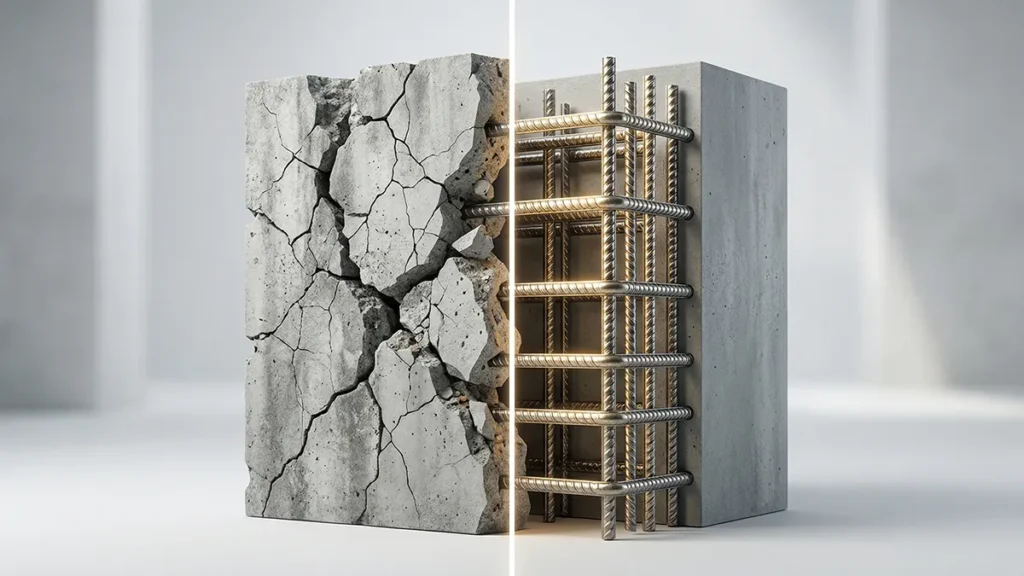
When you look at a building, what do you see?
Walls, glass, design, height.
But what actually holds it all together?
The answer lies inside the concrete – TMT rebars.
In modern construction, TMT rebars are not just a material. They are the foundation of structural strength, safety, and durability.
Let’s break down why TMT rebars are so important and how they define the strength of today’s infrastructure.
What Are TMT Rebars?
TMT (Thermo-Mechanically Treated) rebars are steel reinforcement bars used inside concrete to improve its performance.
Here’s a simple way to understand it:
- Concrete is strong in compression
- Steel is strong in tension
When combined, they create reinforced concrete, which can handle real-world loads and stresses.
This principle is a fundamental concept in structural engineering and is widely used in modern construction practices.
Why Concrete Alone Is Not Enough
Let’s ask a simple question:
Can concrete alone handle cracks, stress, and movement?
The answer is no.
Concrete:
- cracks under tension
- fails under bending stress
- lacks flexibility
That’s where TMT rebars come in.
They:
- absorb tensile forces
- control cracks
- provide flexibility
This is why the role of rebars in construction is critical for structural stability.
1. TMT Rebars Provide Structural Strength
The primary reason TMT rebars are used is strength.
According to BIS standard IS 1786, TMT bars are designed to meet specific requirements for:
- yield strength
- tensile strength
- elongation (ductility)
These properties ensure that structures can:
- carry heavy loads
- resist deformation
- maintain stability over time
Without proper reinforcement, buildings would not withstand everyday loads.
2. They Improve Earthquake Resistance
Here’s something crucial, especially in India:
Many regions fall under seismic zones.
TMT rebars – especially ductile grades like Fe 500D – are designed to:
- bend without breaking
- absorb seismic energy
- prevent sudden collapse
Ductility is a key requirement in seismic design, as per structural engineering standards.
This makes TMT rebars essential for safe and resilient construction.
3. Better Bonding with Concrete
Have you noticed the ribbed surface of TMT bars?
That’s not random.
The rib pattern improves bond strength between steel and concrete, ensuring:
- load transfer efficiency
- reduced slippage
- stronger structural integrity
This bonding is critical for reinforced concrete performance.
4. Resistance to Corrosion
One of the biggest threats to buildings is corrosion.
When steel corrodes:
- it expands
- cracks concrete
- weakens the structure
Modern TMT rebars are designed with:
- low impurity levels (sulphur, phosphorus)
- improved chemical composition
Processes like Ladle Refining Furnace (LRF) help enhance purity and corrosion resistance.
This ensures longer structural life, especially in coastal and humid environments.
5. High Ductility for Flexibility
Strength alone is not enough.
A building must also adapt to stress and movement.
TMT rebars provide:
- high elongation
- flexibility under load
- resistance to sudden failure
This is particularly important for:
- high-rise buildings
- bridges
- infrastructure projects
6. Fire Resistance Properties
Did you know steel reinforcement also plays a role in fire safety?
TMT rebars can:
- retain strength at high temperatures
- delay structural failure during fire
This gives occupants valuable time for evacuation and reduces damage risk.
7. Supports Modern Infrastructure Needs
Today’s construction is not simple.
We build:
- high-rise towers
- bridges
- dams
- industrial structures
These require materials that offer:
- consistent quality
- high strength
- long-term durability
TMT rebars meet these requirements, making them a key structural strength material in modern engineering.
8. Long-Term Durability and Lifecycle Performance
Let’s think long-term.
A building is expected to last decades.
TMT rebars help by:
- maintaining structural integrity
- resisting environmental damage
- reducing maintenance needs
This ensures the structure remains safe throughout its lifecycle.
9. Standardization and Quality Assurance
TMT rebars in India are governed by BIS standards (IS 1786), which ensure:
- consistent quality
- defined strength parameters
- reliable performance
This standardization makes TMT rebars a trusted choice across the construction industry.
So, Why Are TMT Rebars So Important?
Let’s summarize.
TMT rebars are crucial because they:
✔ provide tensile strength
✔ improve earthquake resistance
✔ enhance bonding with concrete
✔ resist corrosion
✔ offer flexibility (ductility)
✔ support long-term durability
Without them, modern construction as we know it would not be possible.
Final Thoughts: Strength Starts Within
You may not see TMT rebars once construction is complete.
But they are always there –
holding, supporting, protecting.
In modern construction, strength is not just about what’s visible. It’s about what lies inside.