
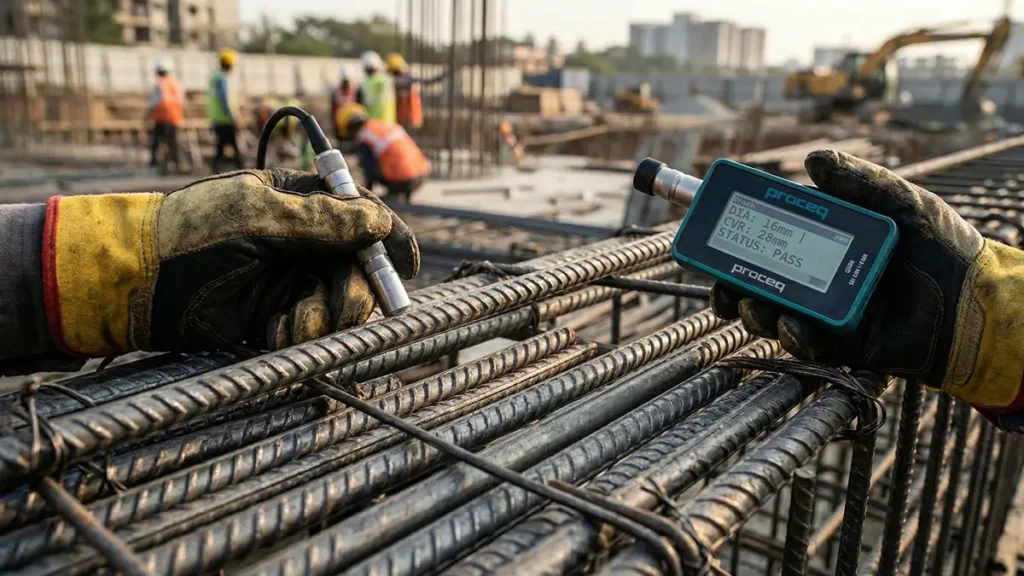
When you think about modern infrastructure – bridges, metros, high-rises – there’s one thing holding everything together:
Steel.
But here’s the real question:
Is the steel industry in India just growing – or is it evolving?
Today, India’s steel sector is not only expanding in scale but also setting new benchmarks in quality, safety, and innovation. Let’s explore how.
The Backbone of Infrastructure: Why Steel Quality Matters
Steel is not just another construction material – it is the core of structural strength.
From buildings to bridges, the performance of any structure depends on:
- material quality
- consistency
- safety standards
In India, this responsibility is governed by a strong regulatory system led by the Bureau of Indian Standards (BIS), which develops and enforces quality benchmarks across industries.
1. Strong Regulatory Framework: The Role of BIS
Let’s start with the foundation – standards.
India’s steel industry operates under strict guidelines defined by BIS. One of the most critical standards is:
IS 1786 – for TMT bars used in construction
This standard defines:
- tensile strength
- ductility
- chemical composition
- bend and re-bend performance
These parameters ensure that steel used in construction meets safety and durability requirements.
✔ Result:
Better quality control
✔ Safer structures
✔ Consistent performance across projects
2. Mandatory Certification for Safety
Here’s something important:
In India, steel bars must carry the ISI mark (BIS certification) to be legally sold and used.
This certification ensures:
- compliance with national standards
- verified manufacturing processes
- reliability in real-world applications
Without this, the steel may not meet minimum safety benchmarks, increasing the risk of structural failure.
3. Advancements in Steel Manufacturing Technology
Now let’s talk about innovation.
India’s steel sector has rapidly adopted advanced technologies that improve both quality and safety.
Example: Ladle Refining Furnace (LRF)
This process:
- removes impurities like sulphur and phosphorus
- improves chemical purity
- enhances strength and consistency
LRF technology is widely used to produce high-quality TMT bars that meet modern construction demands.
4. Evolution of TMT Technology
India has played a major role in advancing TMT (Thermo-Mechanically Treated) steel.
Over time, TMT grades have evolved:
- Fe 415 → basic construction
- Fe 500 / Fe 500D → modern buildings
- Fe 550 / Fe 600 → infrastructure projects
These upgrades have improved:
- load-bearing capacity
- ductility (flexibility)
- earthquake resistance
All governed under IS 1786 standards.
5. Focus on Construction Safety Standards
Let’s make this practical.
Why do these improvements matter on-site?
Because modern construction faces challenges like:
- seismic activity
- heavy loads
- environmental stress
TMT bars today are designed to:
- bend without breaking (ductility)
- absorb stress
- prevent sudden collapse
These properties are essential for safe and resilient structures, especially in urban infrastructure.
6. Multi-Level Quality Control System
India’s steel quality system works at multiple levels:
National Level
- BIS standards and ISI certification
Industry Level
- manufacturer quality control
Project Level
- third-party testing and inspection
Consumer Level
- verification and documentation
This layered approach ensures end-to-end quality assurance in construction materials.
7. Continuous Testing and Compliance
Steel in India is not just produced – it is tested rigorously.
Common quality tests include:
- tensile strength test
- bend and re-bend test
- chemical composition analysis
These tests ensure that steel performs reliably under real-world conditions.
8. Alignment with Global Standards
India’s steel standards are increasingly aligned with international benchmarks.
For example:
- BIS standards are comparable to ASTM (USA) and BS (UK) standards
- focus on performance, safety, and durability
This alignment strengthens India’s position as a globally competitive steel manufacturing hub.
9. Innovation Driving the Future
The Indian steel sector continues to evolve with:
- higher-grade steel (Fe 600 and above)
- improved manufacturing processes
- better quality tracking and certification systems
The focus is shifting from just production volume to performance, safety, and sustainability.
So, What Does This Mean for Construction?
Let’s simplify it.
India’s steel sector today ensures:
✔ safer buildings
✔ stronger infrastructure
✔ longer-lasting structures
✔ better resistance to environmental and structural stress
In short:
Better steel = Better construction outcomes
Final Thoughts: Strength That Sets Standards
India’s steel industry is no longer just supplying material.
It is:
- defining quality benchmarks
- improving construction safety
- driving innovation in infrastructure
And at the center of this transformation is one idea:
Strength backed by standards.
Quick Takeaway
Before choosing steel for any project, always ensure:
✔ BIS (ISI) certification
✔ correct grade selection
✔ advanced manufacturing processes
✔ proper testing and documentation
Because in modern construction –
Quality is not optional.
It is the foundation of safety.