
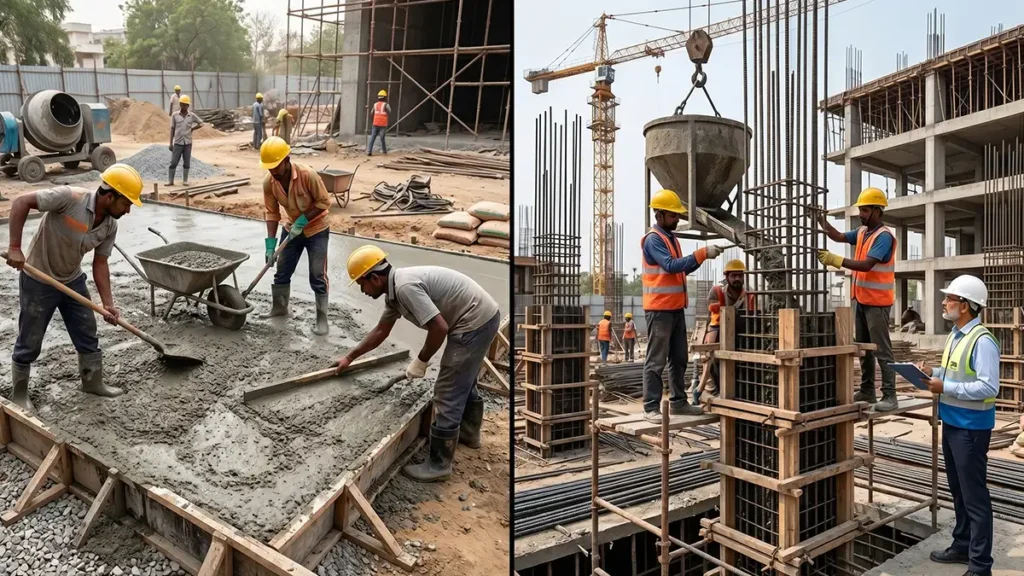
Concrete is one of the most used materials in construction, but not all concrete is used for the same purpose. Two common terms you will often hear on construction sites are PCC and RCC. Both are made using cement, sand, aggregate, and water, but the main difference lies in reinforcement.
PCC is used for plain concrete work, while RCC is used where structural strength is needed. Understanding the difference between PCC vs RCC can help in choosing the right material for the right stage of construction.
What is PCC?
PCC stands for Plain Cement Concrete. It is concrete without steel reinforcement.
PCC is generally used where the concrete does not have to carry major structural loads. It works well as a base layer, levelling layer, or bedding surface. Since it does not include steel bars, it is not usually preferred for areas that experience bending or tensile forces.
Common uses of PCC include:
- Foundation bedding
- Floor base
- Levelling course
- Road base
- Simple non-structural concrete work
In many projects, PCC is placed below RCC work to create a clean and level surface.
What is RCC?
RCC stands for Reinforced Cement Concrete. It is concrete with steel reinforcement, such as TMT bars or steel mesh.
Concrete handles compression well, while steel reinforcement helps resist tension and bending. This combination makes RCC suitable for structural parts of a building.
Common uses of RCC include:
- Slabs
- Beams
- Columns
- Footings
- Staircases
- Retaining walls
- Bridges and infrastructure work
RCC is widely used in residential, commercial, and industrial construction because it supports load-bearing requirements when designed and executed properly.
Strength Difference Between PCC and RCC
The major difference between PCC and RCC is how they behave under load.
PCC can take compressive loads in suitable applications, but it has limited resistance to tension and bending. That is why it is generally used for base layers and non-reinforced concrete work.
RCC is designed for structural strength. The concrete carries compression, while the steel reinforcement helps handle tension and bending forces. This makes RCC a better choice for beams, slabs, columns, and foundations.
Advantages of PCC
PCC is simple, practical, and cost-effective for basic concrete work. It provides a clean and level surface before structural work begins. It also helps separate reinforcement from direct contact with soil in foundation work.
Some key advantages include:
- Simple construction
- Lower cost compared to RCC
- Useful as a base layer
- Good for levelling uneven surfaces
- Suitable for non-structural applications
Advantages of RCC
RCC is preferred for construction areas where strength and durability are important. It can be designed for different loads, shapes, and structural needs.
Some key advantages include:
- Suitable for load-bearing structures
- Better resistance to bending
- Used in slabs, beams, columns, and footings
- Offers design flexibility
- Works well with quality TMT bars and proper site execution
In RCC construction, the quality of reinforcement is important. TMT bars support the concrete by handling tensile stresses. ET TMT offers options such as CRS TMT Bars, Epoxy-Coated TMT Bars, Refined Steel TMT Bars, Superior Quality Steel TMT Bars, and Cut & Bend TMT Bars for different construction requirements.
PCC and RCC in Foundation Work
PCC and RCC are often used together in foundation construction.
PCC is usually placed first as a base layer over prepared soil. It creates a clean and even surface for reinforcement work. After that, steel bars are placed, and RCC is cast to form the actual footing.
So, PCC supports the execution process, while RCC performs the structural role.
Which is Better: PCC or RCC?
There is no single answer because both are used for different purposes.
PCC is better for base, bedding, levelling, and plain concrete work.
RCC is better for structural and load-bearing work.
For example, PCC may be used below a footing, while RCC is used to build the footing itself. Similarly, PCC may be used below flooring, while RCC is used for slabs and beams.
So, PCC and RCC are not direct substitutes. The right choice depends on the application, load requirement, soil condition, design, and construction method.
Final Takeaway
The difference between PCC and RCC comes down to reinforcement and usage. PCC is plain concrete used mainly for base and levelling work. RCC is reinforced concrete used for structural elements such as slabs, beams, columns, and foundations.
For a strong and reliable structure, both materials need to be used in the right place. Along with the correct concrete mix, proper curing, skilled workmanship, and quality TMT bars can make a meaningful difference in RCC construction.