
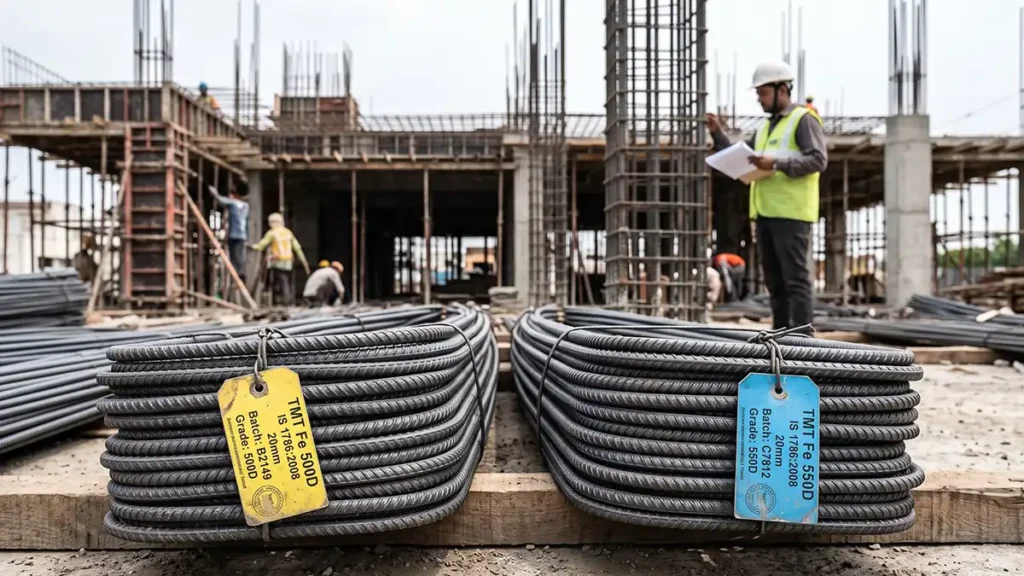
Two TMT bars may look almost identical at a construction site. Their grade markings, however, can represent very different mechanical properties.
The grade of TMT bars is one of the inputs used by a structural engineer while calculating reinforcement quantity, member capacity, ductility and detailing. When the steel arriving at the site differs from the grade mentioned in the structural drawings, the building begins moving away from its original design assumptions.
A lower grade may provide less yield strength than the design requires. A higher grade introduced without approval may affect ductility, reinforcement quantity, anchorage and fabrication requirements. That is why every change in TMT grade deserves an engineering review before the bars are cut, bent or placed.
What Does the Grade of TMT Bars Mean?
TMT bars are commonly identified by grades such as Fe 415, Fe 500, Fe 500D, Fe 550, Fe 550D and Fe 600.
Here:
- “Fe” refers to iron.
- The number indicates the specified minimum yield strength or 0.2% proof stress in N/mm².
- “D” indicates enhanced elongation and additional mechanical-property requirements for the same yield-strength category.
For example, Fe 500 and Fe 500D both have a specified minimum yield strength of 500 N/mm². Fe 500D carries enhanced elongation requirements, making ductility an important part of its performance profile. IS 1786 defines these strength grades along with requirements related to tensile properties, elongation, chemical composition, bending and rebending.
A higher number indicates greater specified yield strength. Overall suitability still depends on the structural design, ductility requirements, bar diameter, spacing, environmental exposure and construction details.
Why Does a Structural Design Depend on TMT Grade?
A structural engineer selects the grade of TMT bars before finalising the reinforcement drawings. The selected grade influences calculations for:
- Required reinforcement area
- Beam, slab and column capacity
- Bar spacing and arrangement
- Lap and development lengths
- Bending and anchorage details
- Seismic detailing
- Reinforcement congestion
- Construction cost
Consider a simple comparison. Fe 500 has a specified minimum yield strength of 500 N/mm², while Fe 415 has 415 N/mm². For the same cross-sectional area of steel, Fe 415 provides a nominal yield force around 17% below Fe 500. The final effect on the reinforced concrete member requires a complete structural calculation, although the difference clearly shows why an on-site substitution can matter.
What Can Happen When the Wrong TMT Grade Is Used?
1. The Reinforcement May Offer Less Strength Than the Design Assumes
Suppose a beam has been designed using Fe 500 reinforcement, while Fe 415 bars are placed with the same diameter and quantity. The steel will reach its specified yield level earlier as the load increases.
This can reduce the intended strength margin of the member. The effect becomes especially important in heavily loaded beams, columns, transfer members, foundations and structures carrying machinery or other concentrated loads.
A lower-grade substitution should therefore be supported by revised calculations and updated reinforcement drawings.
2. The Building’s Ductile Behaviour May Change
Yield strength tells one part of the story. Elongation and ductility describe how much deformation steel can accommodate as stresses rise.
The Indian standard specifies different minimum elongation and tensile-strength-to-yield-strength requirements across regular and “D” grades. For example, Fe 500D carries higher minimum elongation requirements than Fe 500. Similar distinctions exist between Fe 550 and Fe 550D.
Ductility becomes particularly important during earthquake loading because a well-designed structure needs the ability to deform and dissipate energy in a controlled manner. IS 13920 specifically addresses the ductile design and detailing of reinforced concrete structures subjected to seismic forces. Full seismic performance comes from the combined effect of structural design, reinforcement grade, detailing, concrete quality and site execution.
A grade change that looks minor during procurement may therefore influence the intended behaviour of beams, columns and beam-column joints.
3. The Reinforcement Quantity May Become Inconsistent
Higher-strength steel can sometimes help an engineer achieve the required capacity with a different reinforcement area. This benefit belongs within a fresh structural design.
Site teams should avoid reducing the number of bars or replacing specified diameters simply because a higher grade has arrived. Minimum reinforcement, bar spacing, crack-control provisions, anchorage and constructability still require attention.
The reverse situation carries similar concerns. When a lower grade replaces a higher grade, the same reinforcement area may provide less strength than the drawings assume.
Both situations call for review by the structural engineer.
4. Lap Length and Anchorage Details May Need Revision
Reinforcing bars transfer forces to the surrounding concrete through bond. The design of laps, hooks, bends and development lengths depends on factors such as bar diameter, design stress, concrete strength and reinforcement detailing.
Changing the TMT grade alters the stress level used in the design. Existing lap lengths and anchorage details may therefore require recalculation.
A casual substitution can create situations where:
- Bars have insufficient development length
- Laps are placed in unsuitable zones
- Congestion increases around joints
- Bend details differ from the approved bar-bending schedule
- Site fabrication becomes harder to execute accurately
The safest sequence is simple: obtain approval, revise the drawings where required, and then begin fabrication.
5. Bending and Fabrication Performance May Differ
Construction steel goes through cutting, bending, rebending, tying and, in selected applications, welding. Different grades have different bend-test and rebend-test requirements under IS 1786. The standard also places limits on chemical composition and carbon equivalent because these influence weldability and fabrication behaviour.
Using an unapproved grade can affect:
- Required bend diameter
- Behaviour during tight bending
- Rebending performance
- Welding procedures
- Bar-bending-machine settings
- Consistency of prefabricated reinforcement
Fabricators should work from an approved bar-bending schedule that clearly mentions the grade, diameter, shape and quantity.
6. Mixed Grades Can Create Site-Control Problems
Large projects often receive steel in several batches. When different grades are stored together without clear identification, the risk of a mix-up increases.
A misplaced bundle can send the wrong bars to a slab, column, beam or foundation. Once cutting and bending begin, visual identification becomes harder. After concrete placement, tracing individual bars becomes even more challenging.
Good site control includes:
- Separate storage for each grade
- Visible bundle labels
- Grade verification before cutting
- Matching mill test certificates
- Heat or batch traceability
- Inspection before concrete placement
These steps help the contractor, consultant and client maintain a clear record of the reinforcement used in each part of the building.
7. Quality Inspections May Be Delayed
Structural drawings, project specifications, purchase orders and test certificates should all mention the same approved TMT grade.
When inspection reveals a mismatch, the project team may need to pause the work while the structural engineer studies the substitution. The review may involve material testing, revised calculations, additional documentation or replacement of the affected reinforcement.
Early verification at the unloading stage saves far more time than discovering the discrepancy after fabrication.
8. Construction Costs Can Increase
A lower-priced or easily available grade may appear to offer immediate savings. The complete cost can change once redesign, additional reinforcement, replacement, testing, labour and schedule delays enter the picture.
Using a higher grade without a revised design may also add cost while providing limited practical value to the project.
The most economical solution is generally the grade for which the structure has been properly designed and detailed.
Why a Higher TMT Grade Still Requires Engineering Approval
A higher-strength grade can sound like an instant upgrade. Structural engineering works through complete systems rather than individual material numbers.
Moving from Fe 500 to Fe 550 or Fe 600 can influence:
- Reinforcement area
- Minimum steel requirements
- Anchorage and lap lengths
- Crack-control calculations
- Ductility
- Bar spacing
- Member dimensions
- Fabrication requirements
- Overall project economics
The right grade is the one that fits the structural calculations and detailing. A higher yield-strength number alone provides an incomplete basis for substitution.
How to Choose the Right Grade of TMT Bars
Follow the Structural Drawings
The grade should match the reinforcement drawings, structural notes, bar-bending schedule and bill of quantities. Any difference between these documents deserves clarification before procurement.
Get Approval Before Making a Substitution
Availability and price can change during construction. When the specified grade becomes difficult to source, share the proposed alternative with the structural consultant. Written approval creates clarity for the contractor, supplier and inspection team.
Check the Markings and Bundle Tags
Verify the grade, manufacturer, diameter and batch information when the steel reaches the site. Complete this check before unloading the bars into mixed storage.
Review the Mill Test Certificate
The test certificate should correspond with the supplied batch and mention relevant chemical and mechanical properties. These may include yield strength, tensile strength, elongation, bend performance and chemical composition.
Keep Grade and Corrosion Protection as Separate Decisions
The grade indicates strength and ductility characteristics. Environmental exposure creates another layer of selection.
Coastal sites, marine structures, underground works, industrial environments and moisture-prone locations may require corrosion-resistant or coated reinforcement. A project can therefore need both an appropriate strength grade and a suitable corrosion-protection system.
Verify Before Concrete Placement
The final reinforcement inspection should cover grade, diameter, spacing, laps, cover, anchorage and bar placement. This stage offers the last clear opportunity to correct a material mismatch.
Choosing the Appropriate Grade from the ET TMT Range
ET TMT offers different grades across its product categories to support varied structural and environmental requirements.
ET Refined Steel TMT Bars are currently listed in Fe 500D, Fe 550, Fe 550D and Fe 600 grades. The brand states that these bars are produced through an integrated iron-ore induction furnace and ladle refining furnace route, with multi-stage spectrometry testing used during production.
ET CRS TMT Bars are available in CRS Fe 500, CRS Fe 500D, CRS Fe 550, CRS Fe 550D and CRS Fe 600. This range is developed for projects where corrosion resistance forms part of the material-selection criteria.
The final choice should align with the structural design, exposure conditions, construction method and project specifications. A discussion between the structural engineer, contractor and steel supplier helps ensure that each requirement is addressed before ordering.
Final Takeaway
The wrong grade of TMT bars can change the strength, ductility, detailing and economics planned for a building. The difference may appear small on a bundle tag, yet it can affect several calculations behind the structure.
Three practices create a reliable selection process:
- Use the grade specified in the structural drawings.
- Verify the supplied material before cutting and bending.
- Obtain written engineering approval for every substitution.
For project-specific selection, the structural engineer can review the building design while the ET TMT team can help identify suitable product and grade options from its available range.