
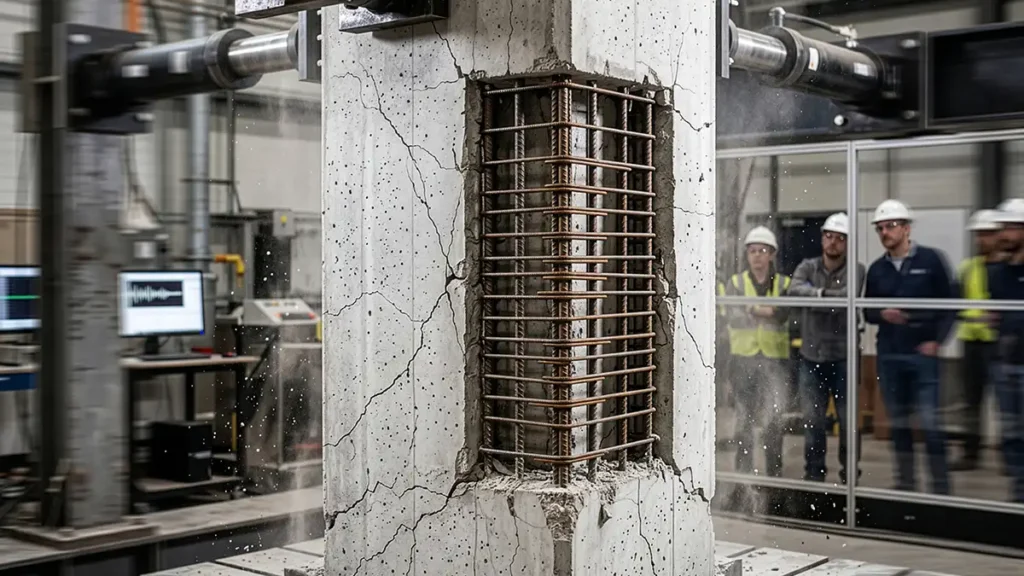
In reinforced concrete structures, columns are the backbone of structural stability. When columns fail, the consequences can be catastrophic – often leading to progressive collapse of the entire structure. In fact, many structural failures originate from column failure triggered by inadequate reinforcement or poor confinement.
One of the most effective ways to prevent such failures is through confinement reinforcement – a critical design element that significantly enhances the strength, ductility, and durability of reinforced concrete (RC) columns.
What is Confinement Reinforcement?
Confinement reinforcement refers to transverse reinforcement (such as stirrups, ties, or spirals) provided around the core of a concrete column. Its primary role is to hold the concrete and longitudinal steel bars tightly together under load conditions.
This reinforcement ensures that the concrete core remains intact even under extreme stress, especially during seismic events or heavy axial loads.
Why Do Columns Fail?
Before understanding how confinement works, it’s important to look at common causes of column failure:
- Concrete crushing under high compressive loads
- Buckling of longitudinal reinforcement bars
- Shear failure due to inadequate reinforcement
- Loss of strength due to lateral expansion of concrete
When concrete is loaded, it tends to expand laterally. Without proper confinement, this expansion leads to cracking, spalling, and eventual collapse.
How Confinement Reinforcement Prevents Column Failure
1. Restricts Lateral Expansion of Concrete
When a column is subjected to compressive loads, the concrete core tries to expand outward. Confinement reinforcement acts like a cage, resisting this expansion and maintaining structural integrity.
Result:
- Delayed cracking
- Increased compressive strength
- Improved load-bearing capacity
2. Enhances Ductility (Flexibility Before Failure)
One of the biggest advantages of confinement is improved ductility – the ability of a column to deform without sudden failure.
Transverse reinforcement allows the column to absorb energy and undergo deformation, especially during earthquakes.
Result:
- Prevents brittle failure
- Provides warning before collapse
- Improves seismic performance
3. Prevents Buckling of Longitudinal Bars
Under high loads, the main reinforcement bars inside a column can buckle outward. Confinement reinforcement holds these bars in position, preventing instability.
Result:
- Maintains alignment of reinforcement
- Ensures consistent load transfer
- Prevents sudden structural failure
4. Improves Shear Resistance
Columns are subjected not only to axial loads but also to shear forces, especially in multi-storey buildings.
Confinement reinforcement contributes to shear strength, reducing the risk of diagonal cracking and shear failure.
Result:
- Better resistance to lateral forces
- Enhanced structural safety
5. Increases Load-Carrying Capacity
Confinement increases the compressive strain capacity of concrete, allowing it to carry higher loads without failure.
Result:
- Stronger columns
- Better performance under heavy loads
- Increased lifespan of structures
6. Prevents Progressive Collapse
Column failure often triggers a chain reaction, leading to the collapse of the entire structure.
By strengthening columns through confinement reinforcement, engineers can localize damage and prevent widespread structural failure.
Types of Confinement Reinforcement in Columns
🔹 Tied Columns
- Use rectangular ties (stirrups)
- Common in standard construction
- Effective but depends on spacing and detailing
🔹 Spiral Reinforcement
- Continuous spiral steel around the core
- Provides uniform confinement
- Offers better ductility and strength
🔹 Advanced Confinement Techniques
- Cross-ties and sub-ties
- Fiber Reinforced Polymer (FRP) wrapping
- High-strength steel reinforcement
These methods enhance confinement efficiency and are widely used in modern infrastructure projects.
Role of High-Quality Steel in Confinement
The effectiveness of confinement reinforcement largely depends on the quality of steel used.
High-performance TMT bars, like those from Electrotherm Steel, ensure:
- Superior yield strength and ductility
- Better bonding with concrete
- Enhanced earthquake resistance
- Long-term durability and corrosion resistance
Using premium steel reinforcement ensures that confinement performs as intended – protecting structures under both normal and extreme conditions.
Best Practices for Effective Confinement
To maximize performance, engineers must follow proper detailing:
- Maintain adequate spacing of ties/stirrups
- Use proper anchorage (135° hooks)
- Ensure uniform distribution of reinforcement
- Increase confinement in critical zones (beam-column joints, base regions)
Poor detailing can significantly reduce confinement effectiveness – even if reinforcement is present.
Conclusion
Confinement reinforcement is not just an optional design feature – it is a critical safeguard against column failure. By restricting lateral expansion, preventing buckling, and enhancing ductility, it transforms brittle concrete into a resilient and reliable structural element.
In modern construction – especially in seismic regions – proper confinement combined with high-quality steel like Electrotherm TMT bars ensures structures that are not only strong but also safe and long-lasting.