
Introduction
Most people think concrete gets its strength from drying. It doesn’t.
Concrete gains strength through a chemical process called hydration – where cement reacts with water to form a hard, crystalline structure. Curing is the process of maintaining adequate moisture and temperature conditions to allow this reaction to complete properly.
Cut the curing process short and the concrete never reaches its potential strength – no matter how good the cement or steel inside it.
Why Curing Concrete Matters
According to the Bureau of Indian Standards IS 456:2000 – the primary Indian standard for concrete construction – inadequate curing is one of the leading causes of premature concrete deterioration and structural weakness.
The numbers tell the story clearly:
Concrete cured for just 3 days reaches approximately 50% of its potential strength. Concrete cured for 7 days reaches approximately 70% of its potential strength. Concrete cured for 28 days reaches 100% of its design strength.
Skipping or shortening curing doesn’t just reduce strength. It increases permeability – making the concrete more vulnerable to moisture, chlorides, and corrosion of the steel reinforcement inside.
The Most Common Curing Methods
1. Water Curing
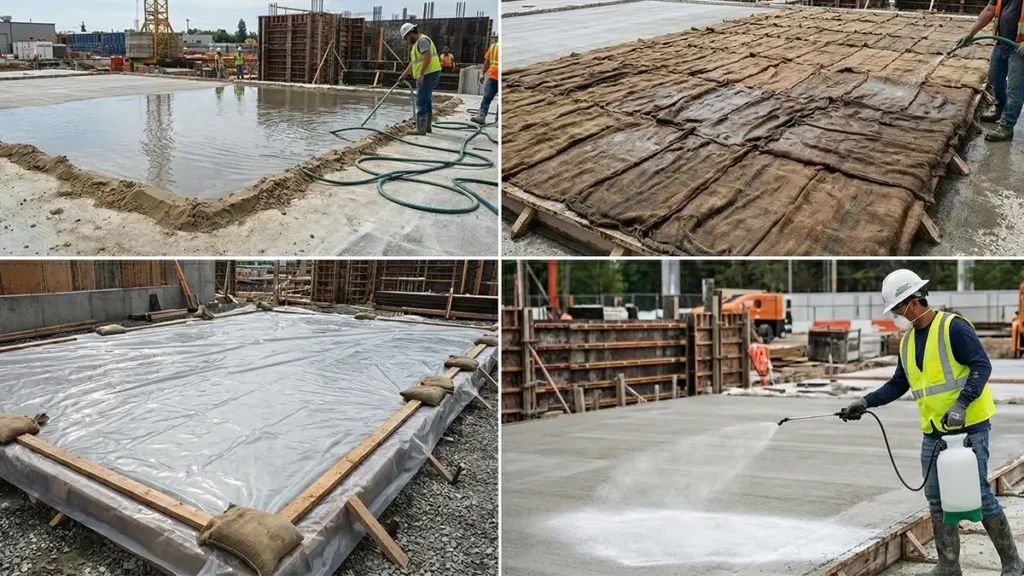
The most effective and widely used method. Water is continuously applied to the concrete surface through ponding, spraying, or wet coverings like burlap or hessian cloth.
Best for: Slabs, floors, and horizontal surfaces.
Duration: Minimum 7 days for OPC cement. 10 days for blended cements like PPC.
2. Membrane Curing
A liquid curing compound is sprayed onto the concrete surface immediately after finishing – forming a thin membrane that prevents moisture evaporation.
Best for: Large slabs, roads, and surfaces where water curing is impractical.
Limitation: Less effective than water curing in extreme heat.
3. Steam Curing
High-temperature steam is applied to accelerate the hydration process – allowing concrete to reach design strength in hours rather than days.
Best for: Precast concrete elements and factory-manufactured components.
Limitation: Requires specialised equipment – not practical for site construction.
4. Curing Blankets and Insulating Covers
Insulating blankets retain heat generated during hydration – particularly important in cold weather when low temperatures slow or stop the hydration process.
Best for: Cold weather construction and exposed structural elements.
Best Practices for Maximum Strength
Start curing immediately. Begin as soon as the concrete surface is finished – typically within 1-2 hours of placing. Delay allows surface moisture to evaporate, weakening the top layer.
Cure for the right duration. Follow IS 456:2000 minimum curing periods – 7 days for OPC, 10 days for PPC. Longer is always better.
Protect from extreme temperatures. Concrete placed in temperatures above 35°C loses moisture too quickly. Use shade, wet coverings, and frequent water application. Below 5°C, hydration slows significantly – use insulating covers or heated enclosures.
Never let the surface dry out. A single drying cycle during curing can cause surface cracking that permanently weakens the concrete. Keep surfaces consistently moist throughout the curing period.
Use the right water. Always use potable water free from salts and organic matter. Saline or brackish water accelerates corrosion of steel reinforcement.
The Connection Between Curing and Steel Reinforcement
Curing concrete and choosing the right steel reinforcement are two sides of the same decision.
Properly cured concrete is denser and less permeable – reducing moisture and chloride penetration that causes steel corrosion. But even perfectly cured concrete cannot compensate for substandard steel inside it.
Fe550-SD TMT bars – with superior ductility and corrosion resistance – work in partnership with properly cured concrete to deliver structural performance that neither can achieve alone.
For coastal and high-humidity environments where moisture penetration is a constant threat, ET TMT Epoxy Coated bars provide an additional layer of protection – ensuring the steel inside remains protected even if the concrete surface is compromised over time.
Conclusion
Curing is not optional. It is the single most critical post-placement step in concrete construction and the one most frequently compromised on Indian construction sites.
The strength of your structure depends on two decisions made before the walls go up: the quality of the steel inside and the discipline of the curing process outside.
Get both right and the structure earns its strength. Get either wrong and no amount of finishing will fix what’s missing inside.